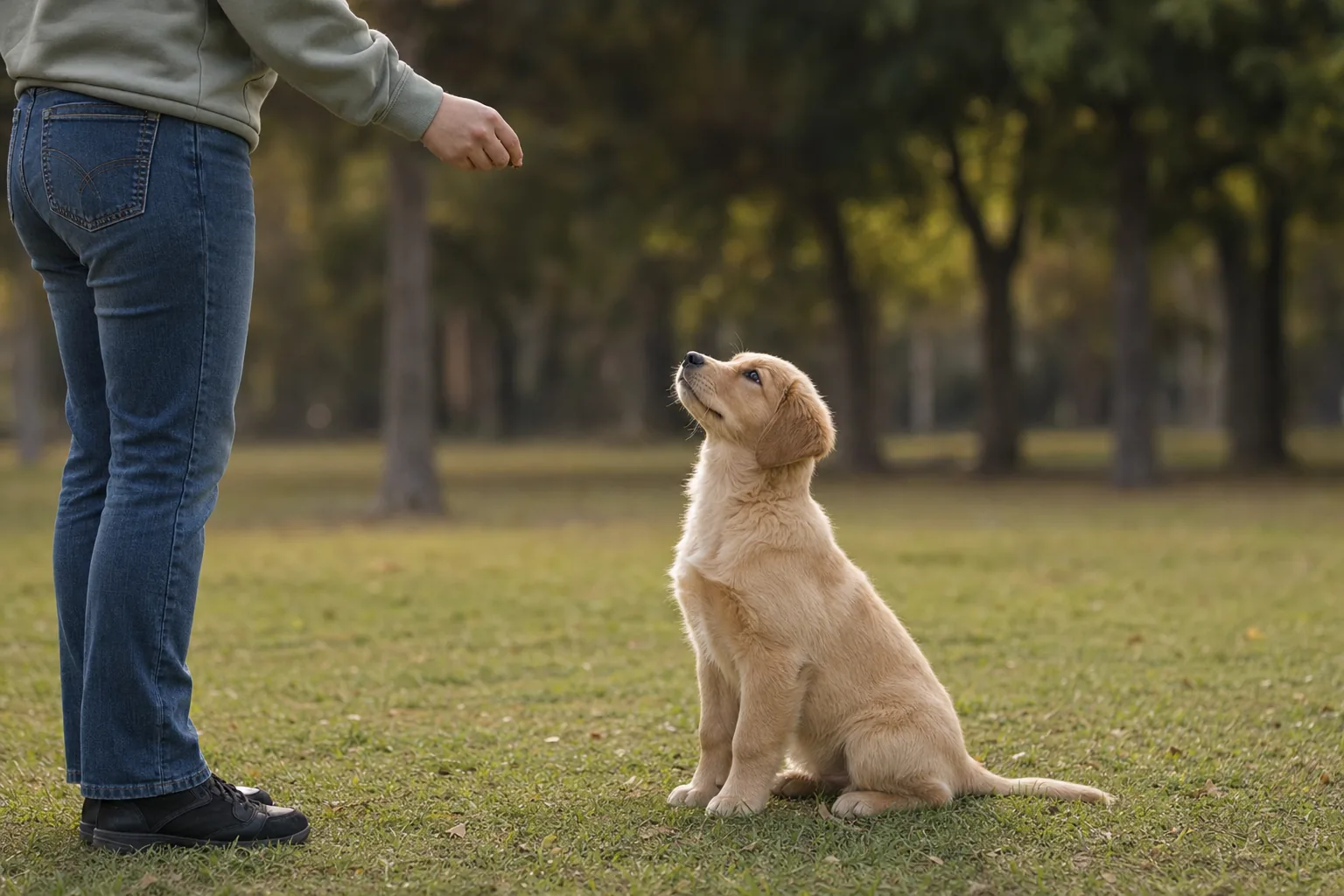
At five months he came at the first "here". He waited at the door until you let him through, followed you round the park like a shadow, and you thought you had landed an easy dog. Now he is eight months old and weighs twice as much. You call him and he looks straight through you, as if he had never heard the word. He jumps on visitors, pulls on the lead, steals off the table and barks at a bin he has walked past a hundred times. It feels as if he is testing you. You have an adolescent dog, that is all. This stage is so predictable that researchers have started studying it the way they study human teenagers, and it passes. Your job until it does is to avoid wrecking what you have built, and to stop him rehearsing the things you do not want to see at three years old.
What to do, step by step
1. Lower your expectations, keep your rules
The adolescent has not forgotten his training. He finds it harder, because his head is full: hormones, smells, dogs, curiosity, new fears. A British study on guide dogs showed something many owners had long suspected. At around eight months, dogs responded worse to "sit" when their own person asked than they had at five months, yet just as well when a stranger asked. Anyone who has lived with a fourteen-year-old will recognise it.
In practice, you take a step back. What he did in the park, you now practise in the garden. What he did first time, you now help him with. The rules stay put, though: what was not allowed at five months is not allowed now, however sweetly he looks at you from the sofa.
2. The long line comes back, anywhere open
An adolescent who discovers he can decline to come and chase a dog, a cat or a bike instead learns that lesson first time. A 5 to 10 metre long line clipped to a harness gives him freedom and spares you the bad lesson. It stays on until the recall is reliable again. If that means until 18 months, then until 18 months.
3. Recall, every day, with joy
Three to five calls on every walk, only when you know he will come. Every return ends with something that makes him leap about: a handful of his favourite treats, his favourite game, your praise in a bright voice, then "off you go" back to whatever he was doing. If recall is the main problem, we have a separate guide just on that.
4. More nose, alongside the running
An adolescent's energy has no bottom. An hour of running just gives you a fitter adolescent who needs an hour and a half tomorrow. Long walks with his nose down, search games, food served in puzzle toys, a short track laid in the grass tire him differently, from the inside. An adolescent who has worked his nose for 30 minutes is often a different dog by the evening. We see it most clearly on the trail: after a track, the young dog who was jumping on everyone lies down and breathes.
5. Sleep, lots of it
Young dogs need 14 to 16 hours of sleep a day. An under-slept adolescent looks exactly like a "naughty" one: he bites, jumps and hears nothing. If evenings are chaos, try an hour of enforced calm, with a chew, somewhere quiet. More often than not he is asleep within ten minutes.
6. New fears, handled gently
Between 6 and 14 months, many dogs go through a phase of being frightened by things they ignored until yesterday: a bin, a statue, a person with an umbrella. You do not drag him towards them and you do not tell him off. Let him look from the distance at which he is still calm, give him a tasty treat and walk on. If nothing bad happens to him during this phase, the fear usually fades by itself.
7. Do not let him rehearse what you do not want
Every jump on a visitor, every bit of food taken off the table, every pull on the lead that got him where he wanted is a successful rehearsal, from his point of view. Arrange the house and the walk so he never gets there: lead on when the doorbell rings, table cleared, a front-clip harness on walks. Meanwhile you praise him and hand over treats for what you do want: four paws on the floor, a loose lead, settling quietly on his mat.
What a good week looks like
| When |
What you do |
| Every day |
A long sniffing walk on a long line. 3 to 5 easy recalls, celebrated. 5 minutes of old, easy exercises. |
| Two or three times a week |
A search game or a short track. An outing to a new, quiet place. |
| As needed |
Lead on when visitors come. The evening quiet hour. A step back in training at the first sign he is struggling. |
| End of the week |
Note down what worked. If anything has got much worse (growling, big fears), read the section on trainers. |
By age and size
The puppy of 4 to 6 months. The start. He does his own thing more often, explores further from you, tries to see what holds. His teeth are changing. This is the time to bring in the long line, before you need it.
The adolescent of 6 to 12 months. Usually the peak. Hormones, curiosity, new fears, all at once. In small dogs adolescence starts earlier and ends sooner. In large and giant breeds it starts at around 7 to 9 months and can last until 2 years or beyond.
The young adult, 12 to 24 months. Slowly, things settle. Large dogs mature mentally at around 2 to 3 years. What you practised consistently through adolescence now comes through, almost without effort.
The dog adopted at this age. Many dogs land in rescue precisely during adolescence, because the family could no longer cope. A dog adopted at 9 to 12 months is carrying adolescence and a change of home at the same time. He needs twice the patience and a routine he can hold on to.
Neutering. The conversation with your vet usually happens now. The right age varies with size, breed and sex, and for some large breeds the advice is to wait until growth has finished. Decide with your vet, not with the neighbours at the park.
The mistakes we see most often
"He's testing me, I need to show him who's boss." The adolescent is not plotting anything against you. His brain is being rebuilt. Harshness damages exactly the relationship you need to get through this together.
Freedom given too early. The five-month-old puppy stayed beside you off lead. The adolescent will not. Many dogs run off or are hit by cars at precisely this age.
Giving up on training. "He doesn't listen any more, there's no point." This is when there is most point. What you practise in these months stays for the rest of his life.
Too much physical exercise for large breeds. Running beside a bike, repeated jumping, frisbee until he drops, for a large eight-month-old whose growth plates are still closing.
Punishing fear. An adolescent frightened of a statue and told off for it learns that the statue really is dangerous, because something unpleasant happened to him right next to it.
"He'll grow out of it." He will, but what the adolescent rehearsed stays. A dog who learned at 10 months that he can jump on people still does it at 3 years, with 30 kilos behind him.
How long adolescence lasts and how you know it is going well
In most dogs, from about 6 months to about 18 to 24 months; shorter in small breeds, longer in large ones. It is not a straight line. There will be good weeks and weeks when it feels as if you are back to zero, and that is part of the deal.
Signs you are doing well: he turns round to check on you often during walks; recall on the long line works nine times out of ten; he settles faster after excitement; new fears shrink rather than grow; in the evening he falls asleep after his sniffing walk. If you see most of these after a few months, it is ordinary adolescence, well handled.
When to call a trainer
- he growls or bites, especially at family members or when you take something from him;
- new fears are growing rather than shrinking and are spoiling walks;
- he has run off several times and you cannot stop him;
- he pulls so hard on the lead that you can no longer hold him;
- you feel your patience running out and your relationship with him getting worse by the day.
A basic course or a few one-to-one sessions during this stage are often the best time you will ever give your dog. What gets built at 8 months lasts for years.