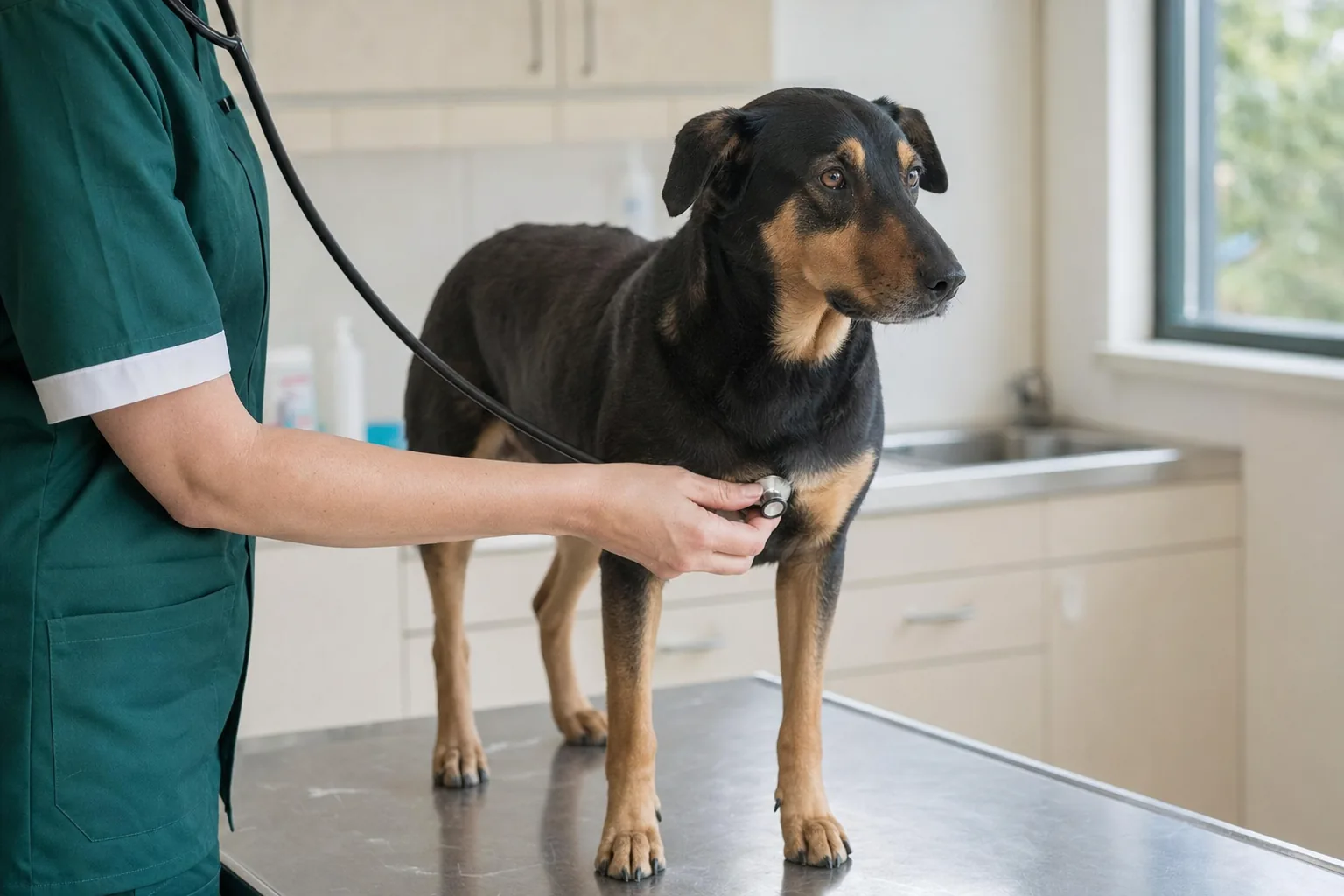
At the annual booster the vet put the stethoscope on your dog's chest, paused, listened again and said: "He's got a murmur." He is an eleven-year-old poodle who still takes the stairs on his own, and you had not noticed a thing. Someone else has a six-year-old Dobermann who went down in the park, got up a few seconds later and carried on as if nothing had happened. Someone else lies awake listening to their old dog coughing at night and pacing the house, unable to settle.
Heart disease is common in dogs, especially from middle age on. A lot of it can be kept under control for years if it is caught in time, and much of the monitoring is down to you, at home, with one number written down each evening.
Two conditions account for most cases. In small and medium dogs (Cavalier King Charles spaniels, Chihuahuas, poodles, dachshunds, Yorkies and their crosses), the valve between the two chambers on the left side of the heart thickens with age and stops closing properly. Some blood leaks backwards, and that noise is the murmur your vet hears. In big breeds (Dobermanns, Great Danes, Boxers, Irish Wolfhounds, some shepherd types) it is more often the heart muscle itself: the heart enlarges and pumps weakly, sometimes with rhythm problems that cause fainting or even sudden death. Heart failure is the point where the heart can no longer keep up and fluid starts building in the lungs or the belly.
When to ring the vet today about your dog's heart
Ring straight away or head for an out-of-hours clinic if he:
- is breathing fast and hard at rest, mouth open and elbows held out from his chest, and cannot lie down;
- has grey, bluish or very pale gums;
- has fainted or collapsed, even if he came round within seconds;
- coughs up pink froth;
- has a belly that has swollen over a few days and is breathing with effort;
- has a sleeping breathing rate that has jumped compared with what you usually count.
Ring the same day or the next for a new cough that is not going away, tiredness on walks that has crept in over a few weeks, restless nights or weight loss for no reason. Ring then as well if the vet has mentioned a murmur and no tests have been done yet.
What to keep an eye on at home: sleeping breathing rate and the rest
Sleeping breathing rate
This is the most useful number you can collect yourself. Wait until he is deeply asleep, not dreaming and not just back from exercise. Count how many times his chest rises in 30 seconds and double it. Most healthy dogs, and most dogs whose heart disease is well controlled, breathe fewer than 30 times a minute in their sleep, often a lot fewer.
When the number climbs and stays above 30, it can be the first sign of fluid building up in the lungs, often days before any cough. This is exactly what veterinary cardiologists ask owners of dogs with murmurs to do: one number a day, at the same time, written down.
The other things worth noting
Describe the cough as precisely as you can. When does it come: at night, when he gets excited, after a drink, after exercise? Dry or wet? Some dogs with valve disease cough because the enlarged heart presses on the windpipe, and a cough from fluid on the lungs sounds different. Film it.
On walks, note how many minutes he manages before he stops, whether he sits down mid-walk, whether he refuses the stairs. Comparing with three months ago tells you a lot.
At night, see whether he can lie on his side. A dog who sits or stands with his neck stretched out and keeps moving from spot to spot is showing you that breathing is hard work.
Weigh him once a month. If the muscle over his back and thighs is melting away while his belly gets bigger, write it down and tell the vet.
If he faints, note what he was doing just before, how long it lasted and how he came round. Film it if you can. The vet has to tell a cardiac faint from an epileptic fit, and footage helps a lot.
The most common heart conditions in dogs
| Condition |
Most often seen in |
What you usually notice |
| Mitral valve disease (the valve thickens) |
Small dogs, middle-aged and older; very common in Cavaliers |
Years of just a murmur, then faster breathing, coughing, tiring |
| Heart muscle disease (enlarged, weak heart) |
Big breeds: Dobermann, Great Dane, Irish Wolfhound |
Tiring, weight loss, fainting, sometimes sudden death with no warning |
| Rhythm problems in Boxers |
Boxers, sometimes Bulldogs |
Fainting with exercise or excitement |
| Defects present from birth |
Puppies and young dogs |
A murmur at the first vaccination, slower growth, tiring during play |
| Heartworm |
Dogs from mosquito areas |
Coughing, tiring on exercise |
What tests the vet will do
- Listens to the heart and grades any murmur from 1 to 6 by how loud it is. In a puppy, a soft murmur can be innocent and may disappear. In an adult dog, a new murmur means tests.
- Takes a chest X-ray, which shows how big the heart is and whether there is fluid in the lungs. Dogs with a murmur usually get a baseline X-ray first, so there is something to compare with later.
- Does a heart scan (echocardiogram). It shows the valves, the thickness of the walls, how well the heart pumps and how enlarged the chambers are. From it the disease is put into a stage; the American veterinary cardiology guidelines (ACVIM) use stages A to D.
- Runs an ECG if the rhythm sounds irregular or after a faint. Dobermanns and Boxers sometimes wear a small recorder on their body for 24 hours.
- Takes blood. One test rises when the heart is stretched and under strain, and it helps with the decision. Kidneys and blood salts get checked too, because treatment affects them.
- Measures blood pressure.
- Draws up the plan. With some conditions, at certain stages, starting treatment before signs appear delays heart failure. At other stages it is just a matter of monitoring. The vet sets how often you come back and tells you which sleeping breathing rate means you pick up the phone.
Bring your breathing notes to the appointment, any videos of coughing or fainting, and a list of everything he eats, the treats on walks included.
What not to do at home when your dog has heart disease
- Do not stop or change his heart medication because he "seems better". Many of these drugs hold the disease back precisely because he gets them every day.
- Do not give him human heart, blood pressure or cough medicines. The substances and amounts are different, and some cough syrups hide the very sign the vet needs to see.
- Do not push him to exercise "to strengthen the heart". Let him set the pace and make walks shorter and more frequent.
- Do not feed him salty scraps from the table: cured meats, salty cheese, crisps, cooked leftovers. Salt makes the body hold on to water, which is the last thing a weak heart needs. For a long-term diet, talk to the vet.
- Do not switch him on your own to grain-free or something exotic. In recent years enlarged hearts have been reported in dogs fed some diets of that kind. The link is still being studied, but it is reason enough to speak to the vet before any change.
- Do not let him lose or gain a lot of weight. Extra kilos load the heart, and big weight loss is a sign of advanced disease.
- If you know he has a murmur, do not wait for a cough before going for a check. The sleeping breathing rate usually goes up first.
- Keep him out of the heat. On hot days, dogs with weak hearts go out early in the morning and in the evening.
Living with a dog with heart disease
Plenty of dogs with a murmur live for years without a single sign, with a check-up once a year or every six months. Others need daily treatment and more frequent visits and still keep their walks, their games, sometimes even a nose sport at a gentle pace. Following a trail at walking speed is one of the things a dog with a tired heart can keep doing for a long time, with the vet's blessing and no rushing.
Your part is small and it matters a lot. The number written down every evening. Tablets at fixed times. And the phone call to the practice when the number goes up, even if you feel you are bothering them.
The information on this page is educational and does not replace an examination. For full details and a diagnosis, consult your dog's own veterinarian.