You took your dog to a group class or left him at kennels for three days. A week later he starts a dry cough like a goose honking, and at the end of each fit he seems to choke and brings up white froth. Another house, another cough: an eleven-year-old bichon who coughs at night when he settles in his bed, and in the morning when he gets excited at the door. Or a dog who comes back from a run through long grass sneezing in bursts and rubbing his nose on the carpet. Three different sounds, and they point you to three different places: the windpipe, the heart and a grass seed. Below you will find what you can tell apart at home, what cannot wait until tomorrow and what your own vet will look for. What you will not find is which syrup to give him: some human cough syrups contain ingredients that are toxic to dogs.
When to ring the vet today
Most coughs in dogs are like our colds. Annoying, catching, and they pass. A few do not pass on their own, and with those the day matters:
- he is struggling to breathe: with effort, with his belly, mouth open, neck stretched out and elbows held wide, or taking more than 40 breaths a minute while asleep;
- gums or tongue are bluish, grey or very pale: emergency, now;
- he is choking, struggling, pawing frantically at his mouth and cannot breathe because something is stuck in his throat: emergency, now;
- he is coughing and also flat, off his food, feverish or has a yellow-green discharge from the nose;
- he coughs up blood or pink froth;
- he is a puppy under six months who is unvaccinated or has not finished his vaccinations;
- he has a known heart problem (a murmur at his last check) and the cough is new or more frequent;
- after a walk through fields or long grass he sneezes violently, suddenly and non-stop, rubs his nose and bleeds from one nostril only. That is usually a grass awn or seed up the nose, and it will not come out by itself;
- he has fainted or collapsed during a coughing fit;
- the cough has lasted more than two weeks, however mild;
- along with the cough, his belly has grown and he tires on short walks.
There is also something that looks frightening but is not an emergency: the reverse sneeze. The dog stops dead, stretches his neck and snorts air in through his nose noisily, in bursts, for 10 to 30 seconds, as if he cannot get a breath in. Then he is completely back to normal. It is a spasm at the back of the throat, common in small and short-nosed breeds. Film it and show your vet at the next check-up. If the episodes become frequent or long, do not wait for the check-up; book sooner.
What to watch and note at home
A cough is one of the few signs you can take to the vet exactly as it is: on video. The sound tells your vet more than any description.
Start filming at the first fit and keep going until it is over, including what he does afterwards: swallowing, gagging, bringing up froth. Get three or four episodes at different times of day. Your vet will hear in ten seconds what would take you five minutes to describe.
What the sound and the timing tell you
A dry, loud cough like a goose or a car horn usually comes from the windpipe and the larger airways. A moist, rattly cough that sounds as if there is fluid in it points to the lungs or the heart. A short, repeated cough followed by swallowing comes from the throat. The white froth at the end is not vomit and has nothing to do with the stomach. It is simply how a coughing fit usually ends.
When he coughs matters too. At night and when he lies down, think heart or lungs. When he gets excited, pulls on the collar, drinks fast or is hot, think windpipe. After exercise, heart, lungs or windpipe. After eating or drinking, the throat, sometimes the gullet. First thing in the morning, the bronchi.
What to measure
- Roughly how many fits a day. Note whether there are more than yesterday.
- His breathing in sleep. When he is fast asleep, count breaths for one minute (one rise and fall of the chest is one breath). Under 30 is normal. Over 40, repeatedly, needs a same-day visit even if the cough seems mild. It is the best early sign of heart trouble you can measure at home.
- His temperature, if you have a rectal thermometer and he will allow it. Under 39.2 °C is normal, above 39.5 is a fever.
- Nose and eyes. A watery discharge from both nostrils usually means irritation, allergy or an infection getting going. A thick, yellow-green discharge, or one from one nostril only, may be a foreign body or a local infection, and in older dogs something else. Note runny eyes as well.
What to remember
Where he has been in the last two weeks: kennels, training school, a group session, a show, a busy park, a new dog in the family or next door. Kennel cough appears 2 to 10 days after contact. Then his vaccinations: when the last one was and what it covered. The kennel cough vaccine is separate from the core vaccines, and many kennels require it.
Look around the house too. Cigarette smoke, scented candles, cleaning sprays, very dry air, dust from building work and mould can all keep a cough going. Weight and collar count as well: an overweight dog with a soft windpipe coughs more, and a dog who pulls on his collar coughs on every walk.
What you might be dealing with
| Problem |
Who, usually |
Sound and timing |
| Kennel cough (infectious tracheobronchitis) |
Any dog, 2–10 days after contact with other dogs |
Dry, loud, in fits, foam at the end; dog otherwise bright; clears in 1–3 weeks |
| Other respiratory infections, including pneumonia |
Puppies, old dogs, dogs with weak immunity |
Cough plus fever, listlessness, runny nose, fast breathing |
| Collapsing trachea |
Small and toy breeds, middle-aged, often overweight |
Goose honk with excitement, collar pressure, heat; goes on for years |
| Chronic bronchitis |
Adult and senior dogs, any breed |
Daily cough for months, especially mornings and after exercise |
| Heart (heart failure) |
Seniors, often small breeds with a known murmur |
At night, when lying down; fast breathing in sleep; tires quickly |
| Heartworm (dirofilariasis) |
Dogs from mosquito areas without prevention; present in Romania |
Cough on exercise, tiredness, weight loss; shows on a blood test |
| Foreign body in the nose (grass awn, seed) |
After fields or long grass |
Sudden violent sneezing, rubbing the nose, blood from one nostril |
| Allergy or irritant |
Seasonal or linked to the home |
Sneezing, watery discharge from both nostrils, runny eyes, no fever |
| Larynx that no longer opens properly (laryngeal paralysis) |
Old large-breed dogs |
Noisy breathing in, changed bark, cannot cope with heat |
| Reverse sneezing |
Small and short-nosed breeds |
Bursts of noisy inhaling, 10–30 seconds, then nothing |
The table gives you directions; your vet confirms them. An old dog can have a soft windpipe and a weak heart at the same time, and each is treated differently.
What your vet does
- Asks questions and watches your video: contacts, vaccinations, when he coughs, how often, how he breathes in sleep, what heartworm prevention he has. With the footage, the first part of the diagnosis is already done.
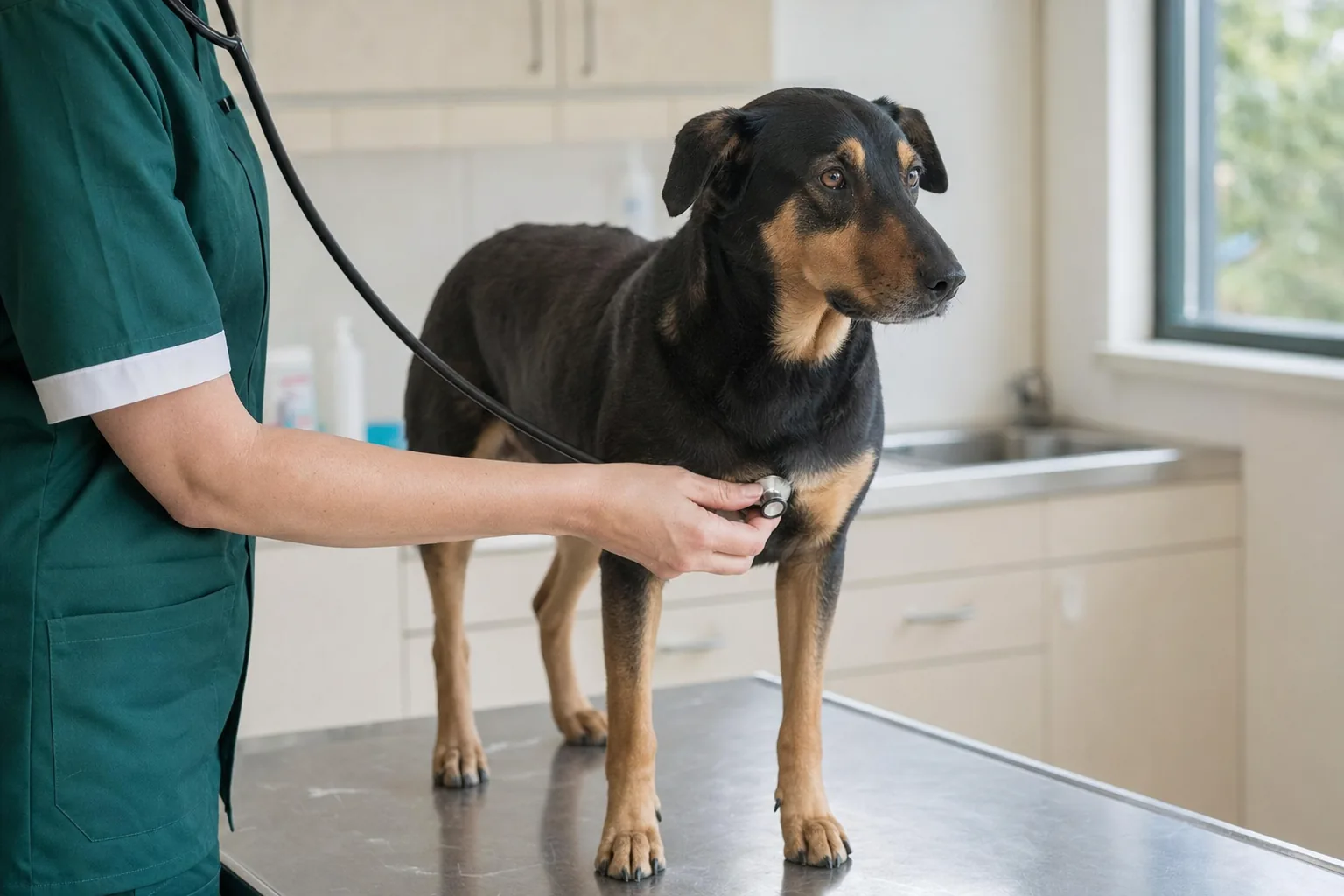
- Examines him: temperature, gum colour, lymph nodes, listens to the heart (murmur, rhythm) and to every part of the lungs. Presses gently on the windpipe, because a dog with an irritated trachea coughs when it is touched. Looks into the throat and nose as far as an awake dog allows.
- If everything fits kennel cough (recent contact, bright dog, no fever, clear lungs), often nothing more is needed. Your vet tells you what to watch, when to come back and how long to keep him away from other dogs. If treatment is needed, your vet chooses it case by case. Plenty of kennel cough clears up without any.
- If it does not fit, or the cough has been going on a while: a chest X-ray (lungs, heart, windpipe), blood tests and a heartworm test, which is worth doing yearly anyway if you live where there are mosquitoes. Sometimes a swab to identify the respiratory bugs.
- If the heart is suspected, a heart scan, sometimes with a veterinary cardiologist, and a blood pressure check. You will be asked to count his sleeping breaths at home every day and write them down.
- For a chronic cough that is not responding, a scope of the airways with a lung wash under anaesthetic, to see the windpipe and take samples. For the nose, a CT scan.
- A grass seed in the nose comes out under sedation with an endoscope. Tweezers on an awake dog will not do it.
- The plan depends on the cause. It ranges from "rest, harness instead of collar, humid air and see me in ten days" to lifelong heart treatment. Before you leave, ask two things: how long he is contagious and when to ring if he is not getting better.
What not to do at home
- Do not give him human cough syrup. Many contain ingredients toxic to dogs or dangerous sweeteners, and a moist cough is doing a job: clearing the airways. If the cough needs calming, the vet chooses the product.
- Do not give him antibiotics left over from an old illness or from your own cupboard. Most kennel cough is viral and clears without them, and a random antibiotic hides the signs and muddles the next treatment.
- Do not walk him on a collar while he is coughing. Use a harness. Every jerk on the windpipe means another fit.
- Do not take him to training, the park, kennels or the groomer while he is coughing and for two weeks after he stops. Kennel cough spreads through the air and through shared water bowls. At our training sessions the rule is simple: a coughing dog stays at home, however well he feels.
- Do not tire him out. Short walks at a stroll, no rough play, until it has passed.
- Do not keep him in smoke, near scented candles, in a freshly painted room or in air dried out by radiators. A bowl of water on the radiator, or ten minutes in the bathroom with a hot shower running (no essential oils), moistens the air. That is all it does.
- Do not go digging in his nose for the seed you think you can see. You will push it further in.
- Do not wait with a puppy. An unvaccinated puppy can go from an ordinary cough to pneumonia in a few days.
- Do not settle for "it's only kennel cough" if it lasts beyond two weeks, a fever appears or the dog is old. That diagnosis is made after the other causes have been ruled out, and ruling them out happens at the vet's.
If it is kennel cough
You need two or three weeks of patience. His bowl stays separate from the other dogs' in the house. They will most likely catch it anyway, but there is no need to hurry things along. Harness, short walks and soaked food if the kibble irritates his throat when he swallows. Keep a diary of the fits each day so you can see them dropping off. Ring the vet if a fever appears, if he refuses food, if his breathing speeds up or if in the third week he is coughing as much as at the start.
The kennel cough vaccine does not cover every bug and does not stop every cough, but it shortens the illness and makes it milder. Talk to your vet about whether it is worth it for your dog, especially if he goes to group classes or kennels.
At training, you hear the cough before you see the dog. One fit in the car park and you know you are working without him that week. We ask the same of everyone else. If you do not have a regular vet yet, our page on related services helps you choose a practice.
The information on this page is educational and does not replace an examination. For full details and a diagnosis, consult your dog's own veterinarian.