Eleven at night, the bedroom is cool, your dog has slept all evening, and yet now he is sitting by the bed panting with his tongue out as if he had just been for a run. Or your old dog is asleep and you can see his flank going up and down fast, much faster than you remember. Or you have a French bulldog who snores and breathes noisily after five minutes of walking. Dogs cool down by panting, so most of the time there is nothing to worry about. What is worth knowing is the difference between panting after a run and panting at eleven at night, what to count at home to tell them apart, and which signs send you straight to the vet.
Warning signs: when to call today
Some breathing problems are emergencies measured in minutes. Head for an open clinic and phone from the car if you see:
- blue, purple, grey or very pale gums or tongue;
- breathing with the neck stretched out and elbows held away from the chest, unable to lie down, or only lying on his chest;
- heavy effort from the belly with every breath, flaring nostrils, mouth wide open even at rest;
- a loud noise on the in-breath (a wheeze or a rasp he did not have before);
- panting after heat or exercise in warm weather, with thick saliva, wobbling or vomiting (heatstroke kills quickly);
- a swollen, tight belly, restlessness and retching that brings nothing up, especially in large, deep-chested breeds (bloat and stomach twisting);
- sudden panting after eating something, with tremor, heavy drooling or agitation (possible poisoning);
- fainting, collapse, coughing up pink froth;
- in a dog known to have heart disease, a sleeping breathing rate that climbs and stays up.
If none of that applies but he has been panting at rest, in the cool, for several days, call the vet the same day and book an appointment.
What to watch and note at home
Count his breaths while he sleeps. Nothing else you can do at home is as useful, and it takes a minute. While he is sleeping peacefully (not dreaming, not paddling his paws), count how many times his chest rises in 30 seconds and double it. Most healthy dogs come out under 30 breaths a minute asleep, usually between 15 and 25. If the number is consistently above 30 to 35, or creeps up from one evening to the next, call the vet. Cardiologists ask owners of dogs with heart disease to do exactly this every day, because the number often rises several days before a crisis.
It helps a lot to know his number now, while he is healthy. Count two or three times a week for a few weeks and jot the results in your phone with the date. Some dogs breathe 14 times a minute asleep and others 24, and both are fine. What you are watching for is change. A dog who used to be at 16 and is now at 32 is telling you something, even if 32 does not sound like much. Your phone helps with the counting too: start the timer and tap the screen each time the chest rises, and apps made for this give you the number directly.
The context. Does he pant after a walk, in the heat, in the car, at the vet, when visitors come, during fireworks? Then it is usually heat, effort or emotion, and it stops within 10 to 15 minutes once the cause has passed. Does he pant at night, in the cool, for no reason, for hours? Write down the time and film him.
Video. A 30-second clip of him breathing, shot from the side with his whole body in frame, is worth more than any description. Plenty of problems vanish in the consulting room, out of nerves.
His gums. Lift his lip and press gently on the gum with a finger. Normal colour is pink, and after you take your finger away the pink comes back in under two seconds.
What you can hear. Does he snore when he is awake? Make a noise when he breathes in, especially on exertion? Has his bark changed or gone hoarse? Does he cough?
Other signs. Drinking more, eating more, a pot belly (Cushing's disease often causes panting). Limping, getting up stiffly, not settling (pain causes panting too). Losing weight, tiring quickly.
Common causes, as a rough guide
| Situation |
What it looks like |
How urgent |
| Heat, exercise, excitement |
Panting with a long tongue, stops in shade and quiet |
Normal, if it stops within 10 to 15 minutes |
| Pain |
Panting at rest, restless, will not settle, trembling |
Vet the same day |
| Fever |
Panting, listless, off his food; a warm nose is not a reliable sign |
Vet the same day |
| Heart disease |
Fast breathing while asleep, coughing at night, tires quickly |
Today, if the sleeping rate has gone up |
| Laryngeal paralysis (large, older dogs) |
Noisy breathing, hoarse voice, worse in the heat |
Emergency if he is choking, otherwise a prompt appointment |
| Flat-faced breeds |
Snoring, noisy breathing, cannot cope with heat |
Planned appointment; emergency in a heatwave |
| Cushing's disease |
Panting at rest, drinks a lot, pot belly |
Planned appointment |
| Anaemia |
Pale gums, tiredness, fast breathing |
Today |
| Heatstroke |
After heat or exertion, thick saliva, staggering |
Emergency, now |
What the vet will check
- How he is right now. If he is struggling to breathe, the vet stabilises him first: oxygen, quiet, and the long examinations wait until he settles. A dog who is suffocating does not get laid on the table for X-rays.
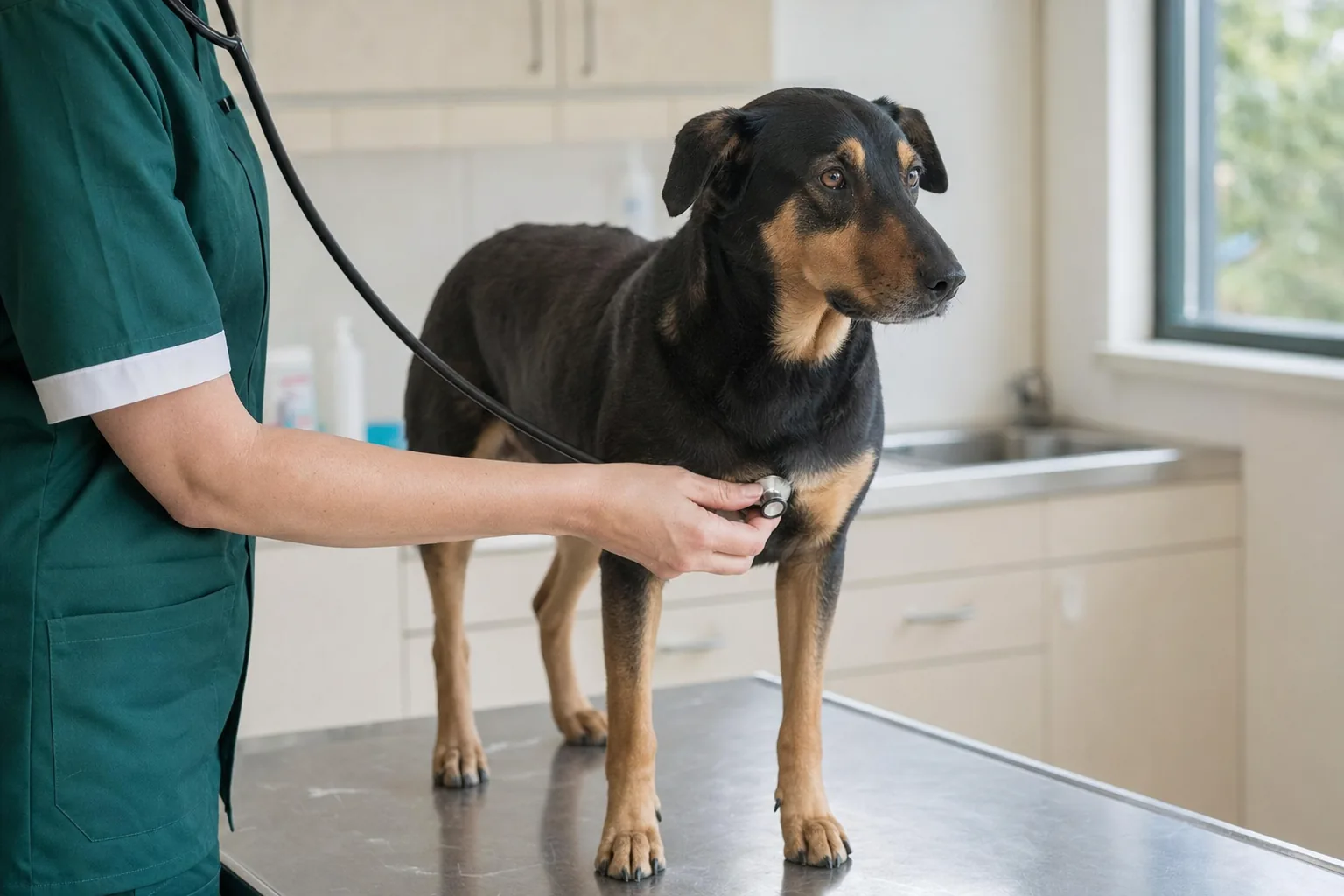
- A clinical exam. Gum colour, temperature, listening to the heart and lungs, feeling the belly, checking for pain.
- Your video and your home counts. Show them.
- Chest X-rays, for the lungs, the heart and any fluid in the chest.
- A heart scan, if there is a murmur or the heart looks enlarged.
- Blood tests, for anaemia, infection or hormone problems.
- A look at the larynx, under light sedation, in large, older dogs with noisy breathing.
- An airway assessment in flat-faced breeds: nostrils, palate, sometimes with a discussion about surgery to widen the nostrils and shorten the soft palate.
Treatment depends entirely on the cause, and only your vet can set it. If it is his heart, ask at what sleeping breathing rate you should call or come back.
What not to do at home
- Do not give him sedatives or any medicine of your own to calm him down. Some slow breathing, others lower blood pressure, and they can turn a heart or lung problem into a crisis.
- Do not wrap him in wet towels or put ice on him for heatstroke. A wet towel warms up within two minutes and traps the heat in. Douse him generously with cold tap water all over, keep it coming fresh, put him in a draught and set off for the clinic. Our heatstroke page has the steps in full.
- Do not take him on a long walk "to burn it off" when he is panting for no reason. Exercise makes almost every cause above worse.
- Do not use a collar on a dog who breathes noisily or on flat-faced breeds. Switch to a harness, which keeps pressure off the throat.
- Do not leave him in the car, not for five minutes, not in the shade, not with the window cracked. A car heats up within minutes.
- Do not wait a week if his sleeping breathing rate is high several evenings in a row. With the heart, time matters.
- Do not force him to lie down or be held when he is struggling to breathe. Let him take whatever position he chooses; it is usually the one in which he breathes most easily.
Summer, training and walks
In summer we only train early in the morning and in the evening, with breaks in the shade and water after every trail. For flat-faced and older dogs, a heatwave day is a day for nose games indoors on a cool tiled floor. A dog panting with his tongue spread wide like a spoon, who has stopped looking at you, has done enough for the day.
That one-minute count while he sleeps, done now and then on a healthy dog, gives you a number to compare against on the day it really matters: a winter evening when he is panting in a cool room and you cannot tell whether it is something or nothing.
The information on this page is educational and does not replace an examination. For full details and a diagnosis, consult your dog's own veterinarian.