Your dog runs, eats and greets you at the door like nothing is wrong. At the annual check-up the vet takes a few drops of blood, sets the test on the counter and ten minutes later tells you it is positive for heartworm. Another story we hear just as often: an eight-year-old dog who spends his summers in a garden near a river has started coughing after walks, and stops for a breather on the stretch where he used to drag you along. Or you were stroking him and found a small lump under the skin that slides away under your finger, and someone said "it could be a worm".
All three can be the same disease. Dirofilariasis is caused by two thin worms that mosquitoes carry from dog to dog. Dirofilaria immitis, the one people call heartworm, lives in the arteries of the lungs and, once the disease is advanced, in the heart itself. It can grow to 20 to 30 cm. Dirofilaria repens lives under the skin, where it causes lumps and sometimes itching. It is milder for the dog but can pass to people, again through mosquitoes. Both are found across southern and eastern Europe, Romania included, mostly in low, warm, damp country around rivers, deltas and standing water, and both have been moving north.
What makes it tricky is the timescale. A mosquito bites an infected dog and picks up tiny larvae from the blood. It carries them for around two weeks, and only in warm weather, then passes them on to another dog with its next bite. In the new dog the larvae grow slowly and reach adulthood after about six months. Only then can the usual tests turn positive. The signs come later still, often years later.
When to ring the vet today
Most infected dogs look fine for years, and when signs do show they creep in. A few situations, though, do not wait for next week's appointment:
- the dog suddenly collapses, has pale gums, struggles to breathe and passes dark urine, like strong tea (a severe form in which the worms block blood flow through the heart);
- fast, laboured breathing with his mouth open while he is lying down and has not been running;
- coughing up blood;
- fainting during exercise or straight after it;
- a belly that swells up suddenly and wobbles like a water balloon when you touch it;
- a dog already on heartworm treatment who starts coughing a lot, runs a temperature or struggles to breathe.
That last one needs a word of explanation. During treatment, the worms that die break into pieces and the pieces end up in the lungs. Your vet will warn you about this at the start. If you see these signs, ring straight away, not in the morning.
What you can keep an eye on at home
The best tool you have at home is his breathing while he sleeps. Vets use the same measure for heart disease in general. Wait until he is properly asleep, count how many times his chest rises in 30 seconds and double it. Under 30 breaths a minute is usually normal. If it comes out above 30 consistently, tell your vet. Do it on several days in a row and keep the numbers on your phone.
Then watch how he copes with exercise. Does he stop on walks where he never used to? Sit down after the stairs? Look at the ball on the third throw and stay put? You see these things first. Your vet does not see them in the consulting room.
Describe the cough as precisely as you can: when it happens (after exercise, at night, when he gets excited), what it sounds like (dry or moist) and how long it lasts. A one-minute clip on your phone beats any description.
Besides breathing, stamina and the cough, keep track of a few things your vet will ask about anyway:
- any slow weight loss without a change in food, and a coat that has lost its shine;
- lumps under the skin: small, movable, not painful, especially on the legs, belly or head. Write down where they are and how big, and photograph them next to a coin;
- his history: where he spends the summer (garden, countryside, near water), whether he has ever been tested, what prevention he has had and when.
Dogs adopted from southern Europe or from shelters in high-risk areas get tested regardless, however well they look.
The two dirofilaria side by side
|
Dirofilaria immitis |
Dirofilaria repens |
| Where it lives |
Lung arteries, heart |
Under the skin |
| What you see |
Nothing for years, then cough, tiring on exercise, weight loss, fainting, swollen belly |
Lumps under the skin, sometimes itching, often nothing |
| How serious for the dog |
Can be very serious |
Usually mild |
| Risk to people |
Very rare |
Yes, rarely: lumps under the skin or in the eye |
| How it is confirmed |
Blood antigen test, larvae test, imaging |
Larvae test, PCR, removed lump examined |
What your vet does
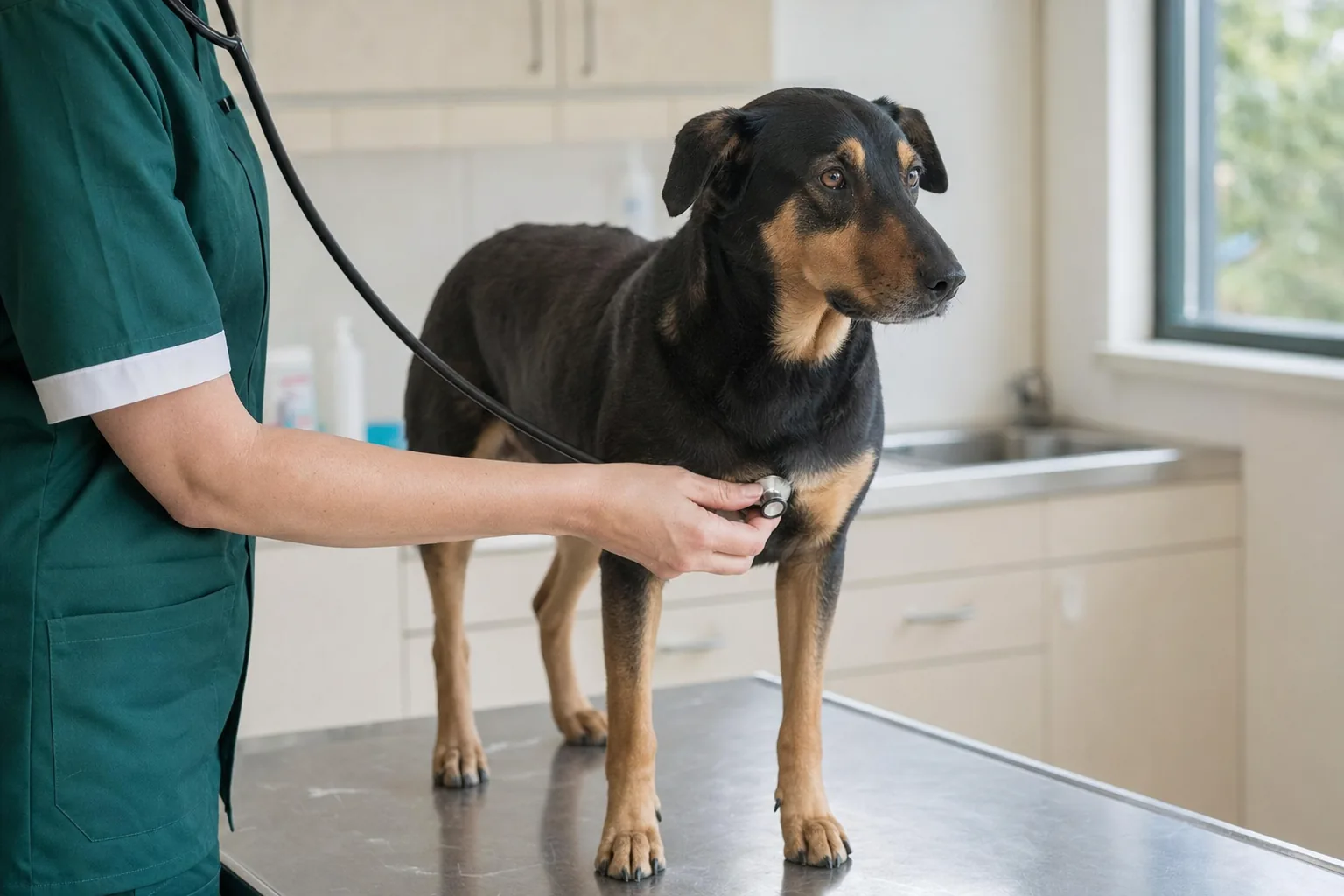
- Takes a history and examines him: listens to the heart and breathing, checks the gums, weighs him and feels for lumps under the skin.
- Runs the antigen test. A few drops of blood are checked for a protein made by adult female Dirofilaria immitis worms. It is the standard test, but it only turns positive six to seven months after infection. A test in August tells you nothing about July's mosquitoes, which is why many vets do it in spring, before the season starts.
- Looks for larvae in the blood. The tiny larvae (microfilariae) are found under the microscope once the blood has been concentrated using a specific technique. This test also picks up Dirofilaria repens, which the antigen test misses.
- Asks for a chest X-ray and a heart scan. These show how much damage there is to the lung arteries and the heart, and sometimes the worms show up on the screen. That is how the vet grades the case.
- Runs blood and urine tests to check the kidneys, liver and general condition before any treatment starts.
- Heartworm treatment is given in stages over several months, following a protocol your vet picks from specialist guidelines. For you, the hard part is the rest rather than the injections. For weeks he has to stay calm: no running, no rough play, only short walks on the lead. Exercise pushes fragments of dead worm into the lungs.
- With Dirofilaria repens, the lumps can be removed surgically and the larvae in the blood treated on your vet's plan.
- A few months after treatment the tests are repeated to make sure the worms have gone.
What not to do on your own
- Do not start prevention without a test in an adult dog who has already been through a mosquito season in a risk area. If he is infected and has larvae in his blood, some preventive products kill them all at once and can trigger a reaction. The vet tests first and then picks the product.
- Do not order "heartworm" products online without a vet. Some breeds (collies, Australian shepherds, Shetland sheepdogs and their crosses) have a genetic sensitivity to certain ingredients, and the dose varies a lot with weight.
- Do not let him run during treatment, however well he seems. That is where most complications come from.
- Do not count on him being an indoor dog. Mosquitoes come inside too. The risk is lower, that is all.
- Do not stop prevention in August because summer feels over. European guidelines (ESCCAP) recommend monthly prevention from the start of the mosquito season until a month after it ends. In much of south-eastern Europe that means roughly May to November.
- Do not remove lumps under the skin yourself. Show them to your vet.
- Do not put the cough down to age. In a dog who has lived where mosquitoes are common, a cough plus tiring on exercise calls for a test, and a cough syrup will not touch it.
What prevention looks like day to day
A product given monthly or, in some cases, a longer-acting injection. You choose it with your own vet according to where you live, the breed and the weight. The rest is down to you. During the season, bring the dog in at dusk and have him sleep indoors. Fit screens to the windows. Empty anything in the garden that holds standing water: buckets, plant pots, old tyres, anywhere mosquito larvae can grow. Some topical products that keep mosquitoes off help as well; ask your vet which one suits your dog.
If you are taking him somewhere warmer for a summer holiday, such as Greece, Italy or the Black Sea coast, talk about prevention before you pack. The mosquito season there is longer and the risk higher.
One test a year in spring, prevention right through the mosquito season, and most dogs never meet this disease at all. The ones who end up on treatment are nearly always dogs who had neither the test nor the prevention.
The information on this page is educational and does not replace an examination. For full details and a diagnosis, consult your dog's own veterinarian.