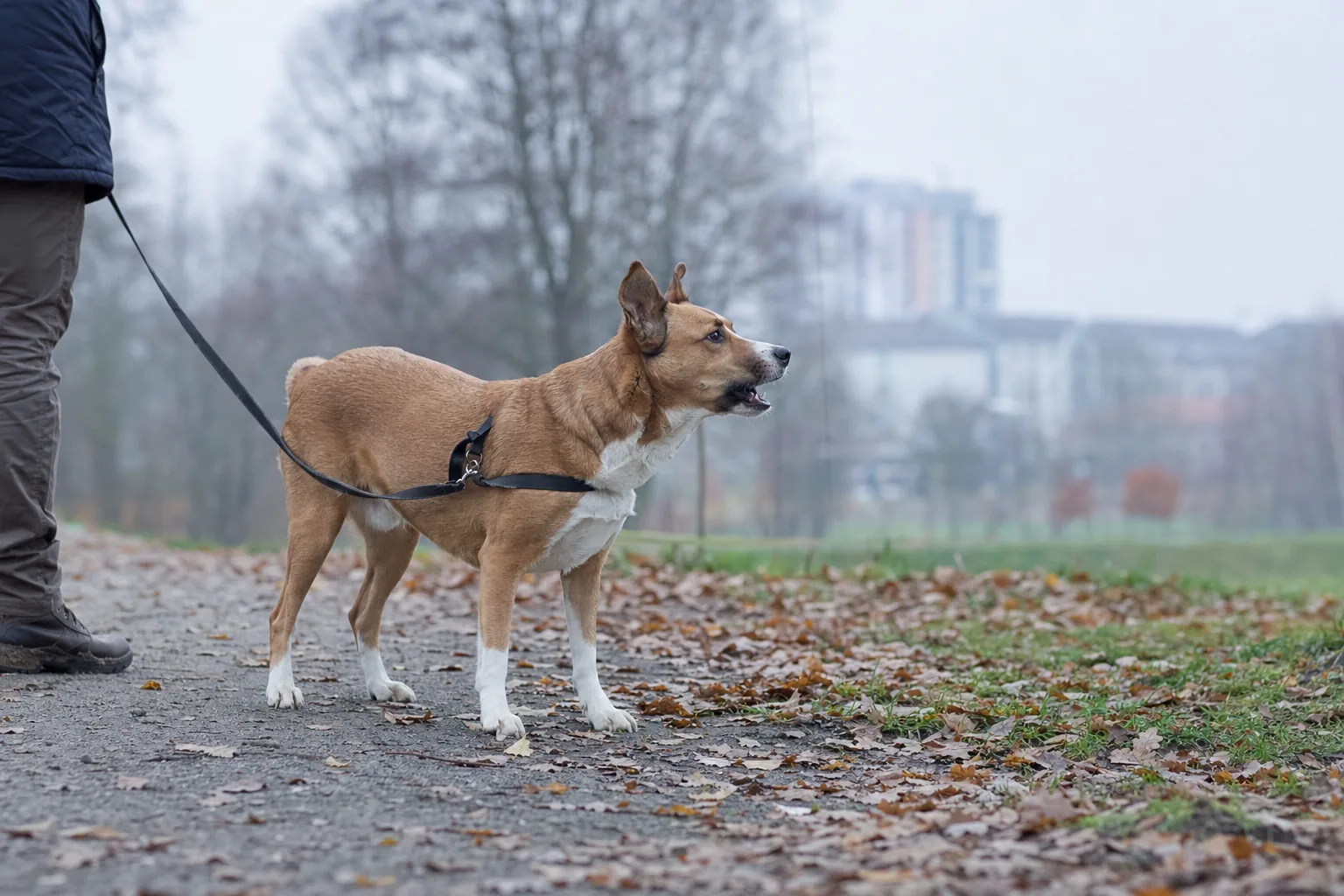
Last week you made the decision you had been putting off for months. Your thirteen-year-old dog went to sleep on the vet's table with his head in your hand. Now the house is too quiet. You wake at six, walk time. You hear claws on the floor and there is nobody there. A colleague said "it was only a dog, get another one", and you have not mentioned him since. Maybe there is a second dog searching the house for him, or a child asking where he has gone. This page is about that grief: why it hurts so much, what does not help, and what you can do in the first weeks for yourself, for the children and for the dog left behind.
Why it hurts this much
You lived together every single day, for years. He was there in the morning, every time you came home, on the bad evenings. He never asked for anything complicated and he saw you in every mood you have. When he goes, the shape of the day goes with him: the six o'clock walk, the bowl to rinse, the path through the park. You feel the gap dozens of times a day, in small things.
Studies of people who have lost dogs show that, for many of them, the grief after a pet dies comes close in intensity to losing a person they were close to. You are not overreacting and it is not weakness.
The people around you do not always see it that way. Psychologists have a name for this: disenfranchised grief, a loss others do not take seriously, so you carry it alone. No time off, nobody turning up with a casserole, nowhere to cry without feeling embarrassed.
Then there is the guilt. If you chose euthanasia, you wonder whether it was too soon or too late. If he died suddenly, you wonder what you missed. Nearly everyone goes through these questions. Most of them have no answer, and the ones that do usually let you off: you decided with what you knew at the time, out of care for him.
Dogs feel the loss too. We do not know what they understand about death. We do know that a dog who has lived for years with another often changes once the other one is gone. He searches the house, eats less, sleeps more, plays less and sticks to you like glue. Part of that is missing his companion. The rest comes from your sadness, which he reads perfectly.
What seems to help and does not
"Get another dog straight away." For some people it works. For many, the new dog is measured against the old one at every turn and always comes up short. He is a different dog, not a replacement part, and deserves to be chosen for who he is.
Pretending you are fine. Grief that gets pushed aside does not go away; it just waits. You do not need anyone's permission to cry.
Telling a child the dog "went to live on a farm" or "went to sleep". The child will wait for him to come back, or start to fear going to sleep. Tell the truth in simple words that suit their age: "He died. His body stopped working. He isn't coming back. It's all right to be sad."
Clearing everything away the next day, or not touching a thing for months. Both are ways of not looking at the loss. Clear up at your own pace and keep what you want to keep.
Going over and over what you could have done differently. If the question will not leave you alone, go to the vet who treated him and ask directly. More often than not, the answer brings some peace.
Smothering the other dog with attention, treats and new indulgences, or changing his whole routine. He needs the opposite: his old routine, as untouched as possible.
What you can do, step by step
1. The first hours and days
- His body. Your vet can put you in touch with a licensed pet cremation service, individual with the ashes returned, or communal. Burial in the garden is regulated differently from one country and one area to the next, so check first. You do not have to decide in the first minute; the practice can keep the body for a few days.
- Saying goodbye. Some people want a few minutes with him, to cut a lock of fur, to take a paw print. Others do not. Both are fine.
- The dog left behind. Some people let him sniff the body of the dog who died, where that is possible. We do not know for certain what he takes from it, but it does no harm and many people find it comforting.
- Children. Tell them the truth and let them ask questions, draw, write something. Young children may ask the same thing ten times. Answer the same way each time, calmly.
2. The first weeks
- Keep the remaining dog's routine as it was, with the same mealtimes and walk times. For him, routine is the best comfort there is.
- If the old route hurts too much, change it a little. Or walk exactly that route, if that is what settles you.
- Talk about him with people who knew him. Write him a letter. Make a photo album.
- His collar, favourite toy and tag can go in a box. There is no need to throw them out.
- Sleep, eat and get out of the house, even when you do not feel like it. Grief wears the body down like an illness.
3. Later on
Grief does not move in a straight line. His birthday, the first snow, the first holiday without him can bring it all back. That is normal.
A new dog comes when you can enjoy him for who he is. For some people that means a few weeks, for others years, and some never get another. Every one of those is right.
The first weeks at a glance
| When |
For you |
For the dog left behind |
| The first days |
Saying goodbye, deciding about the body, a few days off if you can |
Unchanged routine, more quiet walks |
| Weeks 1–2 |
Talk to people who knew him; sleep and eat |
Watch eating, sleep, play; note what has changed |
| Weeks 3–6 |
The memory box, your own ritual |
Food-searching games, a few new things |
| After 6–8 weeks |
If you cannot function at all, ask for help |
If he has not picked up at all, see the vet |
When it becomes a health problem
For you. Sadness, crying, no energy and poor sleep in the first weeks are normal. Talk to your GP or a counsellor if, after a few months, you cannot cope at work or at home, you are not sleeping or eating, you have shut yourself off completely or nothing seems to have any point. If you are thinking of harming yourself, call your local emergency number now; in the UK and Ireland you can also call Samaritans on 116 123, day or night.
For the dog left behind. A grieving dog usually eats a little less for a few days and sleeps more. See your vet if he eats nothing at all for two days, loses weight, vomits, has diarrhoea, hides and will not come out, or shows no sign of picking up after a few weeks. Many dogs left on their own are old themselves, and a new illness can look exactly like sadness.
When to call in a specialist
- your grief has not softened at all after a few months, or it stops you living normally: a counsellor or psychologist, ideally one who has worked with people who have lost an animal;
- your child has nightmares, is frightened to go to sleep or will not go near any dog: your GP or a child psychologist;
- the remaining dog has never been alone before and now howls, chews or wees indoors when you go out: that is fear of being alone on top of sadness, and a behaviour specialist can help you with a plan;
- you want a new dog and are not sure the one you have will accept him: an assessment of your dog and a first meeting on neutral ground, with a trainer present.
Some vet practices and charities run support groups or phone lines for people who have lost a pet; in the UK, Blue Cross runs a free pet bereavement support service. It is worth asking. An hour with people who will never say "it was only a dog" does more than you might expect.
A behaviour that appears suddenly or changes for no apparent reason can have a medical cause. For full details, consult your dog's own veterinarian.