Your dog is thirteen. For a month he has not managed the stairs on his own, he only eats if you hand-feed him, and at night he pants on the floorboards and cannot settle. Or he has an illness your own vet has already put a name to, and since then you look at him every morning and wonder whether today is the day.
Nobody can make this decision for you, and nobody should rush you into it. What you will find here: how suffering shows in a dog, how to keep track of good days and bad ones, how to talk it through with your vet, and what happens, step by step, if you choose euthanasia. The part about the procedure is written in detail, because so many people have told us the same thing afterwards: "I wish I'd known beforehand how it goes."
How to tell he is suffering, and when to ring the vet now
Dogs hide pain; they are built that way. An old dog can wag his tail when you come through the door after a whole night in pain. Watch him in the moments when he thinks there is nobody to put on a show for.
Ring your own vet the same day if you see:
- laboured breathing at rest, the belly pumping, the neck stretched out or the gums gone blue;
- that he has eaten nothing at all for more than a day or two, or has stopped drinking;
- repeated vomiting, blood in his stools, a swollen, painful belly;
- his back legs giving way, so that he cannot get up on his own and lies in his own wee or poo;
- groaning, whimpering, trembling, growling when you touch one particular spot;
- seizures, especially if they keep coming;
- sudden confusion: he does not know you, circles, gets stuck in corners and panics.
Some of these can be treated or at least eased. Others mean the illness has reached a point it will not come back from. Only the vet can tell which, and it is far easier if the vet sees him then rather than a week later.
Quality of life, day by day: what to watch at home
There is no blood test that tells you "now". Vets use quality-of-life scales, and the idea behind them is simple. Instead of one enormous question ("should I let him go?"), you ask yourself a handful of small ones every day and write the answers down.
The first is pain. Is he panting at rest, breathing shallowly, shifting position all the time, struggling to get up, licking one spot over and over, flinching from your hand?
Then food and water. Does he eat from his bowl, only from your hand, or not at all? Does he drink by himself?
Hygiene tells you a lot too. Does he make it outside in time? Does he soil himself and stay lying in it? Has he got sores from lying down so much?
Movement: can he get up on his own, walk to the end of the road, still climb onto the bed or sofa where he always used to lie?
And joy. Does he still meet you at the door? Is he still asking for things, a treat, a fuss, a patch of sun? Does he still enjoy sniffing the grass on a walk? A dog who has given up on his favourite things is telling you something important.
In practice, one question helps more than all the rest: have there been more good days or more bad ones?
Get a wall calendar or open a note on your phone. Each evening, mark the day: good, bad or somewhere in between, and if you can, write down why. After two or three weeks you can see which way things are going, without relying on the memory of one bad day or the hope of one good morning. When the bad days start to outnumber the good, the answer is already on paper, ready for the conversation with your vet.
Some people write a list of the three or four things their dog loves most: the morning walk, his ball, keeping guard by the front door, cheese. When he can no longer do any of them, the list speaks for itself.
What to bring to the appointment
| What you note |
Why it matters |
| The calendar of good and bad days |
Shows the trend, not just the day you happen to be at the vet's |
| What he ate and drank, and how much |
Losing his appetite is an early sign |
| Videos of his sleeping breathing and his walking |
At the practice, nerves make him look different |
| Toilet accidents |
They say something about pain, kidneys or nerves |
| The list of favourite things and what is left of it |
His joy is something only you see |
Deciding with your vet, and how euthanasia is done
Talking it through
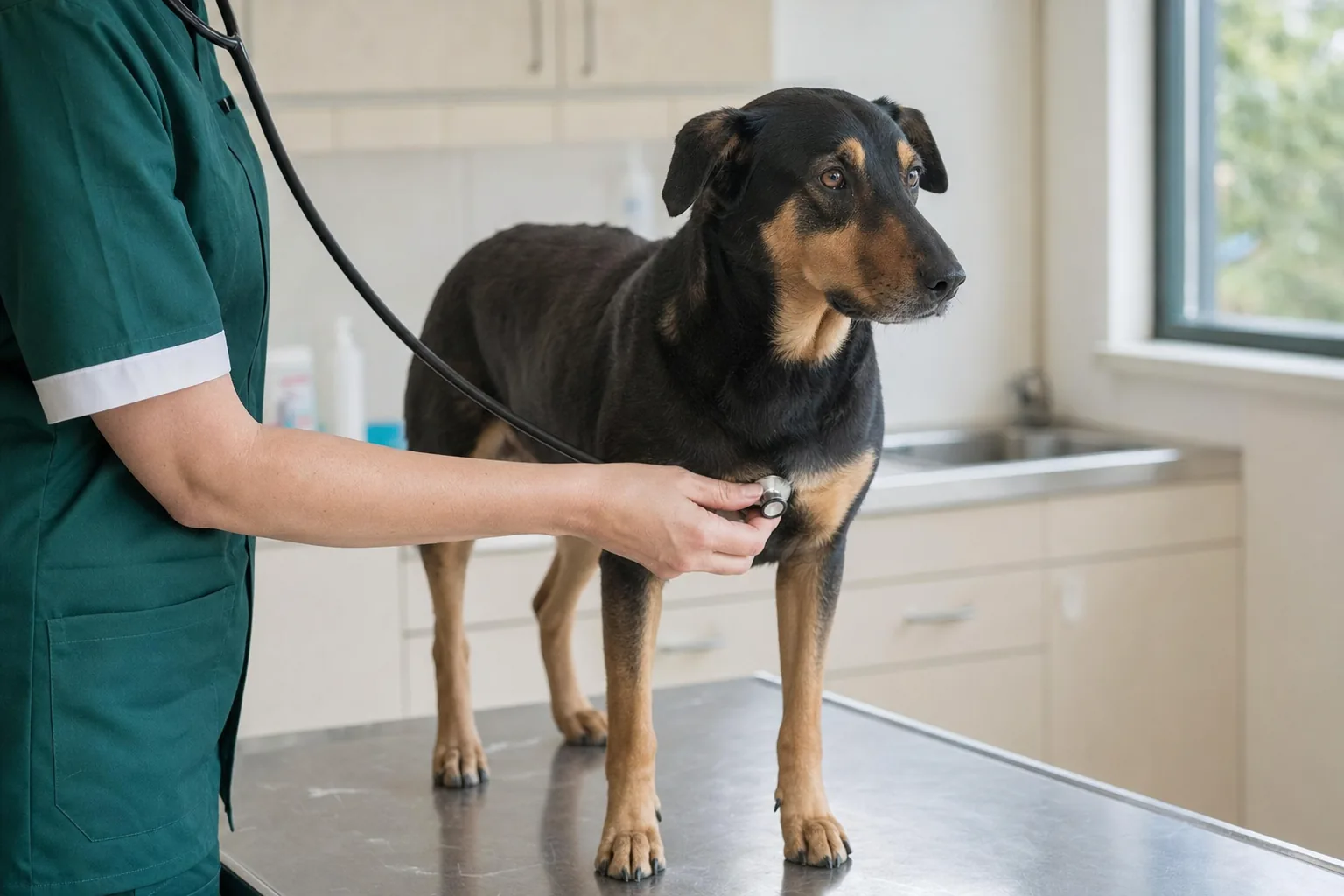
Ask for an appointment just to talk, with no rush, ideally at the end of the day, and say when you ring what it is for. The vet will examine him (weight, pain on handling, breathing, sometimes bloods or a scan to see how far the illness has gone). Then you will hear what options are left: pain relief, palliative care at home (care aimed at comfort once a cure is no longer possible), another test, or euthanasia.
Ask straight out: "If he were your dog, what would you do?" Most vets will answer honestly. Beyond that, a few more questions are worth asking:
- How much comfortable time can treatment give him, and what signs will tell me it has stopped working?
- What could happen suddenly (a fit, a bleed, choking), and what do I do if it happens at night?
- Can you come to the house, or do you know a colleague who does?
- What happens to his body afterwards, and what are my options?
A lot of people are afraid of choosing "too soon". In practice vets more often hear the opposite, owners who feel they waited too long. There is a saying among vets: better a week too early than a day too late. It is not a rule, but it tells you something.
You do not have to decide in the consulting room on the day. You can go home, have one more day with him, let the rest of the family come.
The procedure, so it does not catch you off guard
In dogs, euthanasia is usually done in two steps, and it helps to know both before the day comes.
- First, sedation. The vet gives an injection that puts him into a deep sleep. Within a few minutes he relaxes, his head grows heavy, sometimes he snores. From that point on he feels nothing. You can hold him, talk to him, give him one last treat if the vet says it is fine.
- Then the final injection, usually into a vein, often through a cannula placed in a leg. It is a large dose of anaesthetic, and the heart usually stops within one or two minutes. The vet listens with a stethoscope and tells you when it is over.
Afterwards you may see a few things that are normal: his eyes stay open, there may be one or two reflex breaths or muscle twitches, and the bladder and bowel may empty. His body is relaxing. He is not suffering and he has not "woken up".
You can choose to stay or to step out, and either is fine. If you stay, he has you beside him at the end, and many people say that helped them later on.
At home the procedure is the same, just on his own bed or out in the garden in the sun, with the family around him. Not every vet does home visits, so ask in good time rather than on the day of a crisis.
Afterwards
The vet will explain the options: individual cremation (the ashes come back to you), communal cremation, or other arrangements allowed where you live. Burial in a garden or on private land is not permitted everywhere, so check before you plan it. You can keep his collar, a lock of fur, a paw print; many practices will make one if you ask.
Children and the other dogs at home
Tell children the truth, pitched at their age: the dog is very ill, the vet cannot make him better, and he is going to die without pain. With little ones, avoid "we put him to sleep", because some start to be afraid of going to sleep. Avoid the farm story as well: they find out later and lose trust in you just when they need it most. Let them say goodbye, draw him a picture, put his toy next to him.
If you want, let the other dogs sniff his body. Some seem to understand more quickly that way than if their companion simply vanishes.
What not to do at home with an old or ill dog
- Do not give him human painkillers. Many are toxic to dogs even in small amounts and can bring on exactly the suffering you are trying to stop. Pain relief is for the vet to decide.
- Do not wait for him to "die peacefully in his sleep" if he is suffering. It does happen, but in an ill dog a natural death often comes after days of struggling for breath, hunger or pain.
- Never try to put him down yourself, and never turn to anyone without the right to practise. It ends badly, for the dog and for you.
- If you do not have to, do not make the decision on your own. Talk to your family, to the vet, to someone who has lost a dog themselves.
- Afterwards, do not judge yourself. Whether you chose a day earlier or waited another week, you decided with what you knew at the time, out of care for him.
Grief can last weeks or months and it is as real as any other loss. If you feel you are not getting through it, talk to someone. There are support groups for people who have lost an animal.
The information on this page is educational and does not replace an examination. For full details and a diagnosis, consult your dog's own veterinarian.