You bag it up off the grass and there are red streaks on it. Or he has had diarrhoea all night and what comes out in the morning looks like raspberry syrup. Or the stool is a normal shape but black and shiny, like tar. All three get called "blood in the stool", and they mean very different things. The first often settles in a couple of days on a bland diet. The other two don't wait until morning. Below: how to tell them apart, what photos and sample to take to your own vet, and what not to try at home.
When it is serious and you go today
A little red blood, once, on a soft stool, in an adult dog who is eating, drinking and playing, can be talked through with your vet on the phone and watched for a day. Everything in the list below means being seen the same day, and some of it within the hour:
- diarrhoea with a lot of blood, like purée or raspberry jam, especially with vomiting; small and medium dogs dehydrate within hours;
- black, sticky, shiny stool, like tar: digested blood from higher up, the stomach or small intestine;
- a puppy or young dog not fully vaccinated with bloody diarrhoea and vomiting; that is exactly how parvovirus looks, a serious viral disease of the gut;
- pale or white gums, weakness, a dog who wobbles or lies down and won't get up;
- lethargy and a painful belly, the dog standing hunched;
- bleeding from elsewhere: the nose, in the urine, bruising on the belly; this can be a clotting problem, for instance after rat poison;
- he has swallowed something in the last few days: a bone, a toy, something from the bin or off the pavement;
- an older dog whose bleeding keeps coming back and who is losing weight.
On the phone, open with "blood in the stool" and the colour, red or black. Then whether he is vomiting, whether he is drinking, and what he weighs.
What to look at and note down at home
Photos. The stool close up, in good light, with the bag beside it for scale. A photo tells your vet more than the best description. Keep them in an album with the date.
Colour. This matters most. It tells your vet which part of the gut the blood comes from, and it tells you how fast you need to get there. Look in daylight; under the yellow bulb on the stairs everything looks brown.
- Bright red, fresh, in streaks or drops, on the surface or at the end: it comes from low down, the colon or rectum. Most of the time this is an irritated colon. Sometimes it is parasites, a foreign body or an anal gland, more rarely a growth.
- Black, like tar: digested blood from higher up. Seen today. Bear in mind stool can turn black without any blood: from some iron supplements, from charcoal given by the vet, from a diet heavy in blood or raw liver. Tell your vet what he has eaten.
- Like red purée, with a strong metallic smell: haemorrhagic diarrhoea. An emergency, today.
Mucus. A shiny, jelly-like coating on the stool, sometimes streaked red, is common when the colon is irritated. Note that too.
How often and how. How many times today, how much, whether he strains hard and produces very little (typical of the colon), whether he has had accidents indoors.
The rest of the dog. Note whether he is eating, drinking, vomiting, still playing. Check his gums too. Press a finger on the gum: in a healthy dog it is pink and the colour comes back in under two seconds.
The last few days. New food, scraps from the table, something stolen from the bin, an overnight change of diet, stress (a house move, kennels, visitors, fireworks), a new medication, the date of his last worming, his vaccinations.
The sample. A piece of fresh stool about the size of a walnut, in a clean bag or pot, kept cool until you get there. Your vet uses it for the parasite check and the quick tests.
What it might be, in brief
| Cause |
What you usually see |
| Irritated colon (unsuitable food, stress, sudden change of diet) |
Soft stool with mucus and red streaks, lots of small trips, dog otherwise bright |
| Intestinal worms, Giardia |
Soft stool that keeps coming back, sometimes bloody, puppies losing weight |
| Parvovirus |
Unvaccinated puppy or young dog, vomiting, foul-smelling bloody diarrhoea, lethargy |
| Acute haemorrhagic diarrhoea |
Sudden onset, red purée, adult dog, usually a small breed, dehydrates fast |
| Foreign body, bones |
Vomiting, straining, sometimes blood, after swallowing something |
| Rat poison (anticoagulant) |
Bleeding elsewhere too, pale gums, a few days later |
| Stomach ulcer (for example after human anti-inflammatories) |
Black stool, vomiting, sometimes like coffee grounds |
| Growths in the intestine or rectum |
Older dog, bleeding that recurs, weight loss |
The table helps you answer your vet's questions. It isn't for choosing a treatment.
What your vet will do
- Questions. Colour, since when, how often, what he has eaten, vaccinations, worming, other signs. With your photos this part is quick.
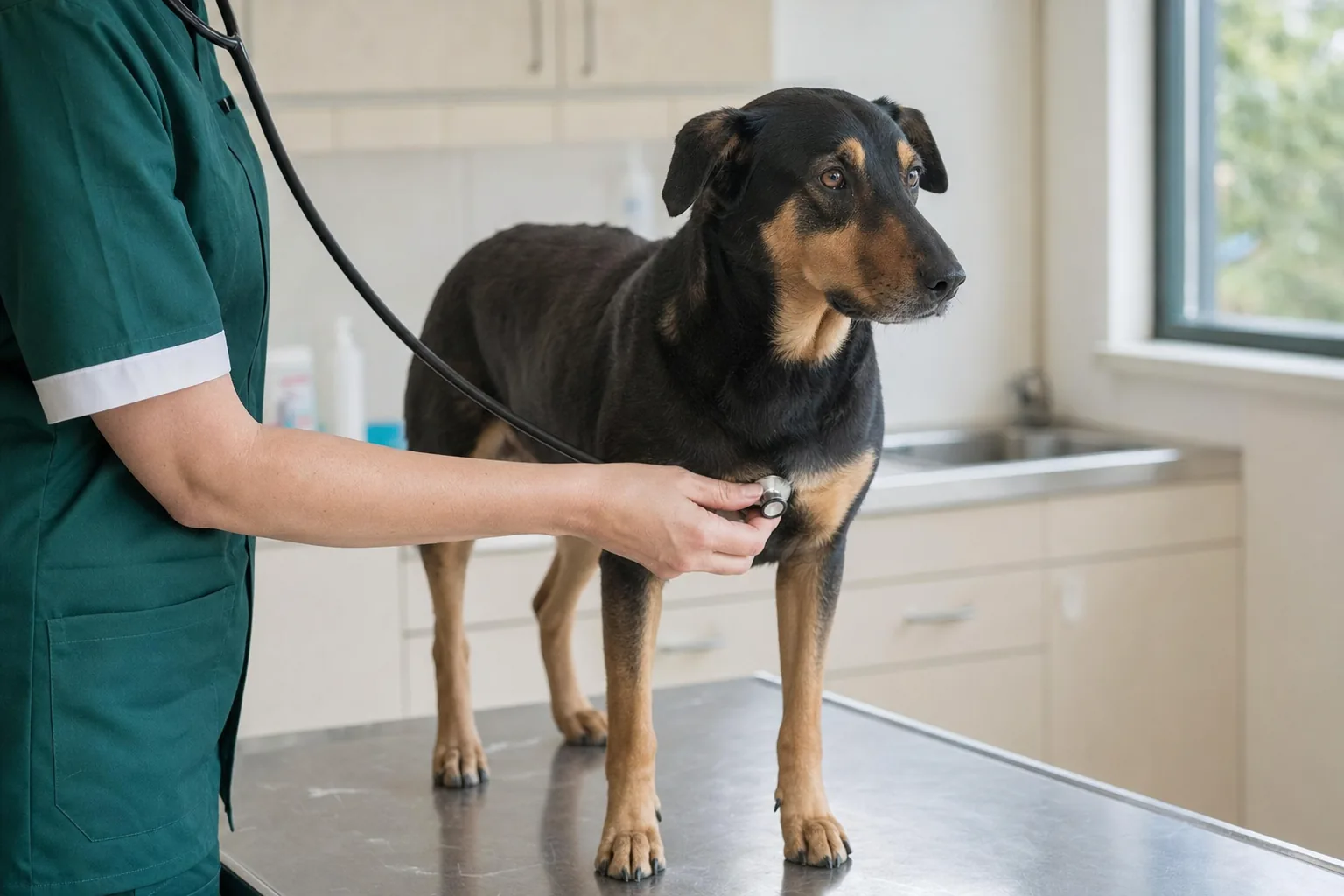
- Examination. The gums and how fast the colour returns, how dehydrated he is, temperature, the belly, the lymph nodes. Almost always a rectal exam too: with a gloved finger the vet checks the rectum, the anal glands and, in males, the prostate. It takes a few seconds.
- Stool tests. Parasites under the microscope, a quick Giardia test, and in puppies a quick parvovirus test, right there in the practice.
- Blood tests. A full blood count shows how much blood he has lost and whether there is infection; biochemistry and sometimes clotting tests fill in the picture.
- X-ray or ultrasound, if a foreign body, a blockage or a growth is suspected.
- Endoscopy or colonoscopy, when the bleeding keeps returning with no cause found, especially in older dogs.
- Treatment, depending on the cause. It may be a bland diet and a few quiet days, or hospital and a drip for haemorrhagic diarrhoea or parvovirus. With heavily bloody diarrhoea the drip matters most, because a dog in that state loses fluid faster than he can drink it.
Before you leave, ask what he should eat over the next few days, what his stool ought to look like and by when, and which signs mean coming back.
What not to do at home
- Human medicines for diarrhoea or upset stomach. Some are dangerous for dogs; others hide the signs or keep a toxin in the gut for longer.
- Human anti-inflammatories or painkillers "for a sore tummy". They can cause ulcers and bleeding, which is exactly what you are trying to stop.
- Waiting, with a puppy that has bloody diarrhoea, with black stool, with red purée. There, a few hours make the difference.
- Days without food that you decided on, without your vet. In puppies and small dogs blood sugar drops fast.
- Three different foods in one week to "see what suits him". Every sudden change irritates the colon again.
- Old wives' remedies: burnt rice, strong black tea, charcoal from the stove, vinegar, garlic.
- Binning the sample before the appointment. We know carrying it around is grim. Your vet needs it.
If it could be catching
An unvaccinated puppy, or several dogs ill in the same house, should make you think of an infectious disease. In that case keep the dog away from other dogs, pick up stools straight away, wash soiled areas with hot water and disinfectant, and wash your hands. Parvovirus survives in the environment for months, so ask your vet which disinfectant works against whatever they have found.
Most episodes of a little red blood in a cheerful dog are irritations that settle within a few days on the bland diet you agree with your vet. Your job is to keep them in a separate box from black stool and red purée.
The information on this page is educational and does not replace an examination. For full details and a diagnosis, consult your dog's own veterinarian.