This morning your dog is holding his left eye half shut. It is red and watering, and he keeps rubbing his face along the rug. Or your cocker wakes up every day with sticky brown gunk in the corners of his eyes; you wipe it away and by the next morning it is back. Or your old Labrador's eye has gone bluish and cloudy in the space of a few days. People type "conjunctivitis in dogs" into a search engine, and very often that is not what it is. It can be an ulcer on the cornea, high pressure inside the eye or a gland that has stopped making tears, and at first glance all three look like a red eye. Below is what you can check at home, why eyes are the one organ where the rule is "seen the same day", and what your own vet will do. What you will not find is which drops to use. With eyes, the wrong drops can cost a dog his sight within 24 hours.
When to ring today (with eyes, nearly always)
The cornea is thin. An ulcer can go right through it in a day or two, and high pressure destroys the optic nerve within hours. Ring the same day if:
- he keeps the eye shut or half shut, blinks a lot, shies away from light. That is pain, from an ulcer, a scratch or pressure;
- the cornea, the clear window at the front, has suddenly turned white, or bluish and cloudy;
- one eye looks bigger than the other, feels hard through the closed lid, is red with a wide pupil, and the dog is subdued or vomiting. That is high pressure (glaucoma), and you are counting hours;
- the pupils are different sizes, or one no longer closes down in light;
- the eye has come out of its socket, partly or fully, after a knock or a fight, especially in flat-faced breeds. That is an emergency right now: keep the eye moist with gauze soaked in clean water and go;
- he has suddenly started walking into furniture, cannot find his food, seems lost. He has lost his sight;
- there is blood in or around the eye after any kind of knock: a branch, a cat's claw, a ball, rough play;
- there is a lot of thick yellow-green discharge;
- the third eyelid (the membrane in the corner nearest the nose) has stayed up across part of the eye;
- something chemical has got in, such as shampoo, detergent or spray. Rinse straight away for 10–15 minutes with clean room-temperature water or saline, then go;
- the eye is red and the dog is also off his food, has a temperature or seems ill in some other way.
A red eye that waters clear tears and stays fully open, in a bright dog who is not in pain, can wait until tomorrow morning. A closed eye cannot.
What to look at and note at home
Always compare with the other eye, in daylight, without forcing it open.
Which eye, and since when. One eye on its own points more often to something local: a scratch, a foreign body, an ulcer, pressure. Both eyes together point to irritation, allergy, poor tear production or an illness affecting the whole body.
How open it is. Fully, half, shut. Is he blinking more on that side? Avoiding light? A shut eye means pain, and eye pain means a vet today.
The discharge. Watery and clear comes from irritation, wind, allergy or a blocked tear duct. Thick, greyish-white, sticky, gathering in the corner and back again after you wipe it, means too few tears: dry eye. Yellow or green means infection, usually sitting on top of another problem. A little dry brown crust in the morning is normal in many breeds, especially when both eyes look the same.
Where the red is. Large, straight vessels across the white of the eye running towards the cornea point to something deep: pressure, or inflammation inside the eye. Red on the lids and on the pink lining inside them is on the surface, in the conjunctiva. Intense red everywhere with a hard eye means pressure.
The cornea. Shiny and clear is good. Cloudy, bluish, with a white dot or a dull patch: ulcer or inflammation. Vessels growing across the cornea like red threads mean the problem is old, weeks rather than days.
The pupils. Are they the same size? Shine your phone torch: do both close down, or only one? One big and one small is worth noting and mentioning on the phone.
The eyelids. Swollen, crusty. A pink lump in the inner corner, which is the gland of the third eyelid popping out ("cherry eye"). The lid edge rolled inwards with lashes on the eye, as in Shar Peis, Chow Chows and sometimes puppies. Or the lid sagging outwards like a pocket, in breeds with loose facial skin.
Sight. In a room he knows, silently drop a ball of cotton wool in front of him, half a metre away. A dog who can see follows it with his eyes. Repeat with each eye covered in turn by your palm, without touching it.
The lens. In old dogs the pupil takes on an even grey-blue sheen and the dog still sees well. That is normal ageing of the lens. Dense, chalky white in a dog who bumps into things is cataract. And a cataract that appears quickly in a dog who is drinking and weeing a lot is a reason to ask for a blood glucose test.
What happened beforehand. A walk through long grass or fields (a grass seed can lodge under the third eyelid), head out of the car window, wind, dust, a new dog or cat at home, yesterday's shampoo, dry air. Breed matters too. Cockers, Westies, bulldogs, pugs and Shih Tzus often get dry eye; cockers, Bassets and Huskies get glaucoma; breeds with prominent eyes scratch them easily.
What it might be, in short
| Problem |
What you see |
One eye or both |
How soon |
| Irritation or allergic conjunctivitis |
Red lids, watery discharge, itching, eye open |
Usually both |
Tomorrow, if it stays open and he is bright |
| Dry eye (too few tears) |
Thick grey-yellow sticky discharge that keeps coming back; dull cornea |
Usually both |
This week; it is lifelong and treated for life |
| Corneal ulcer or scratch |
Eye shut, watering, dull or bluish patch, pain |
One |
Today |
| Glaucoma (high pressure) |
Intense red, hard enlarged eye, cloudy cornea, wide pupil, dog subdued |
One, then the other is at risk |
Today, within hours |
| Inflammation inside the eye (uveitis) |
Small pupil, deep red, cloudy eye, avoids light |
One or both |
Today; often a sign of illness elsewhere |
| Foreign body (grass seed) |
Sudden, one eye shut, watering, rubbing |
One |
Today |
| Cherry eye |
Soft pink lump in the inner corner |
One, often the other later |
This week |
| Eyelid rolled inwards |
Constant watering, eye half shut, lashes on the cornea |
One or both |
This week |
| Cataract |
White, dense pupil; bumps into things |
One or both |
This week; today if he is drinking a lot |
| Ageing lens |
Even grey-blue sheen, sees well |
Both |
At the next check-up |
Two pairs get mixed up all the time. Dry eye gets called "conjunctivitis that won't go away", and an ageing lens gets called a cataract. A one-minute tear test sorts out the first, an ophthalmoscope the second.
What your vet will do
- Questions. Since when, which eye, what happened before, whether he rubs it, whether you have put anything in it. Be honest here; it matters for everything that follows.
- A quick general examination. A red eye can be the first sign of an illness that involves the whole body.
- Reflexes. Does the pupil close down to a torch? Does he blink when a hand comes close? How does he react to bright light?
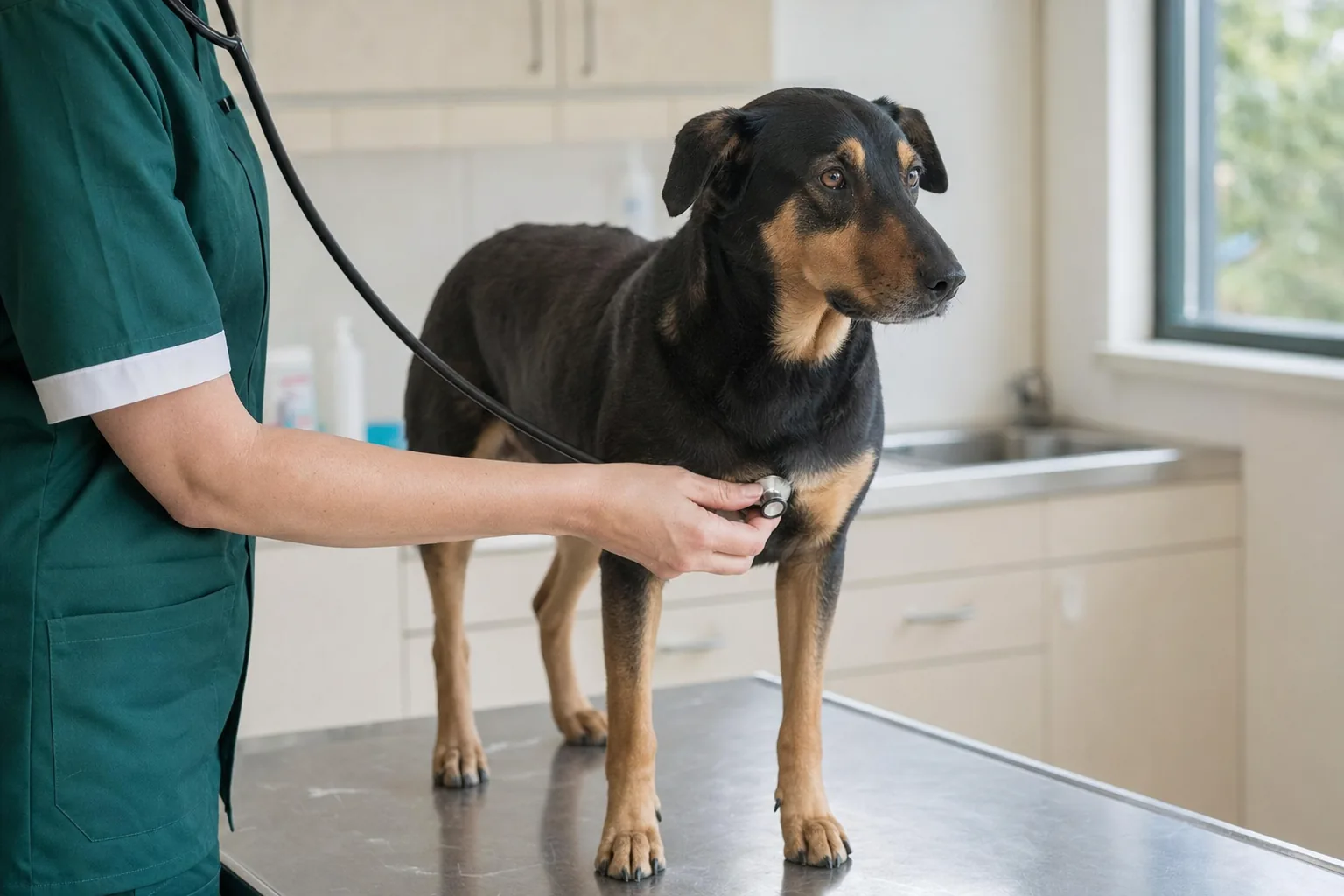
- The tear test. A folded paper strip held under the lower lid for one minute. How far it wets shows whether the eye makes enough tears. This is how dry eye is told apart from conjunctivitis, and it is done before any drops go in.
- The stain. An orange drop that turns green wherever the cornea is scratched or ulcerated, seen under a blue light. An ulcer you cannot see with the naked eye shows up at once. It does not hurt and takes a minute.
- Eye pressure. After a numbing drop, a small device touches the cornea a few times. A high reading means glaucoma; a low one can mean inflammation inside the eye.
- Looking inside with an ophthalmoscope, sometimes after a drop that widens the pupil: lens, the back of the eye, the optic nerve. The vet will also turn the third eyelid over to look for a grass seed. Sometimes a sample of cells is taken from the conjunctiva.
- Referral to a veterinary ophthalmologist for ulcers that do not heal within a few days, for glaucoma, for cataract surgery and for eyelids that need surgical correction.
- The plan. Drops or ointment chosen on the test results, on an exact schedule. A protective cone so he cannot rub; ask for one even if it feels excessive, because two minutes of rubbing makes an ulcer deeper. A recheck after a few days for ulcers, which can get worse quickly. Lifelong treatment for dry eye. Surgery for cherry eye (the gland is put back, not removed, or the eye is left without tears), for rolled-in lids and for cataracts.
What not to do at home
- Leftover drops from an old problem, another dog or your own cupboard do not go in his eye. Some very commonly used eye drops deepen an ulcer within 24 hours. They are right for one problem and dangerous for another, and the stain at the clinic is what tells the two apart.
- No camomile, tea, breast milk, honey, saliva or any other home recipe. None of them treats anything in the table, and they carry bacteria and bits of plant into the eye.
- Do not let him rub. Until you reach the vet, a makeshift collar of cardboard or a loosely tied towel is better than nothing; failing that, your hand on his head. Every rub makes the damage deeper.
- Do not test his sight by waving your hand in front of the eye. The draught makes him blink and it looks as though he can see. Use the cotton wool dropped silently.
- Anything stuck into the eye stays where it is. Cover the eye with damp gauze and go. A loose grass seed under the lid can be rinsed with saline; if it does not come out with the first rinse, the vet removes it.
- Do not trim the hair around his eyes with scissors while he is moving. There is a centimetre between the scissor tip and the cornea.
- Keep his head inside the car. The wind dries the eye and fires insects and grit at it.
- Do not wait for the weekend with a shut eye. That is what emergency clinics are for.
- Do not tell yourself "it's only conjunctivitis". Conjunctivitis that starts with bacteria is rare in dogs. A red eye is usually the sign of another problem, and some of those do not forgive a delay.
Everyday care for a healthy eye
Wipe away the small, dry morning crust with cotton wool dampened in clean water, from the corner by the nose outwards, a fresh piece for each eye. Long hair in front of the eyes gets tied up or trimmed by someone with a steady hand. After a walk through long grass or fields, gently pull down the lower lids and look in both eyes. On windy, dusty days, check his eyes in the evening. And dogs with prominent eyes have no business playing rough with the cat.
Trailing dogs work with their noses down in grass, hedges and fields, so their eyes meet everything that grows there. That is why, for us, a look in the eyes after training is as routine as shaking out the harness. If you do not have a regular vet yet, our page on related services will help you choose a practice. Ask whether they do a tear test and the eye stain; any decent practice will.
The information on this page is educational and does not replace an examination. For full details and a diagnosis, consult your dog's own veterinarian.