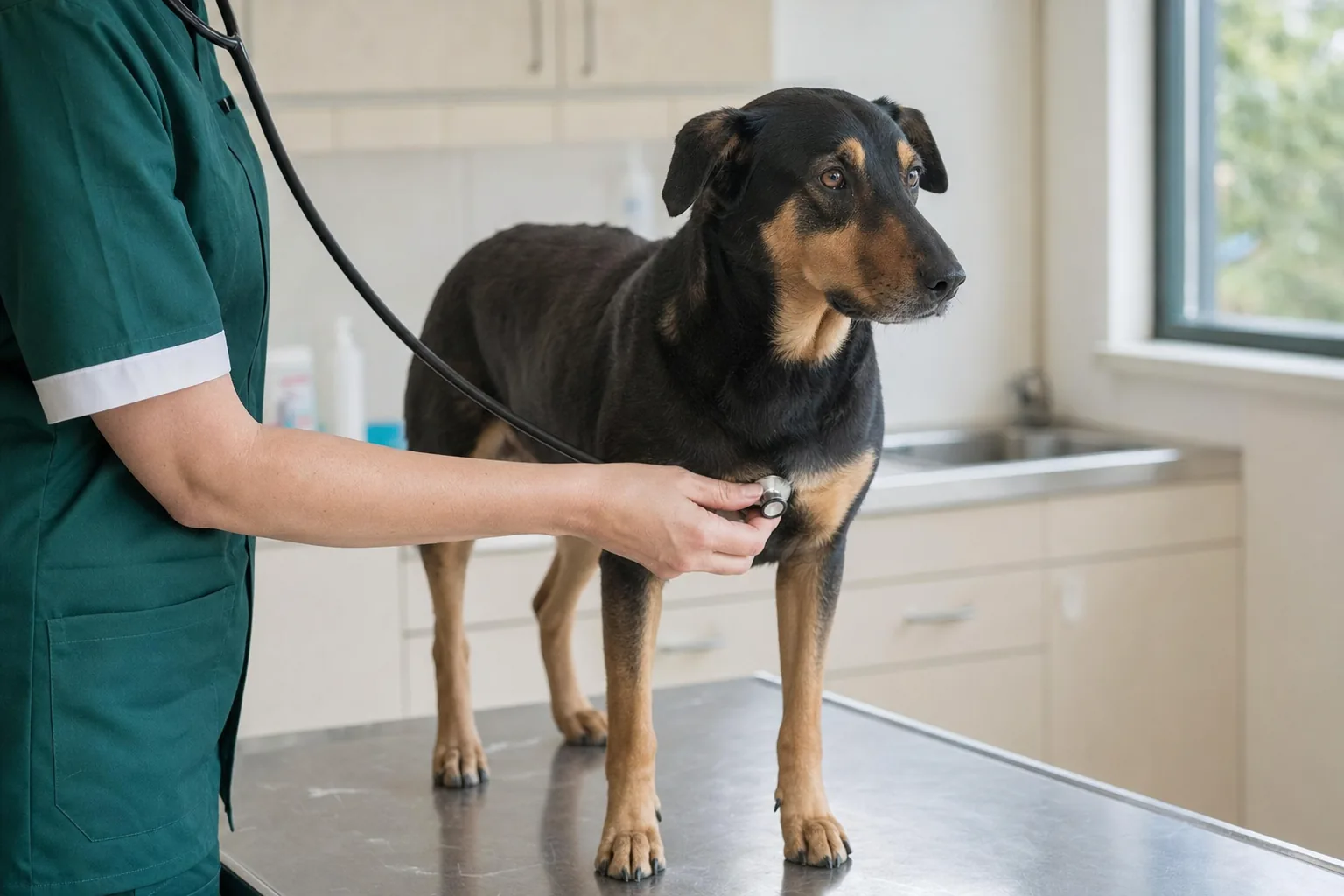
You put on last year's harness and it hangs off him. Your dog, who has always been the right weight, has dropped three kilos since the start of summer and you have only just noticed. Or everyone at the park keeps telling you he is thin: you can see his ribs when he stretches and his hips stick out, even though he gets the amount on the bag and a bit more. Or you have taken on a rescue who is skin and bone and you want to get him back on his feet as quickly as possible. Below is how to tell whether he really is too thin, why a dog who eats can still lose weight, what the vet checks and how to help him put weight on without upsetting his stomach.
Warning signs: when to call today
A dog who has always been lean and is otherwise full of beans is not an emergency. New weight loss, especially fast weight loss, is. Ring the vet the same day or the next if:
- he has visibly lost weight over a few weeks without any change in his food or exercise;
- he is eating a lot, even more than usual, and still losing weight;
- he is drinking and weeing much more than before;
- for several days he has had vomiting, diarrhoea or bulky, pale, greasy poo;
- he has stopped eating, or starts to eat and then walks away from the bowl, as if he wants to but cannot;
- he is flat, has pale gums, is coughing or is breathing hard;
- his breath smells bad, he drools a lot and chews on one side;
- he is a very thin rescue dog who, after being given plenty of food, goes weak, starts trembling or gets swollen legs.
That last one needs spelling out. A dog who has been starved for a long time must not be given free access to food from day one. His body is no longer used to food, and a big meal can throw the salts in his blood badly out of balance, with serious consequences. How much he gets and how fast portions go up is the vet's call.
What you can watch and note at home
The scales. Once a week, same scales, same time of day. A small dog fits on kitchen scales, or you weigh yourself holding him and then without him. If he has lost more than 10% of his weight without being on a diet, book an appointment.
Body condition score. Vets use a scale from 1 to 9, where 4–5 is ideal. At home you check it with your hands:
| What you feel and see |
What it means |
| Ribs, spine and pelvic bones visible from a distance, muscle wasted away |
Very thin (1–2 out of 9): see the vet |
| Ribs easy to see, the tops of the vertebrae felt straight away, a very deep waist |
Thin (3 out of 9) |
| Ribs easy to feel under a thin layer of fat but not visible; a waist seen from above, a tucked-up tummy from the side |
Ideal (4–5 out of 9) |
| Ribs hard to feel, waist barely visible |
Overweight |
Take photos from above and from the side once a month, in the same position. Your eye gets used to a dog you see every day. Photos stay the same.
Exactly what he eats. The grams of food, weighed (a cup is not a measurement), the treats, everything the rest of the household slips him. A lot of dogs who are "thin even though they eat loads" are in fact eating less than their owner thinks, or eating a food that does not cover the energy they burn.
His poo. How much, what colour, what consistency. Very bulky, pale, greasy poo that leaves a smear, in a dog who wolfs his food, can mean the food is not being digested. German Shepherds have a known tendency to a disease of the pancreas that looks exactly like that.
The rest of his day. How much he drinks, how much he wees, how much exercise he gets, and whether anything has changed: another dog in the house eating from his bowl, more sport, a winter spent outdoors.
Breed. Greyhounds, whippets and some hunting and working dogs are lean by build. You can see their last ribs and hip bones, and for them that is normal. If you are not sure where yours fits, your vet will tell you.
What the vet will check
- The history. How long he has been losing weight and what he eats, in grams, from your notes. How much exercise he gets, what has changed, when he was last wormed.
- The clinical exam. His weight and how much muscle he carries over his back and thighs, his mouth and teeth (a painful tooth can stop a dog eating), lymph nodes, heart, abdomen. His coat tells a story too when it is harsh, dull or full of dandruff.
- A poo sample. Intestinal worms and Giardia are among the commonest causes in young dogs.
- Blood and urine tests. Kidneys, liver, blood sugar (diabetes causes weight loss with a big appetite and thirst), proteins, glands, anaemia.
- Digestion tests. If the vet suspects the pancreas is not producing enough enzymes or the gut is not absorbing, there are specific blood tests for that.
- Tests for diseases spread by insects and ticks, if he comes from southern Europe or another area where they are a risk.
- Imaging, if needed: X-rays, ultrasound.
- A feeding plan. Once illness has been ruled out, or alongside treatment, the vet works out how much energy he needs a day and helps you choose the food and the amount.
What not to do at home
- Do not double his portion overnight. Increase it by about 10% a week and keep an eye on his poo. A sudden change brings on diarrhoea and he loses what he gained.
- Do not feed him fat from the table: pork rind, bacon, leftover roast, lard. A lot of fat all at once can set off inflammation of the pancreas, which is painful and sometimes serious.
- Do not let a long-starved dog eat as much as he wants. Small, frequent meals, following the vet's plan.
- Do not use "weight gain supplements", bodybuilding products, recipes heavy on raw eggs or anything you read on a forum.
- Do not blame a "fast metabolism" before tests have been done. It is the last explanation, the one left once everything else has been ruled out.
- Do not worm him "one more time" on a hunch. A poo test will tell you whether he needs it.
- Do not change his food three times in a month. Every change needs a week to switch over, otherwise you can no longer tell what worked.
Helping him gain weight, once the vet says he is healthy
- More meals, smaller ones. Three or four a day instead of one or two, so his stomach copes easily.
- A more energy-dense food in the same amount. Foods for active dogs or puppies usually have more calories per gram. Switch over gradually, across five to seven days.
- Peace at the bowl. If you have several dogs, feed them apart, in different rooms or in open crates. A dog eating with one eye on the other dog eats less and bolts it.
- Food slightly warmed, or with a splash of warm water. It smells stronger and wins over fussy eaters.
- The right amount of exercise. Muscle only grows if it is used, so normal walks and play carry on. Long training sessions wait a few weeks.
- The scales, weekly. A thin dog reaches a good weight over months. A slow gain that keeps going is exactly what you want to see.
A simple rule of thumb for very thin rescue dogs: in the first month you are watching his gut, not his weight. Firm poo, a bright dog and a good appetite mean you are on the right track, even if the scales have barely moved. The kilos come once his gut has got used to food again.
Older dogs are a different story. After ten or twelve years, many lose muscle over the back and thighs while the scales show the same number. More food will not fix that. Good-quality protein and gentle daily exercise help, and a vet check is worth having, because sore joints also make them move less.
Sporting and working dogs are a case of their own. A dog who does mantrailing three times a week, runs in the mountains or pulls a sled in winter may need far more food than the bag suggests. If he loses weight during the training season, check first that he is getting enough. If two or three weeks of bigger portions still put nothing on, see your vet.
The information on this page is educational and does not replace an examination. For full details and a diagnosis, consult your dog's own veterinarian.