You have brought home a nine-week-old puppy, and the breeder gave you a bag of kibble and a sheet of paper that says "three times a day". That was it. Or you have adopted an adult dog and you are standing in front of the pet shop shelves, dozens of sacks and tins, with no idea where to start. Or your seven-year-old has quietly got rounder and you are wondering whether you are giving him too much.
Feeding looks like the simplest part of life with a dog, which is exactly why it is where the most unnoticed mistakes happen. Below: what a complete food is, how many meals a dog needs at each age, how to choose between dry and wet, and how to change food without upsetting his stomach.
How to feed your dog, step by step
1. Choose a "complete" food
Every pack of dog food says either "complete" or "complementary". That difference matters more than the brand. A complete food gives the dog everything he needs to stay healthy on it alone, for the life stage printed on the bag (growth, adult, all life stages). A complementary one (many "gourmet" tins, treats, some pouches) is not enough on its own, however good the ingredient list sounds.
Check what age and size it is made for, too. Puppies need more calcium and more energy. Large-breed puppies need a food made for their growth, with calcium kept within tight limits, because their bones grow a lot and fast.
The advert tells you little. The ingredient list tells you something, though less than you might think. The dog tells you most, after a few weeks: firm stools, a shiny coat, energy, a steady weight.
2. How much to give
Start from the table on the pack, read for the weight your dog ought to be. If he is overweight, his current weight is the wrong place to start. The table is only a starting point. Two dogs of the same weight can need quite different amounts, depending on how active they are, how old, whether they are neutered and how cold it is outside.
For the first few weeks at least, weigh the portion on kitchen scales. A "full" cup can hold a third more or a third less than you think.
Then look at the dog, not the table, and check three things with your hands and eyes:
- you can feel his ribs easily under a thin covering without pressing, but you cannot see them;
- looking down from above, he has a waist: the body narrows behind the ribs;
- seen from the side, his belly tucks up towards the back legs.
If you cannot feel his ribs, cut the portion by about a tenth and check again in two or three weeks. If you can see the ribs and the hip bones show as well, feed more. Weigh him once a month, at the same time of day.
Treats count too. Vets use a simple rule: titbits, chews and anything else he gets outside meals should stay under a tenth of what he eats in a day. At mantrailing training the dogs get a lot of treats, so on training days we cut their evening meal.
3. How many meals a day
| Age |
Meals a day |
| 8 to 12 weeks |
4 |
| 3 to 6 months |
3 |
| 6 to 12 months |
2 to 3, then 2 |
| Adult |
2 |
| Senior |
2, sometimes 3 smaller ones if he does better that way |
For an adult, two meals a day is what most vets recommend. He is less hungry, his stomach is not empty for hours on end and he waits more calmly for food. For big, deep-chested breeds (Great Danes, German Shepherds, setters), give two or three smaller meals instead of one big one, and no running or wild play in the hour after eating. That lowers the risk of bloat and a twisted stomach, a serious emergency.
Fixed times help with house training as well: what goes in at set times comes out at set times. A bowl left full all day suits very few dogs, and you lose track of how much he has eaten.
4. Dry, wet or both
If they are complete, both are fine. The differences are practical.
Dry food is convenient, keeps well once the bag is open and works perfectly in food toys and on snuffle mats. It is dense, though: a handful of kibble packs a lot of calories.
Wet food is about three quarters water. He drinks less from his bowl but takes in more water overall. It is tastier for fussy eaters and for older dogs with few teeth left. Once opened it goes off quickly: keep it in the fridge and use it within a day or two.
You can mix them, on one condition: if you add a tin on top of the kibble, cut the kibble to match. Most of the extra weight we see comes from "a bit of wet to make it nicer" added on top of a full portion.
Home-cooked or raw food can be complete, but only from a recipe drawn up by a veterinary nutrition specialist. Recipes from the internet usually come out unbalanced, especially on calcium, and in a growing puppy that shows in the bones.
5. How to change food
Gradually, over 7 to 10 days, mixing in the same bowl:
| Days |
Old food |
New food |
| 1 to 3 |
three quarters |
a quarter |
| 4 to 6 |
half |
half |
| 7 to 9 |
a quarter |
three quarters |
| 10 |
none |
all |
If his stools go soft, stay on the current step for two or three days. A puppy who has just come home keeps the breeder's food for at least two weeks. Moving house is change enough for him.
6. Water, and what he never eats
Fresh water at all times, in a bowl you wash every day. And never from your plate: grapes and raisins, onion and garlic, chocolate, "sugar-free" sweetened products, macadamia nuts, cooked bones, raw yeast dough, alcohol, coffee. The full list, and what to do if he has eaten something on it, is in our guide to dogs who have swallowed something.
Feeding at every age
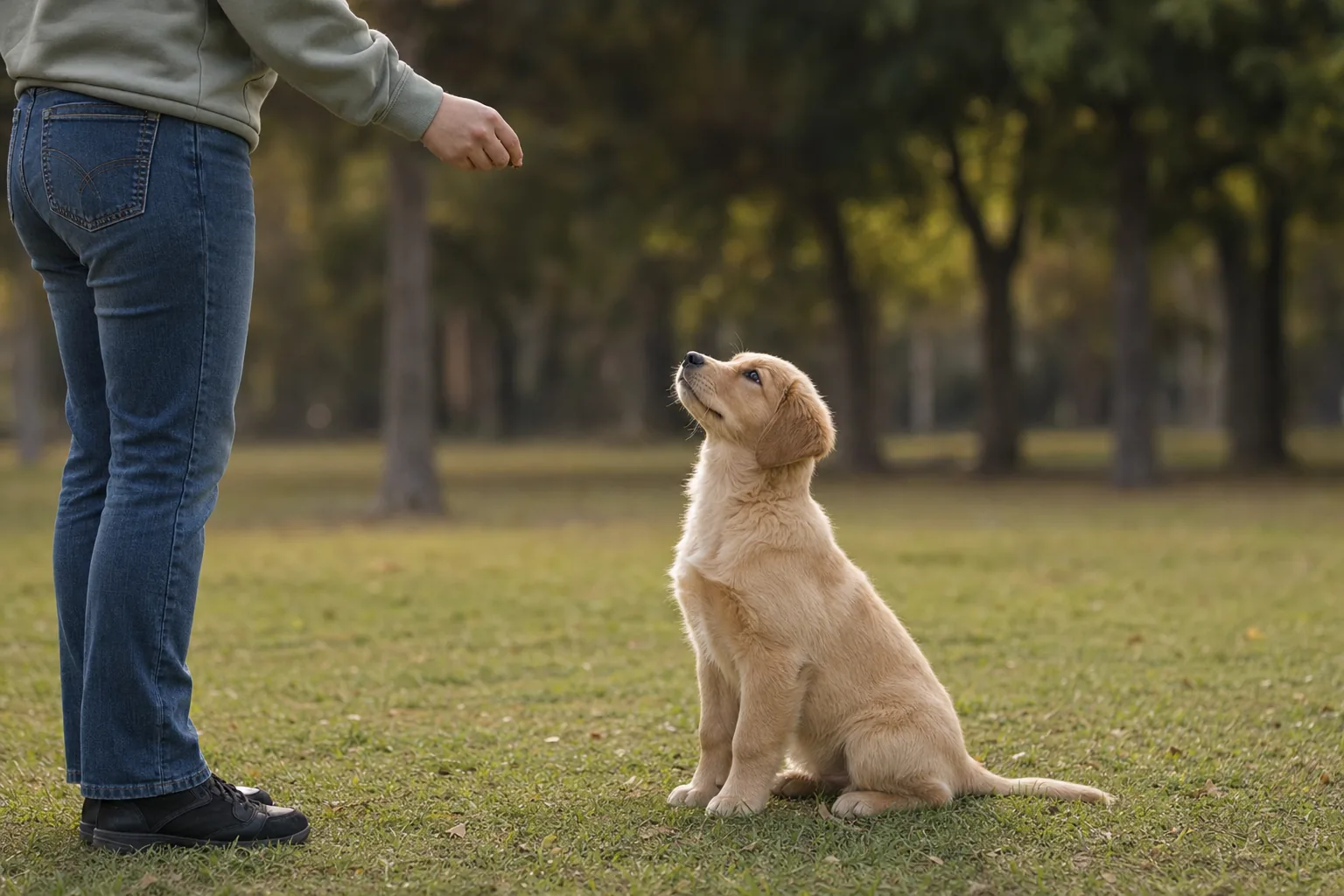
A puppy, from 8 weeks to 6 months, grows fast and has a small stomach, hence the frequent meals. Feed a growth food suited to his adult size. Use part of the ration for training: every day, half his kibble comes from your hand, for things done well. A puppy who eats from your hand learns to look at you.
In adolescence, between 6 and 18 months, small and medium dogs move onto adult food at around a year. Large and giant breeds switch later, at 12 to 18 months or even 24, after you have talked to your vet. His appetite may drop or shoot up suddenly; you adjust by his ribs, not by the empty bowl.
An adult gets two weighed meals, and you make small corrections. After neutering, many dogs need fewer calories. If the portion stays the same, the weight goes on within a few months.
A senior, from around 7 or 8 (earlier in big breeds), can go either way. Some put on weight because they move less, others lose it because they chew with difficulty or digest less well. A senior food is a good option, not a must. If an old dog's appetite changes suddenly, see the vet before you change brands.
Common feeding mistakes
- A cup instead of scales. Small daily differences add up to kilos over a year.
- Reading the table by the current weight of an overweight dog. That keeps him fat for life.
- Treats nobody counts. Training titbits, crusts from the children, the evening chew: a third meal that nobody sees.
- Changing food often "so he doesn't get bored". Dogs do not tire of food the way we do, and their stomachs cope better with routine. Change when you have a reason, and do it gradually.
- The fussy dog who gets something better. He left his kibble and got chicken; next time he waits for the chicken. With a healthy dog, the bowl goes down for 15 minutes, then comes up until the next meal.
- Food from the family table. Besides the calories, it brings begging and sometimes toxic ingredients.
- The large-breed puppy fed "to grow big". In big breeds, growing too fast is linked to joint problems. A puppy should be lean, not roly-poly.
How long before you know a food suits him
Judge a new food after six to eight weeks. The first few days only tell you whether his stomach tolerates it; the coat, for example, takes a month or two to show the change.
Signs it suits him, which you can follow at home:
- firm stools, the same colour, a steady number a day, easy to pick up;
- ribs you can feel but not see, and a visible waist;
- a shiny coat with no dandruff and no new itching;
- steady energy and appetite at fixed times;
- a stable weight at the monthly weigh-in (in a puppy, steady growth).
If after two months his stools are still soft, he is scratching more, or he has gained or lost weight for no reason, write down what you have seen and take your notes to the vet before you change the bag again.
When to get professional help
- He has visibly lost or gained weight though neither his food nor his exercise has changed.
- He is vomiting or has diarrhoea or soft stools for several days after a change of food.
- He refuses food for more than a day, especially if he is a puppy or an older dog.
- He scratches, has red ears or skin problems that keep coming back. It could be a food allergy, which can only be sorted out with an elimination diet done together with your vet.
- You want to switch to home-cooked or raw food and need a complete recipe.
- You have a large or giant-breed puppy and are not sure how to feed him through the first year.
For nutrition questions, your own vet is the person to ask, and for recipes, a vet who specialises in nutrition. For begging, gulping food or growling over the bowl, get in touch with us. That is about training, and we work on it in our foundation classes.