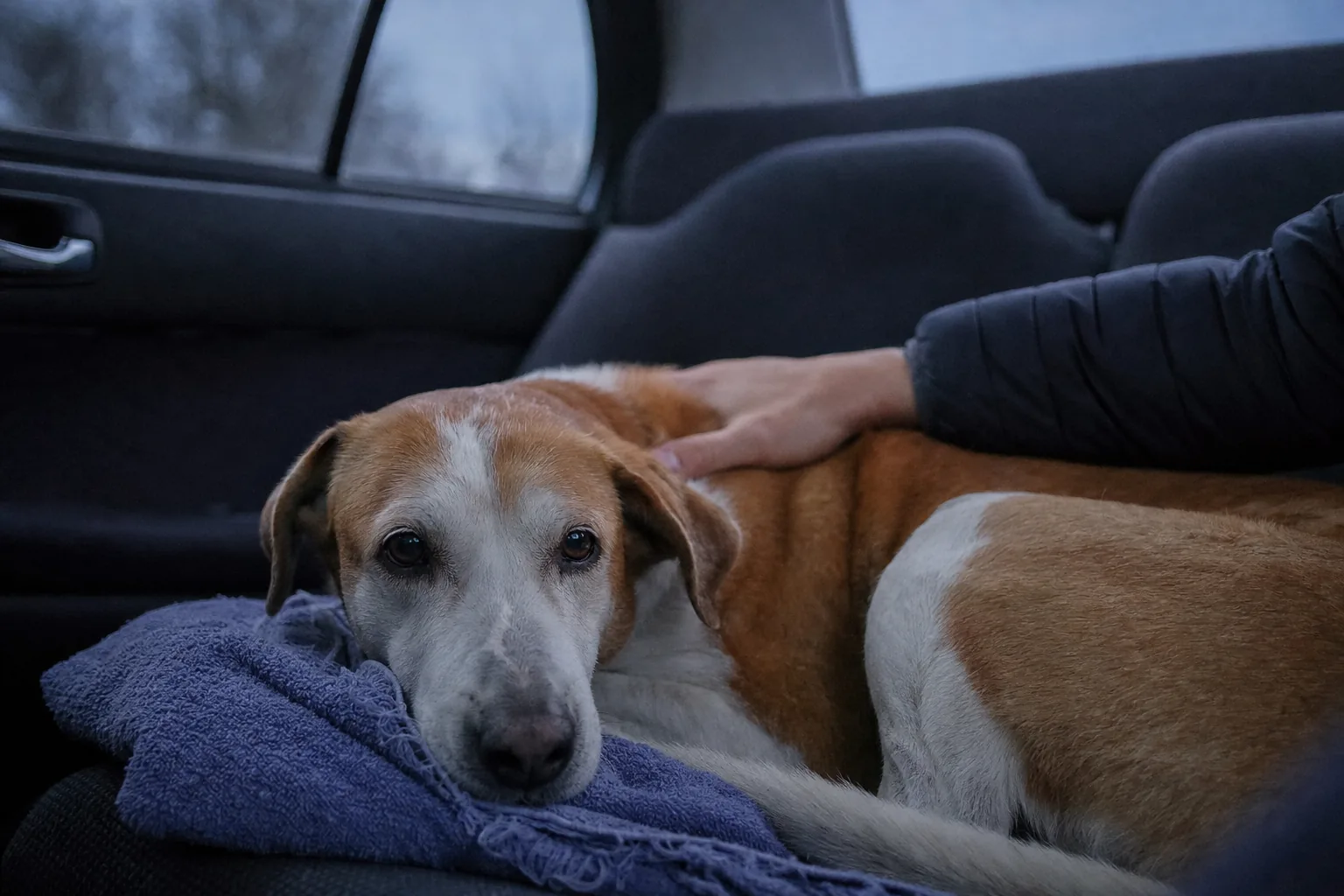
Emergency. Laboured or noisy breathing, vomiting, sudden diarrhoea, pale gums, weakness or collapse after a sting mean a severe allergic reaction. Go to the nearest clinic now, with someone ringing ahead from the car.
Noticed something different about your dog? Go straight to their vet.
Call your own vet or the nearest clinic with an emergency service now, and set off. Do not ask a group what to do: every answer you wait for there is time lost for the dog.
- The same sign, dozens of causes. A dog that vomits may have eaten grass or may have an object stuck in the gut. From two lines you typed, nobody can tell which. The vet feels the abdomen, takes the temperature, runs tests.
- Nobody on the internet sees your dog. They see a photo and a story. A diagnosis comes from an examination and investigations, not from a resemblance to someone else's dog.
- In groups you hear from the people whose dog "got better on its own". Those for whom it ended badly rarely post again. What you read there is a selection, not a statistic.
- Doses are calculated by weight and species. Human medicines that look harmless, paracetamol or ibuprofen, are toxic to dogs. "I gave mine half a tablet" is the most dangerous advice you can get.
- Hours matter. With a twisted stomach, a poisoning or a urinary blockage, the time spent asking online is exactly the time that decides the outcome.
- The vet is accountable for what they say. They have your dog's record, history, vaccinations, past treatments. An anonymous account has none of that and answers for nothing.
Use this page to know what to observe, what to note and what to ask at the appointment, not to treat at home. If you still have doubts after a consultation, ask another vet or a specialist (dermatologist, internist) for a second opinion, not a group. And if you do not have a regular vet yet, find one now, while your dog is healthy: how to choose a veterinary clinic.
It is the afternoon and you are out in the garden. Your dog has been hunting something in the grass, jumps, shakes his head, and ten minutes later one side of his muzzle is puffed up, one eye half closed, and he is rubbing his face on the rug. Or he has trodden on a bee and is limping and licking his paw. Or he has snapped a wasp out of the air, as plenty of dogs do in summer, and now he is drooling.
Dogs get stung by bees and wasps a lot, mostly on the muzzle, face and paws, and most of the time the swelling goes down on its own within a day or two. A few situations turn serious within minutes, though. You will spot them if you know what to look for. Below: what to do right now, which signs mean going straight to the vet and how to prevent stings.
What to do in the next 10 minutes
- Check his breathing and gums before anything else. Is he breathing calmly? Are his gums pink? Is he steady on his feet? If so, you have time. If his breathing is laboured or noisy, his gums are pale or white, he is vomiting, has sudden diarrhoea, is staggering or collapses, skip the rest of this list: go to the nearest clinic now, with someone ringing ahead from the car.
- Look for the sting. A bee leaves its sting in the skin with a small venom sac attached. Wasps and hornets leave nothing behind and can sting more than once. A bee sting looks like a tiny black splinter, 2 to 3 mm long, in the middle of a red dot. On the muzzle it is easy to see. In a thick coat, harder.
- Get it out quickly with whatever is to hand. Scrape sideways across the skin with a fingernail, the edge of a bank card or a blunt knife until it comes out. Speed matters more than method, because the sac keeps pumping venom for about a minute. Do not waste time hunting for tweezers.
- Cool the area: a cold compress or ice wrapped in a tea towel, ten minutes at a time, with breaks. Never put ice straight on the skin. If it is a paw and he will let you, hold it in cold water for a few minutes.
- Check his mouth. If he bit the insect, open his mouth carefully and look at his tongue, the roof of his mouth and the back of his throat. A sting in the throat can swell enough to narrow his airway. That means the vet, even if he is breathing fine right now.
- Count the stings, roughly. One or two are usually not serious. If he trod on a nest or was caught by a swarm and has dozens, go to the vet even if he seems fine. A large dose of venom can affect the kidneys and the blood, sometimes only after a day or two.
- Ring the vet, even for an ordinary swollen muzzle, so they know and can tell you what to watch for. They can decide over the phone whether you need to come in or whether he can have something at home. Do not give him human hay fever or allergy tablets on your own initiative. Some combination products contain ingredients that are toxic to dogs, and the dose depends on his weight.
- Stay with him for half an hour. Severe allergic reactions usually appear within the first 30 minutes. Keep him in the shade, quiet, and watch him, not your phone.
What is normal and what is not
| What you see |
What it usually means |
What you do |
| Swelling at the sting site, pain, licking or rubbing the spot |
Ordinary local reaction |
Cool it and keep watching; it goes down in 12 to 48 hours |
| Swollen muzzle and eyes, a "bulldog face" |
Allergic reaction in the face |
Ring the vet now; usually you go in |
| Hives or small lumps all over, fur standing up in patches |
Urticaria, a body-wide allergic reaction |
Ring now and watch his breathing |
| Vomiting, diarrhoea, weakness, pale gums, collapse |
Severe allergic reaction (anaphylaxis) |
Go to the clinic now |
| Laboured, noisy breathing after a sting in the mouth |
Throat swelling |
Go now |
| Dozens of stings |
Venom poisoning |
Go today, even if he looks fine |
| Two small puncture marks, swelling that grows fast, bruising, in long grass or among rocks |
Possibly an adder bite |
Go now; that is a different emergency |
What to tell the vet and what they will do
On the phone
- Where he was stung (muzzle, mouth, paw, body) and how many times, as far as you know.
- What stung him, if you know: a bee (the sting was left behind), a wasp or a hornet.
- How long ago, as precisely as you can.
- What you see now: swelling only at the site or across the whole face, hives, vomiting, diarrhoea, weakness. How he is breathing, what colour his gums are.
- How much he weighs.
- Whether he has ever reacted to a sting before. A second reaction can be stronger than the first.
- Anything you have already given him.
At the practice
- Breathing and circulation first. The vet checks pulse, gum colour, blood pressure and how freely he is breathing. In a collapsed dog or one struggling to breathe, emergency treatment starts before any questions.
- Treatment for the allergic reaction, chosen by the vet according to how severe it is. It may be an injection and a few hours of observation, or in serious cases oxygen, a drip and admission.
- Mouth and throat, if the sting was in the mouth. If the swelling threatens his breathing, the vet has ways to keep his airway open.
- Blood and urine tests for multiple stings. A large dose of venom destroys red blood cells and can damage the kidneys and muscles. The tests are sometimes repeated the next day, because the problems can show up late.
- Observation. Many vets keep a dog in for a few hours after a moderate reaction, because some reactions come back after seeming to settle.
- Next time. If he has had a severe reaction, ask what to do if it happens again and whether it makes sense to keep an emergency treatment prescribed for him at home, with written instructions.
How to prevent stings
You cannot keep a dog away from every insect, but you can cut the risk a lot. Most of the stings we come across in summer come from the same few situations: dogs who hunt insects, windfall fruit and the bowl left outside.
Insect hunting
Lots of dogs, young ones especially, leap at anything that buzzes. Teach him a solid "leave it", practised at home with treats, and call him to you with real delight when he sets off after an insect. A dog who comes to you for a tasty treat instead of snapping at the wasp has made a good choice. Praise him for it every time.
Windfalls
In autumn, fallen plums, pears and grapes are crawling with wasps. A dog who eats fruit off the ground (and plenty do) swallows the wasp along with the plum. Clear them up or keep him away from the trees while the fruit is dropping.
The outdoor bowl
Water and food left out in the garden draw wasps, which end up falling into the bowl. Keep the bowl in the shade, change the water often and do not leave food outside.
Nests
In spring, check the eaves, the shed, fences, hollow trees, roller-shutter boxes and loose soil in the corners of the garden, because some wasps nest underground. A nest near where your dog plays should be moved, with help from someone who knows how.
Walks
In meadows full of clover and flowers, in the warm part of the day, bees fly right at the height of a dog's nose. That is no reason to avoid meadows. Just keep an eye out.
A dog who has had a severe reaction before
For him you want a written plan from the vet, a clear idea of what is in your kit at home and in the car, and the out-of-hours clinic's number saved in your phone.
The summer kit
An old bank card for scraping out stings, compresses, a gel pack kept in the freezer, a towel, a muzzle (a dog in pain may defend himself), your vet's number and an out-of-hours clinic's, and your dog's weight noted in your phone. If your vet has prescribed something for your dog, keep it in the kit with its instructions.
Most stings end with an afternoon of puffy muzzle and a photo you show your friends. The kit is for the other ones.
Frequently asked questions
What dog owners search for most often on the internet about this problem, with the short answer. The answers are a guide only: the decision belongs to your dog's own vet, after an examination.
My dog's muzzle is swollen. Could it be a sting?
Yes, in summer it is the most common cause. The muzzle or an eye swells within minutes, sometimes on one side only, and the dog rubs his face on the carpet or paws at it. It could also be an adder bite, a reaction to a food or a medicine, or a tooth abscess. Ring your vet today, even if he is breathing normally.
How do I get a bee sting out of my dog?
Scrape sideways across the skin with a fingernail, the edge of a bank card or a blunt blade until it comes out. Speed matters: the venom sac attached to the sting keeps pumping for about a minute. Do not waste time looking for tweezers. Wasps do not leave their sting behind, so if you find nothing it may have been a wasp.
Can I give my dog a human antihistamine?
Not on your own initiative. Some combination allergy tablets contain ingredients that are toxic to dogs, and the dose depends on his weight. Ring your vet: they can tell you over the phone whether you can give anything at home, and what, or whether you need to come in. A severe reaction needs clinic treatment anyway; a tablet is not enough.
How long does the swelling last after a sting?
An ordinary local reaction goes down within 12 to 48 hours. Cold compresses, ten minutes at a time, help in the first few hours. If the swelling grows after the first hours, spreads over the whole face, lumps appear on his body or he becomes lethargic, ring the vet. Severe reactions usually appear within the first 30 minutes.
What do I do if my dog has eaten a wasp?
Look in his mouth, at his tongue and the back of his throat, and watch his breathing. A sting in the throat can swell and narrow his airway, so ring the vet even if he seems fine right now. If he is breathing hard or noisily, drooling heavily and getting distressed, go to the clinic straight away.
The information on this page is educational and does not replace an examination. For full details and a diagnosis, consult your dog's own veterinarian.