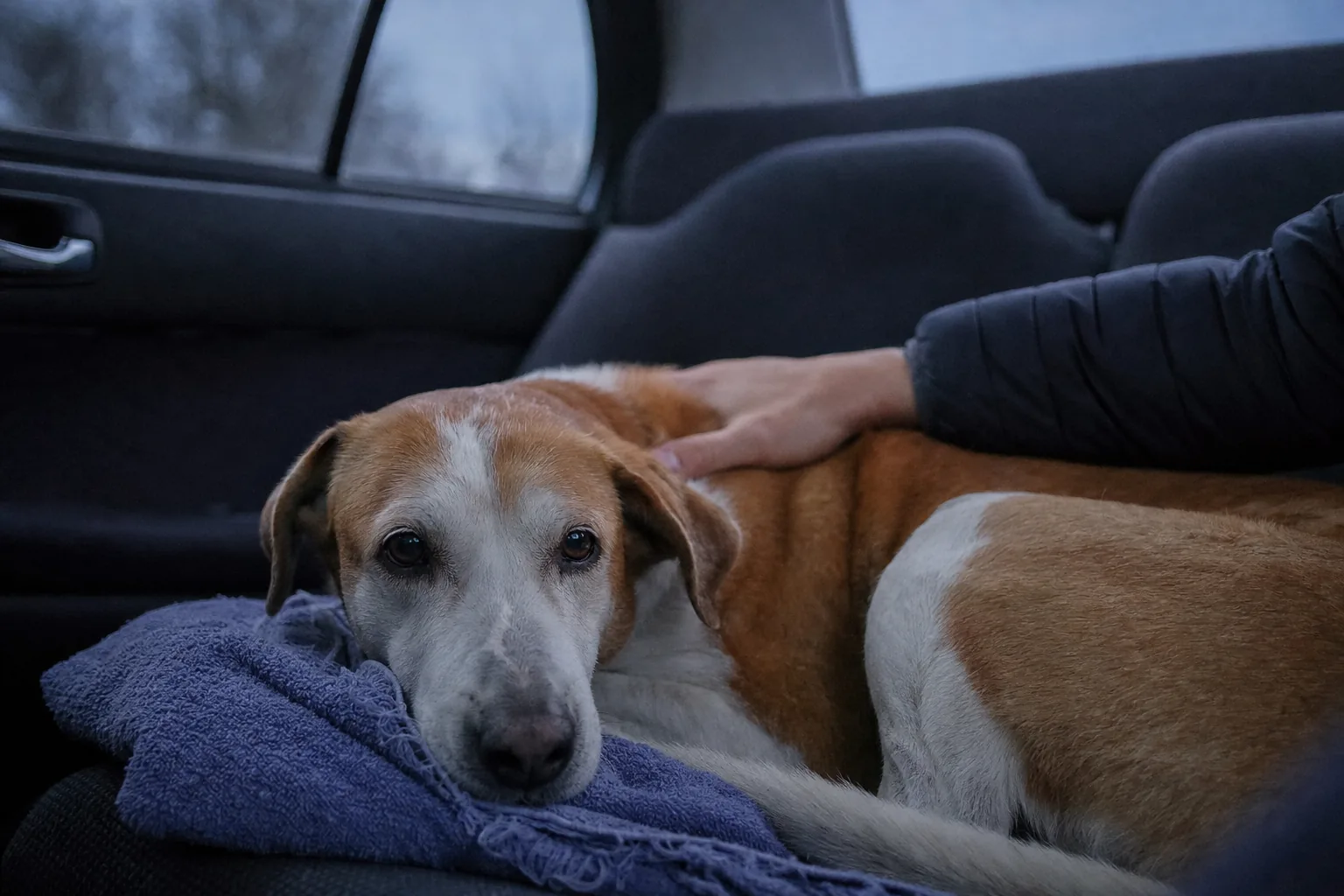
Emergency. Get him somewhere safe, check he is breathing and what colour his gums are, film if you can and note how long it lasted. Keep your hand out of his mouth, give no food or water. Ring your own vet now; go straight away if the gums are white or grey, he is breathing hard, his belly is swollen or he does not come round within minutes.
Noticed something different about your dog? Go straight to their vet.
Call your own vet or the nearest clinic with an emergency service now, and set off. Do not ask a group what to do: every answer you wait for there is time lost for the dog.
- The same sign, dozens of causes. A dog that vomits may have eaten grass or may have an object stuck in the gut. From two lines you typed, nobody can tell which. The vet feels the abdomen, takes the temperature, runs tests.
- Nobody on the internet sees your dog. They see a photo and a story. A diagnosis comes from an examination and investigations, not from a resemblance to someone else's dog.
- In groups you hear from the people whose dog "got better on its own". Those for whom it ended badly rarely post again. What you read there is a selection, not a statistic.
- Doses are calculated by weight and species. Human medicines that look harmless, paracetamol or ibuprofen, are toxic to dogs. "I gave mine half a tablet" is the most dangerous advice you can get.
- Hours matter. With a twisted stomach, a poisoning or a urinary blockage, the time spent asking online is exactly the time that decides the outcome.
- The vet is accountable for what they say. They have your dog's record, history, vaccinations, past treatments. An anonymous account has none of that and answers for nothing.
Use this page to know what to observe, what to note and what to ask at the appointment, not to treat at home. If you still have doubts after a consultation, ask another vet or a specialist (dermatologist, internist) for a second opinion, not a group. And if you do not have a regular vet yet, find one now, while your dog is healthy: how to choose a veterinary clinic.
You threw the ball for the fifth time. Your dog set off after it, took three strides and went down on his side, limp as a rag. For a few seconds he did not respond to his name. Then he lifted his head, got up unsteadily and a minute later was his usual self again. Maybe it happened at home instead, in the middle of a coughing fit, or as he leapt about at the door to greet you. Your heart stopped, and now that he looks fine you are wondering whether a vet visit is really needed. It is. A dog who collapses and loses consciousness, even for a few seconds, nearly always has a cause that needs finding, and some of those causes are in the heart. Here is what to do in the first few minutes, what to tell your vet and what happens next.
What to do now, in the first 10 minutes
- Stop and go to him calmly. If you are on the street, move him carefully somewhere away from cars and other dogs. Lift him with his whole body supported, not by the neck or the legs.
- Check he is breathing. Is his chest rising? Hold your palm in front of his nostrils for a few seconds. If he is not breathing and you cannot feel a heartbeat, go straight to step 8.
- Look at his gums. Lift the lip. Pink means blood is getting round properly. White, grey or bluish means it is serious and you leave for the vet now. Press a finger on the gum: in a healthy dog the white mark goes pink again in under two seconds.
- Start filming on your phone if someone is with you or you can manage the phone one-handed. Thirty seconds of video shows the vet exactly what happened, far better than any frightened person can describe it.
- Note the time and how long it lasted, as precisely as you can. Seconds feel like minutes at a moment like this, so look at a clock.
- Keep your hand out of his mouth. A dog who has passed out does not "swallow his tongue", and one who is thrashing can bite without meaning to. No water or food until he is fully awake and you have spoken to the vet.
- Ring your own vet, or an out-of-hours clinic if they do not answer. Say he collapsed, how long it lasted and how he looks now. Go straight away if he does not come round within a few minutes, if his gums stay pale, if he is breathing hard, if his belly is swollen and tight, if it happens again, or if it is a hot day and he feels hot.
- If he is not breathing and has no pulse, and the clinic is far away, you can start CPR on the way. Lay him on his side. Press rhythmically with both hands on the widest part of the chest, 100–120 times a minute, about a third of the chest's depth. After every 30 compressions, hold his mouth shut and blow twice into his nose. Someone else drives meanwhile. The odds are poor; without CPR they are nil.
Faint or seizure?
The vet will ask this first, because the answer decides which tests come next.
| What you see |
Looks like a faint |
Looks like a seizure |
| The body |
Limp, drops |
Rigid, paddling legs, chomping jaw |
| How long |
Seconds, rarely over a minute |
Usually over 30 seconds, sometimes minutes |
| What came before |
Exertion, excitement, coughing, weeing |
Often resting or asleep; sometimes restless beforehand |
| Afterwards |
Comes round quickly, within seconds or minutes |
Confused, bumps into furniture, seems blind, thirsty, for minutes or hours |
| Saliva, urine, faeces |
Sometimes a little urine |
Often lots of saliva, urine, faeces |
| Gums |
Can be pale or grey during the episode |
Usually pink or red |
If you did not manage to see everything, that is normal. It is what the video is for.
What to tell your vet, and what they will do
On the phone and when you arrive
- What he was doing beforehand: running, playing, coughing, weeing or passing faeces, excited, asleep, a very hot day.
- How he went down and how long for: limp or rigid, eyes open or closed, paddling or not, any urine.
- How he came round: straight away or after a few minutes, confused or not.
- Gum colour during the episode and now.
- Whether it has happened before and when. Brief moments of "weakness" or "wobbliness" you let pass at the time count too.
- Anything else in recent weeks: tiring quickly on walks, coughing at night, breathing fast in his sleep, a bigger belly, weight loss.
- Age, breed, illnesses and treatment. Whether he has eaten in the last few hours (this matters a lot in very small puppies), whether he could have swallowed something, whether he was stung.
What the vet will do
- The basics: pulse, heart listened to with a stethoscope, gums, breathing, temperature, blood pressure, belly felt.
- Electrocardiogram (ECG). It shows the heart's rhythm. Many faints come from a heart that, for a few seconds, beats too slowly, too fast or irregularly. Because episodes come and go, a few minutes of ECG may look normal, so your vet may suggest a monitor worn for 24 hours (a Holter) or longer.
- Heart ultrasound, to look at the muscle and valves and how well it pumps.
- Blood tests. Glucose, because low blood sugar causes collapse, especially in very small puppies and with some tumours. Electrolytes, red cells (anaemia), kidneys and liver, sometimes hormones.
- Abdominal ultrasound if the gums were pale or the belly is enlarged. In an old dog, internal bleeding, for instance from a ruptured tumour on the spleen, can look exactly like a faint. That is a surgical emergency.
- Chest X-rays for the heart and lungs.
- Treatment depends on the cause. Some rhythm problems are managed with medication or a pacemaker, others with changes to daily life. Not every dog who faints needs long-term treatment. Every one of them needs a diagnosis.
What it might be, in short
| Situation |
What is usually behind it |
| Collapse with exertion or excitement in Boxers, Dobermanns, Miniature Schnauzers, cockers |
Heart rhythm problems, diseases of the heart muscle |
| Collapse after a coughing fit or after weeing |
A reflex that suddenly slows the heart (common in small breeds with windpipe or heart problems) |
| Old dog going down with white gums and a big belly |
Internal bleeding, most often from the spleen: emergency |
| Very small puppy, weak, not eaten for hours |
Low blood sugar |
| Young Labrador whose back legs give way after 10–20 minutes of hard play |
A genetic exercise-induced collapse condition, which can be tested for |
| Flat-faced breeds in heat or with exertion |
Not getting enough air |
| Collapse in the heat, dog hot to the touch |
Heatstroke (it has its own page) |
| Sudden collapse after an insect sting |
Severe allergic reaction |
How to head off the next one
Not every faint can be prevented. Many of the causes can be caught early, though, and with an at-risk dog you can avoid the situations that set it off.
- An annual check with the heart listened to, and after 7–8 years every six months or as your vet advises, with blood tests. Many heart conditions can be heard through a stethoscope before they cause a collapse.
- Breeds with a known risk (Boxer, Dobermann, Great Dane, Miniature Schnauzer, cocker, Cavalier King Charles) can have regular cardiology checks from adulthood if your vet recommends it.
- Exercise that suits him. A dog who tires quickly, pants heavily or lags behind on walks may have a problem; it is not necessarily age. Do not push him, and tell your vet.
- Heat. On hot days, walk early in the morning and in the evening, carry water, no running at midday. Even more so for flat-faced breeds.
- Clip the lead to a harness, especially for dogs with a sensitive windpipe or a cough. A collar pressing on the throat can set off the coughing fits that end in a faint.
- Meals for very small puppies. Toy-breed puppies eat four times a day and never skip a meal. A floppy puppy who has not eaten since morning is an emergency.
- If the cause has been found, follow your vet's plan exactly and steer clear of whatever sets it off. A dog who faints with excitement gets calm greetings at the door, with no fuss. A dog with exercise-induced collapse plays in short bursts with plenty of breaks.
- Get ready for next time now. Save the out-of-hours clinic's number in your phone and film any episode. Keep a diary with date, time, what he was doing and how long it lasted. Three episodes written down tell the vet more than any memory.
On a mantrailing session the dog works with his nose and his head. Speed hardly matters and breaks come often. Even so, a team that has once seen a dog go down checks gums and breathing at every break from then on. It is a good habit for anyone with a dog.
Frequently asked questions
What dog owners search for most often on the internet about this problem, with the short answer. The answers are a guide only: the decision belongs to your dog's own vet, after an examination.
Why would a dog suddenly collapse?
Most often the heart: rhythm problems or diseases of the heart muscle. Other causes include a reflex that slows the heart after coughing or weeing, internal bleeding in older dogs, low blood sugar in very small puppies, heat and, in some breeds, genetic conditions that make the dog collapse with exercise. Some collapses are actually seizures. Your vet finds the cause with an ECG and blood tests.
My dog fainted and now seems fine. Do I still need the vet?
Yes. A faint usually passes quickly, so the fact that he has come round tells you nothing about the cause. Some causes, such as a heart rhythm problem or a small internal bleed, can happen again, and worse next time. Ring your own vet the same day and take the video and your notes.
How do I tell fainting from a seizure?
In a faint the dog drops limp, it is over in seconds and he comes round quickly. In a seizure the body goes rigid, the legs paddle, the jaw chomps, there is often saliva and urine, it lasts longer, and afterwards the dog is confused for minutes or hours. A video taken during the episode helps enormously.
What do I do if he stops breathing?
If he is not breathing, has no pulse and the clinic is far away, start CPR until you get there. Dog on his side, rhythmic compressions on the widest part of the chest, 100–120 a minute, and after every 30 compressions hold his mouth shut and give two breaths into his nose. Someone else drives to the clinic meanwhile.
What tests are done after a dog faints?
Usually an examination with the heart listened to and blood pressure taken, an ECG, sometimes a monitor worn for 24 hours to record the heart rhythm, a heart scan, blood tests including glucose and electrolytes, and chest X-rays. If the gums were pale, also an abdominal ultrasound to look for internal bleeding.
The information on this page is educational and does not replace an examination. For full details and a diagnosis, consult your dog's own veterinarian.