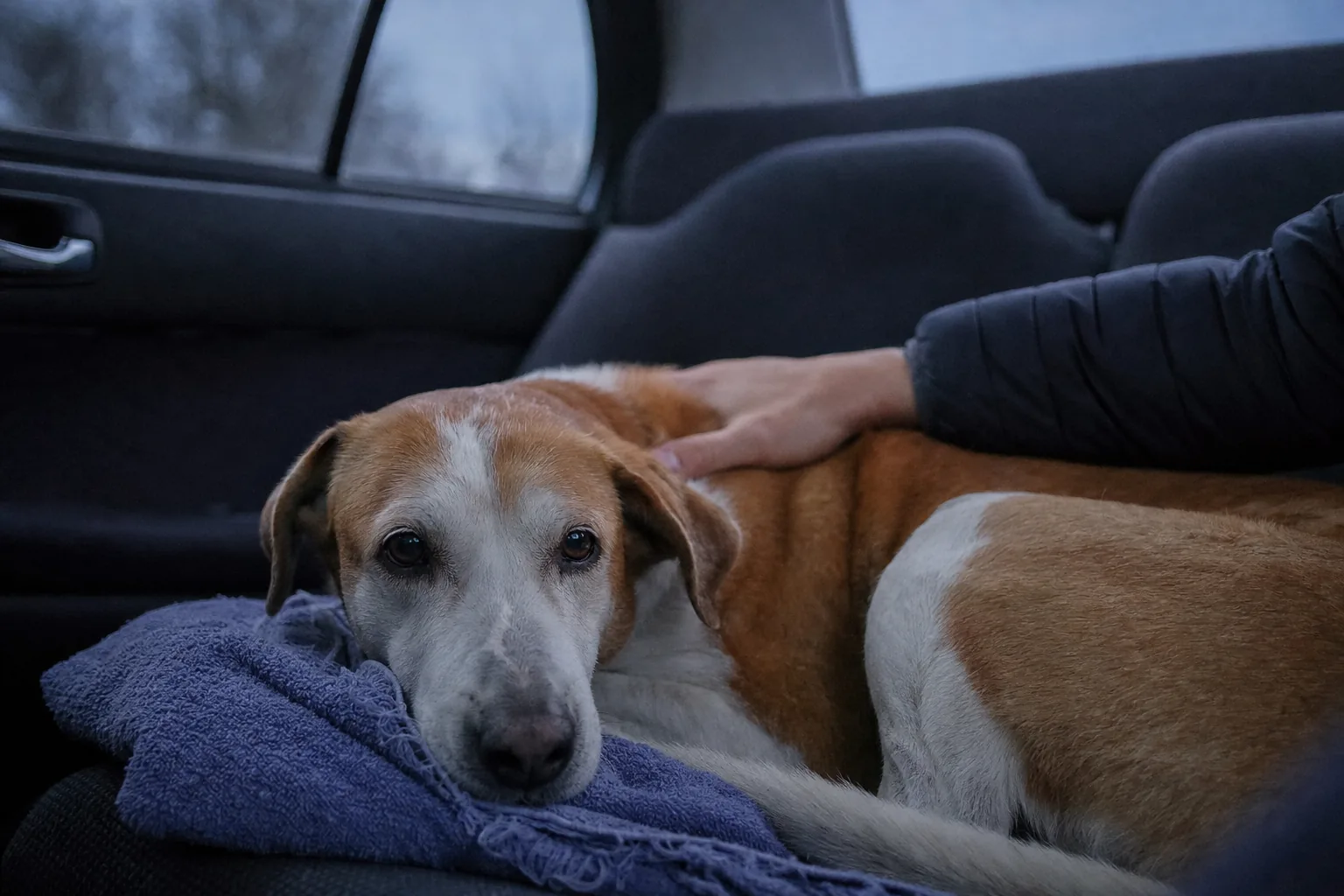
Emergency. Keep him still, carried if you can, take the collar off, note the time and ring the nearest vet now to ask whether they have antivenom. Do not cut, suck, use a tourniquet or ice, give him your own medicines or wait to see how much it swells.
Noticed something different about your dog? Go straight to their vet.
Call your own vet or the nearest clinic with an emergency service now, and set off. Do not ask a group what to do: every answer you wait for there is time lost for the dog.
- The same sign, dozens of causes. A dog that vomits may have eaten grass or may have an object stuck in the gut. From two lines you typed, nobody can tell which. The vet feels the abdomen, takes the temperature, runs tests.
- Nobody on the internet sees your dog. They see a photo and a story. A diagnosis comes from an examination and investigations, not from a resemblance to someone else's dog.
- In groups you hear from the people whose dog "got better on its own". Those for whom it ended badly rarely post again. What you read there is a selection, not a statistic.
- Doses are calculated by weight and species. Human medicines that look harmless, paracetamol or ibuprofen, are toxic to dogs. "I gave mine half a tablet" is the most dangerous advice you can get.
- Hours matter. With a twisted stomach, a poisoning or a urinary blockage, the time spent asking online is exactly the time that decides the outcome.
- The vet is accountable for what they say. They have your dog's record, history, vaccinations, past treatments. An anonymous account has none of that and answers for nothing.
Use this page to know what to observe, what to note and what to ask at the appointment, not to treat at home. If you still have doubts after a consultation, ask another vet or a specialist (dermatologist, internist) for a second opinion, not a group. And if you do not have a regular vet yet, find one now, while your dog is healthy: how to choose a veterinary clinic.
A warm May morning, a hillside path, an old dry-stone wall. Your dog pushes his nose into a bush, yelps once, jumps back and paws at his muzzle. Ten minutes later one side of his face is noticeably bigger than the other, and there are two small dots on the skin with a little blood coming out. Sometimes you see nothing at all: he goes suddenly lame on a front leg, and the leg swells while you watch. An adder or viper bite is an emergency, even though most dogs who reach a vet in time recover. Here is what to do now, what to tell the vet and how to avoid it.
What to do in the next 10 minutes
- Stop and keep him as still as you can. Every step and every struggle moves the venom round his body faster. Pick him up if you can. A big dog walks slowly on a short lead, or two of you carry him lying on a blanket.
- Take his collar off. Swelling on the muzzle, head or neck can come up fast, and a tight collar can choke him. If you have a harness, put that on instead.
- Ring now, the nearest vet or an out-of-hours clinic, and say "snake bite". Ask whether they have antivenom, or where the nearest clinic that does is. Plenty of practices do not stock it, especially small rural ones.
- Note the time of the bite. The vet uses it to judge how quickly things are moving.
- Leave the snake alone. Try to catch or kill it and the next one bitten is you. If you can see it clearly from a distance, take a photo. If you cannot, it does not matter, because the vet treats the dog's signs.
- Head for the clinic, ideally with someone driving and someone else next to the dog. In the car keep him lying down and calm, with the bitten part, as far as possible, no lower than his heart.
What not to do
- Do not cut the wound or suck out the venom. It does not get the venom out. You just make a second wound and put yourself at risk.
- Do not use a tourniquet. It cuts off the circulation and can do more harm than the bite.
- Do not put ice straight on the bite, and do not pour alcohol on it.
- Do not give him anything from your own medicine cupboard, whether for allergy or for pain. Some human medicines are toxic to dogs, and others hide exactly the signs the vet needs to see.
- Do not wait and see whether it swells badly. Even a bite that looks minor can cause clotting or heart problems a few hours later.
- Do not let him walk miles back to the car if you are able to carry him.
What an adder bite looks like
Dogs mostly get bitten on the muzzle and head, or on a front leg, because that is how they approach a snake: nose first. The first signs come within minutes. The pain is sudden, the swelling grows fast, and sometimes there are two small punctures about a centimetre apart, oozing blood or a pinkish fluid. Often you will not find them under the fur and the swelling. The skin around can bruise. Drooling, trembling, vomiting, fast breathing, pale gums and weakness can follow, and in serious cases the dog collapses.
Some bites are "dry", with no venom in them. You only know which after a few hours, so you treat every bite as an emergency.
Where and when
Europe has several species of viper, all of them venomous. In Britain the adder is the only venomous snake, found on heaths, moors, sand dunes and woodland edges. Across the continent, Romania included, vipers live mostly in hills and mountains and in dry, rocky country. They are out from mid-spring until autumn. You find them most often on sunny slopes and along stone walls or rock piles, though woodland edges, long grass, heather and bilberry suit them too. Harmless snakes such as the grass snake are far more common. From a distance, though, with an excited dog on the lead, telling them apart is hard, so any snake bite is treated as a viper bite until the vet says otherwise.
What to tell the vet and what they will do
On the phone
- "adder bite" or "snake bite", the time, where you are and how long it will take you to get there;
- where he was bitten (muzzle, neck, tongue, leg) and how fast it is swelling;
- his weight and age, any other illnesses, any medication he takes;
- what you can see now: how he is breathing, the colour of his gums, whether he can stand, whether he is vomiting;
- ask whether they have antivenom and whether you would be better off going straight to another clinic.
At the clinic
- A quick assessment. Breathing, pulse, gum colour, blood pressure, size of the swelling. With a big swelling on the neck or tongue, the first job is keeping his airway open.
- A drip, through a cannula in a vein, to support his circulation and kidneys.
- Pain relief. Adder bites are very painful.
- Blood tests for clotting, a full blood count, kidneys, liver and muscle, repeated every few hours.
- Heart monitoring (ECG). The venom can cause an irregular heartbeat, sometimes only after a day.
- Antivenom, if the vet thinks it is needed and has it. It does the most good when given early.
- Observation, usually for at least 24 hours, even if he looks fine to begin with. Clotting and kidney problems can show up later.
- Back home: rest, short walks on the lead for a few days or weeks, check-ups. The swelling usually goes down within a few days. The skin round the bite may darken or even die off in a small patch; if you see that, tell the vet.
Most dogs treated in time make a full recovery. The risk is higher for small dogs, for bites on the tongue, neck or body, and for dogs who arrive late.
How to prevent it
- On the lead where there are adders, especially in spring and summer: sunny slopes, rocks, heather and bilberry, woodland edges. Off lead, a dog pushes his nose straight into the spot where the snake is basking.
- Stay on the path. Adders feel footsteps and get out of the way of people. A dog rummaging through the undergrowth reaches them before they have time to move.
- Do not let him dig in rock piles, old walls or under fallen trunks.
- A solid recall and a good "leave it" are the best kit you can take on a walk. If he comes back when called away from an interesting smell at the edge of the path, his chances of being bitten drop a long way.
- Find out beforehand which is the nearest clinic open at weekends and whether it has antivenom. Save the number in your phone before you set off.
- In your rucksack: a harness, a blanket or large towel (so you can carry a big dog), water, a charged phone.
The risky situations, in short
| Situation |
What you do |
| A hill or mountain walk, May to September, in the morning |
Dog on the lead, especially on rocky slopes and in heather |
| He yelps suddenly by a bush and paws at his muzzle |
Stop, pick him up, check for swelling; if it swells, ring |
| Swelling growing within minutes, on the muzzle or a leg |
Collar off, ring the clinic, go |
| A small dog, or bitten on the neck, tongue or chest |
Top priority, leave at once |
| You do not know whether it was an adder or a harmless snake |
Treat it as an adder |
If your dog comes walking with you, talk to your own vet about snake bites before the season starts: which clinics have antivenom in the areas you visit, and what to do until you get there. Ten minutes of talking at home saves a lot of time on a bad day.
Frequently asked questions
What dog owners search for most often on the internet about this problem, with the short answer. The answers are a guide only: the decision belongs to your dog's own vet, after an examination.
What do I do if my dog is bitten by an adder?
Keep him as still as possible (carry him if you can), take his collar off so the swelling cannot choke him, note the time and ring the nearest vet at once to ask whether they have antivenom. Then set off without waiting. Do not cut the wound, suck out venom, use a tourniquet or ice, or give him medicines from home.
How can I tell if my dog has been bitten by a snake?
Usually he yelps suddenly by a bush, a rock or in long grass, then paws at his muzzle or starts limping. Within minutes a swelling comes up and grows fast, mostly on the muzzle, head or a front leg. Sometimes you can see two small bleeding punctures. Drooling, trembling, vomiting and weakness can follow.
Can a dog die from an adder bite?
It can happen, but most dogs treated in time make a full recovery. The risk is higher in small dogs, with bites to the tongue, neck or body, and when they reach the vet late. That is why you do not wait to see how it develops: some clotting or heart problems only show up hours later.
Does a dog bitten by a snake need a vet even if he seems fine?
Yes. You only find out whether there was venom after a few hours, and clotting, kidney or heart rhythm problems can appear late. The vet examines him, runs tests and usually keeps him under observation for at least a day. For a dog who looks fine at first, the observation is the part that matters most.
Where are adders found and when is the risk highest?
In Britain, on heaths, moors, dunes and woodland edges; across the rest of Europe, mostly in hills, mountains and dry rocky country. They like sunny slopes, stone walls, rock piles and heather, and are out from mid-spring to autumn. In those places keep your dog on a lead and on the path, and find out beforehand where the nearest open clinic is.
The information on this page is educational and does not replace an examination. For full details and a diagnosis, consult your dog's own veterinarian.