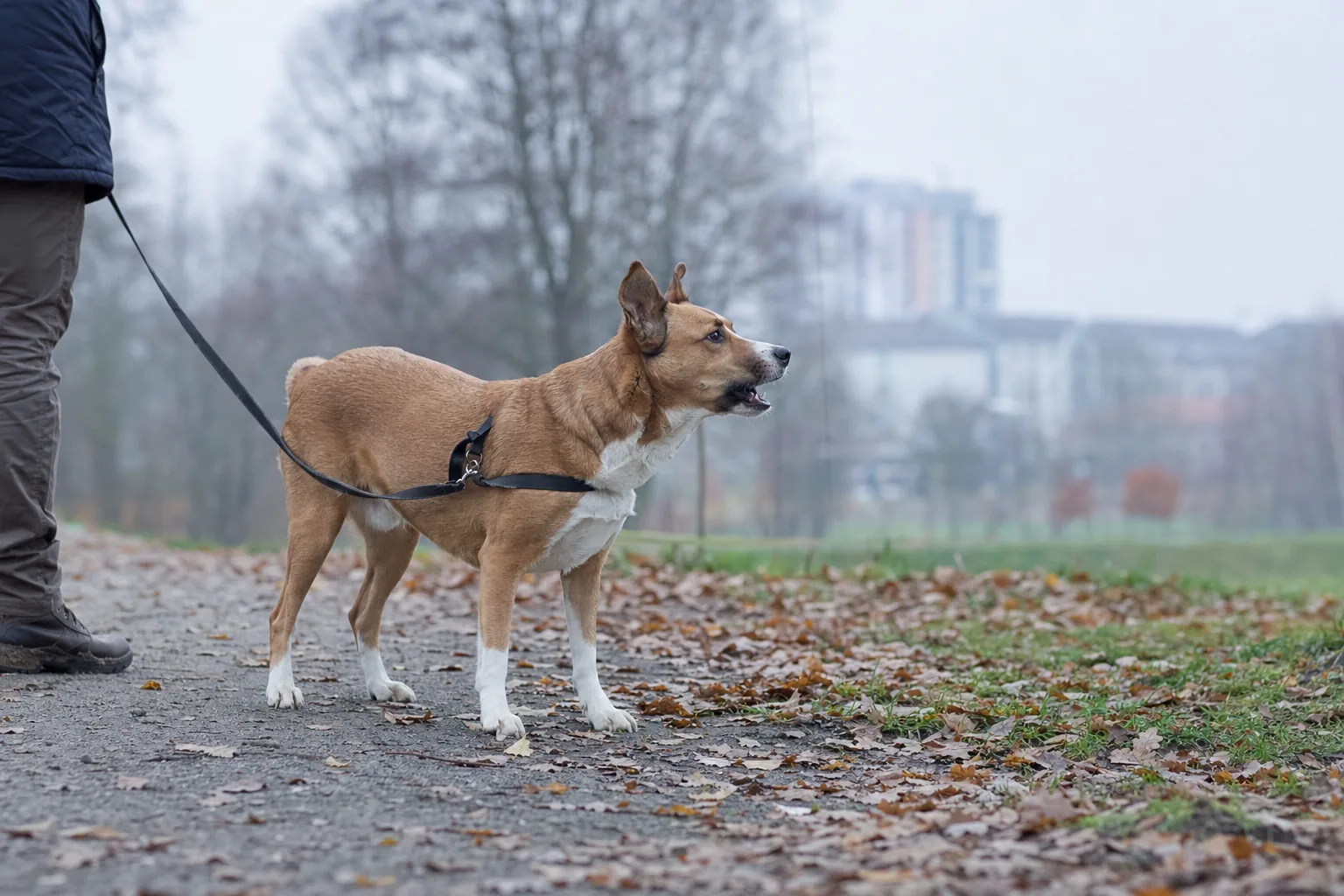
Sunday, out in the fields. Your dog is trotting along happily twenty metres ahead when he stops, sniffs something in the grass, drops a shoulder and goes over onto his back, legs in the air, grinding his neck into the ground with a look of pure bliss. By the time you reach him, the smell hits you from three metres away: fox poo, a dead fish, a hedgehog that has been dead for days. The car is unbearable on the way home. He is not doing it because he is dirty, and he is not doing it to wind you up. Below is why he rolls, what does not work, how to stop him beforehand and what to do afterwards.
Why do dogs roll in poo and dead things?
Nobody knows for certain. There are a few explanations, all plausible, and each dog probably has his own mix.
Smell as news. Wolves roll in new, strong smells, and when they get back the others in the pack come to sniff their coat. The animal "brings home" the news of what it found. Some dogs do the same: straight after rolling they head for you, looking very pleased with themselves.
Smell as disguise. An old explanation says the dog's ancestors covered their own scent so they could get closer to prey without being noticed. It may be true, but it is hard to prove.
He simply likes it. A dog's nose has a sensitivity we lack, and what is a stench to us may be a fascinating perfume to him. A dog rolling about with his eyes half shut looks like a dog enjoying himself.
Getting rid of the shampoo. Plenty of dogs roll straight after a bath, on the grass, the carpet, their own blanket. The shampoo smell is foreign to them, and they swap it quickly for something familiar.
Itching. If he rubs his back on the carpet ten times a day with no smell involved, he may have fleas, itchy skin or back pain. That is a different story, covered in the medical section.
Carcasses, fox poo and dead fish top the list for almost every dog. Do not count on him growing out of it. Some dogs do it all their lives, with the same delight.
What does not work
Telling him off afterwards. You reach him two minutes later and tell him off. He links it with coming back to you, or with the smell on him; the roll from two minutes ago is not part of the picture. Next time he has rolled, he will not come when you call.
Chasing him. You run after him shouting, he runs on ahead with his freshly scented coat. As far as he is concerned it is the best game of the day.
Bath time as punishment. Cold water, angry scrubbing, a raised voice. The bath has to happen. Turn it into a nightmare, though, and you have a dog who runs from the bath for the rest of his life, including the days he really needs one.
Perfume over the smell. Human perfume or a strong spray on top of fox poo makes an even worse mixture, irritates his skin and sends him straight back out to roll it off.
Freedom in high-risk places. A dog without a reliable recall, let off on a lake shore with dead fish or a field full of foxes, will roll, however well trained he is otherwise.
The plan, step by step
1. Learn to spot the seconds before
Rolling does not come out of nowhere. Almost every dog goes through the same sequence: he stops suddenly from a relaxed walk, sniffs one spot intensely, lowers his head with his cheek towards the ground, drops his shoulder. There are a few seconds between that first sniff and the roll, and that is when you step in.
2. A long line where the risk is
In fields, on beaches, along woodland edges, by the water, at times of year when you know there are carcasses about: a 5 to 10 metre long line clipped to his harness. He explores, you can stop the roll in time, and your walk stops being a constant worry.
3. "Leave it" and recall, practised when things are calm
At home and in quiet places, teach him a word that means "leave whatever is there and come to me". Put a treat on the floor, cover it with your hand and wait for him to take his nose away. Then say "leave it", praise him and give him something even better from your other hand. Make it harder bit by bit, take it outdoors, then next to strong smells. For recall we have a separate guide.
4. In the critical seconds
When you see the signs, call his name brightly or use your recall word, turn and walk off the other way, sounding like a party. When he comes, throw a celebration right there: sausage, cheese, his ball, his favourite game. You are up against a dead fish, so you have to be more interesting than it is. Hard, but doable.
5. If he has rolled anyway
- Call him with the same happiness and praise him for coming. A dog who learns that coming to you gets him into trouble is the biggest damage you can do here.
- Clip him onto a short lead and head straight home, with no more detours through the grass.
- The bath: lukewarm water, dog shampoo, two washes, working hard on the neck, shoulders and ears. Fox poo clings to the fur on the neck and to the collar, so wash the collar separately or swap it.
- Tomato juice is a myth. The smell stays, and pale coats end up stained.
- Finish the bath with something good, so that baths stay something he can put up with.
The first week
| Day |
What you do |
| 1–2 |
Long line in high-risk places. Watch for his own warning signs before a roll and write them down. |
| 1–7 |
"Leave it" at home, 10 times a day, with food on the floor. |
| 3–5 |
Recall on the long line, somewhere with no strong smells, with a big celebration every time he comes. |
| 6–7 |
First exercises next to a tempting smell (a bone from the butcher that you have put in the grass), still on the long line. |
When it is a medical problem
Rolling with no smell involved. A dog who rubs his back on the carpet, the grass or the sofa many times a day, who scratches, licks or chews at his skin, may have fleas, allergies, a skin infection, an ear infection or back pain. See your vet with a list: how often and where.
What he touched or ate. Carcasses and fox poo do more than smell awful. Foxes carry parasites, among them a tapeworm that is dangerous to people and present in many parts of Europe, and sometimes mange, which passes to dogs through contact. If he ate some of the carcass as well, vomiting and diarrhoea can follow within hours. Tell your vet that he rolls in fox poo or carcasses often, because they may suggest a different worming schedule. If a few days later he is scratching hard, especially at the ears and elbows, take him in for a check.
How nose work helps
The instinct stays. Nose work helps with two things, though. A dog who regularly gets work for his nose (search games, sniff walks on a long line, a scent sport) is less desperate to throw himself at every new smell in the field. And in mantrailing, dogs pass carcasses, rubbish and fox trails while following the scent of a person, and over time they learn to stay on the job. At our training sessions we often see dogs on a trail walk past a dead fish without stopping, when on a free walk they would have rolled in it.
When to call in a specialist
- once he has found something he will not come back at all, and you cannot build the recall on your own;
- he growls or bites when you get near the carcass or try to take him away from it;
- he eats everything he finds on the ground as well as rolling in it;
- he rolls or rubs obsessively, dozens of times a day, and your vet has found no cause;
- you have stuck to the plan above for a month and see no change at all.
A trainer can help you build "leave it" and recall in real situations, with temptations set up sensibly, and show you exactly when to step in with your dog.
A behaviour that appears suddenly or changes for no apparent reason can have a medical cause. For full details, consult your dog's own veterinarian.