You turn the bath tap on and the dog is already under the bed. Or he stands nicely for the bath but, the moment the brush comes out, turns round and takes your hand gently in his teeth to tell you that is far enough. Or you have a three-month-old puppy and want to get it right from day one, so that a year from now you are not facing 30 kilos of dog you cannot get into the tub. Bathing and brushing are among the few times your dog stands still next to you while you handle every inch of his skin. That is when you find the first knot, the first tick, the first red ear. It is worth turning them into something he accepts calmly and, with a bit of luck, looks forward to.
Getting him used to the brush and the bath, step by step
The rule is the same for both. Small steps, each followed by something good, and the dog always has a way to tell you "stop". It will feel slow. A year of wrestling in the bath takes a lot longer.
First, a signal that says he is ready
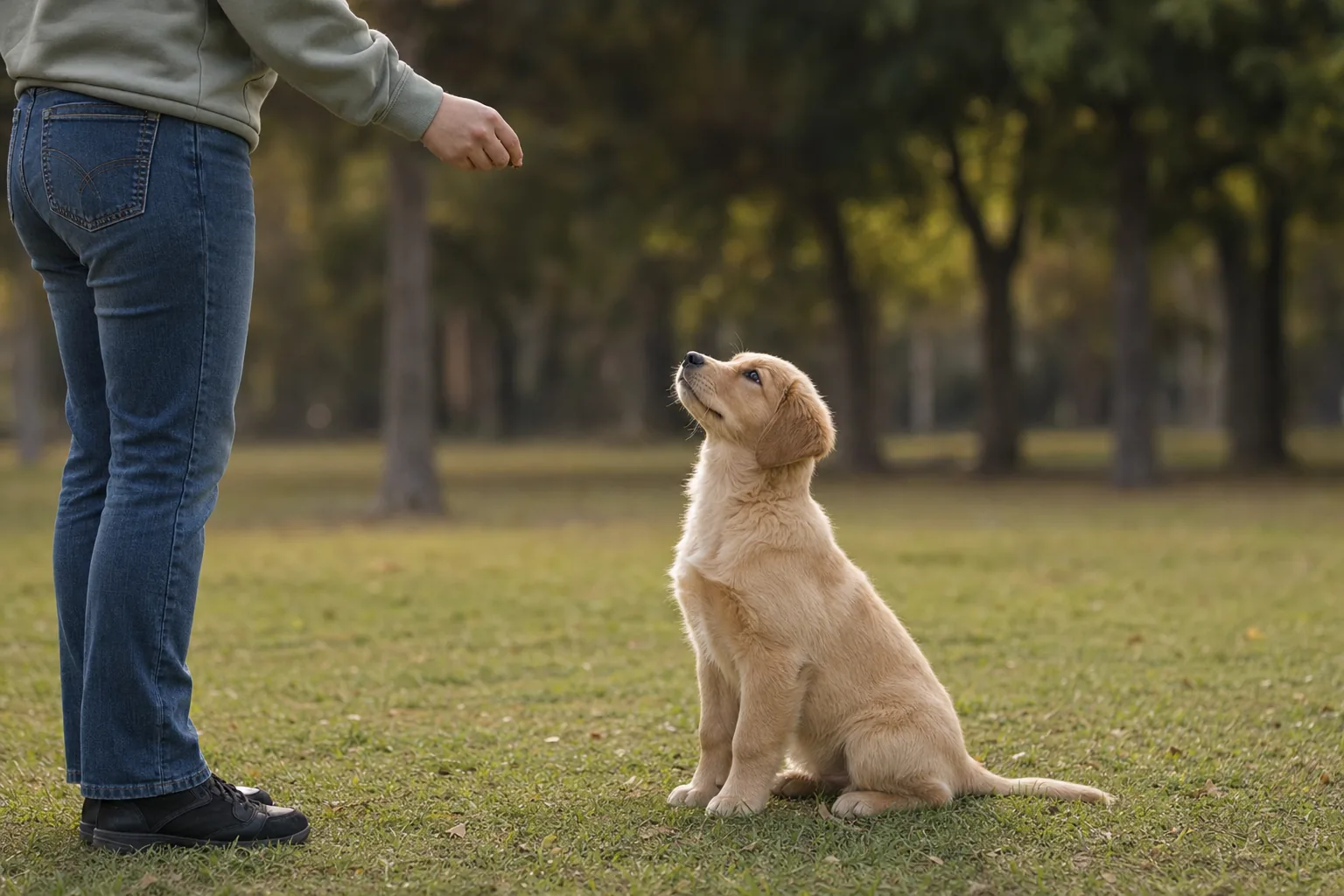
Before the brush ever touches him, teach him a simple way to tell you he is happy to go on. The easiest is a chin rest. Hold your open palm under his muzzle; when he touches it with his chin, he gets a tasty treat. Repeat until he offers it on his own and keeps his chin there for two or three seconds. From then on the rule is simple: while his chin is in your palm, you brush. When he lifts it, you stop at once. He learns that he has a say in what happens, and a dog who has a say struggles far less.
Brushing
- On day one the brush sits on the table. He sniffs it and gets a treat. That is the whole session.
- Touch his back with the back of the brush for a second, then treat. Ten times.
- One brush stroke along his back, with the lie of the coat, then treat. Then two strokes. Then three.
- Only once his back is no problem at all do you move to the touchy areas: neck, chest, thighs, and later the tail, belly, paws and the spot behind the ears.
- A session lasts two or three minutes. Finish before he gets bored, on warm praise.
For dogs who cannot keep still, a lick mat helps enormously. It is a ridged rubber mat you spread with soft cheese or yoghurt. Stick it to the wall or have someone hold it, and while his tongue is busy, his body stays put.
Which brush for which coat
| Coat |
Examples |
Tool |
How often |
| Short, smooth |
Beagle, boxer, labrador |
Rubber grooming mitt |
Once a week |
| Double (dense undercoat) |
German shepherd, husky, golden |
Undercoat rake, slicker brush |
2–3 times a week, daily when moulting |
| Long, silky |
Yorkshire terrier, shih tzu, cocker |
Slicker brush, metal comb |
Daily or every other day |
| Curly |
Poodle, bichon, poodle crosses |
Fine slicker brush, comb |
Daily, plus a groomer every 6–8 weeks |
| Wiry |
Terriers, schnauzer |
Comb, hand-stripping dead hair |
Weekly, plus 2–3 sessions a year |
On long and curly coats the brush glides nicely over the top and leaves the knots underneath, right against the skin. Check with a comb. If it runs from root to tip, you are done. If it catches, there is a knot. The first ones usually form behind the ears, in the armpits, between the back legs and under the collar.
The bath, starting from the next room
- He walks into the bathroom, gets something good and walks out. Several times, without a drop of water.
- Put a non-slip mat in the bath or shower tray. Slipping is the number one reason dogs fear the bath. Lift him in or let him step in, give treats, out he comes.
- Turn the tap on. The water runs beside him and he gets treats. He is not getting wet yet.
- Lukewarm water, as you would for a baby, on his paws only. Pour from a jug or keep the shower on a gentle spray, close to his body so it does not startle him. Treats.
- Then work up from the legs to the back and chest. Leave the head until last and wipe it with a damp sponge, keeping water out of his eyes, ears and nose.
- Use a dog shampoo, neat or diluted as the label says, and work it right down to the skin. Rinse for far longer than seems necessary, because leftover shampoo makes the skin itch.
- Towels, and plenty of them. If you use a dryer, keep it on low warm or cool, a hand's width away, and only once he is used to the noise of it running in another room.
With a double coat the undercoat stays wet for hours. Do not let him sleep damp in the cold, and do not put his collar back on a wet coat: warm, damp skin is exactly where irritation starts.
How often to bath him
Far less often than you think. Many dogs need a bath once every one to three months, or when they have rolled in something or started to smell. Long-coated and curly dogs go in more often. A dog with a skin condition may need regular baths with a shampoo your vet prescribes, but that is a separate matter. Brushing is the other way round: you do it more often than you would expect.
From puppy to old dog
Puppies. This is the best age of all for it. One-minute sessions: a soft brush along the back, a touch of the paws, ears and muzzle, everything paired with treats. In the first weeks after he comes home, give him a first bath on his paws only, with lots of praise, and run the dryer in another room while he eats. Do not wait until he is dirty. A first bath works far better as practice than as an emergency.
Adolescents (6 to 18 months). The puppy who used to stand nicely suddenly wriggles, bites the brush and runs off. That is normal at this age. Shorten the sessions, go back a step and bring the lick mat out again. In long-coated and curly breeds this is also when the puppy coat changes, so it is when most knots appear.
An adult who hates the bath. Especially with rescue dogs, you do not know what happened before. Start from step one with no rush, and in the meantime keep him clean with damp towels, daily brushing and, if needed, help from a groomer or your vet. If after three weeks he is stepping into the bath on his own, you have a dog you will bath without fuss for the next ten years.
Older dogs. Stiff joints, slippery legs, the cold bites harder. Lift him into the bath yourself, use the non-slip mat and make the water a little warmer. Keep sessions shorter and dry him more thoroughly. Brush him lying down on a soft blanket rather than standing. In an old dog, brushing doubles as a check-up: new lumps, sore spots and thinning skin are things your hands find before the vet does.
The mistakes we see most
- Human shampoo. A dog's skin has a different pH from ours, and a shampoo made for people can dry and irritate it. Buy one made for dogs.
- Everything at once. A nervous dog's first bath turns into tub, water, shampoo and dryer, all in ten minutes. After that he is wary of anything to do with the bathroom.
- Holding him down. It works once. The second time, he bolts when he sees the towel. If he really needs a wash now because he has rolled in something, keep it as short as you can, with treats from start to finish, and go back to the step-by-step work the next day.
- Cutting knots out with scissors. The skin is caught up in the knot and gets cut with it. A lot of wounds reach the vet exactly that way. Work big knots apart with your fingers and a comb, from the tip towards the skin, or have a groomer or your vet clip them out.
- Brushing over knots. The brush pulls on the skin, it hurts, and the dog takes away one lesson: the brush hurts.
- Shaving a double coat. On a husky, shepherd or golden, the coat insulates in summer as well as in winter. Once shaved, it sometimes does not grow back properly for years. Regular brushing that takes out the dead undercoat does far more good.
- Rushing the rinse. Leftover shampoo itches, the dog scratches, and you end up thinking he has an allergy.
- Bathing straight after a spot-on parasite treatment. Some products lose effect if the dog is washed too soon before or after they go on. Read the leaflet or ask your vet how long to wait.
- Water in the ears. In breeds with floppy ears, water left inside makes ear infections more likely. Keep the ears dry and wipe only the opening with a pad, without pushing anything deep inside.
How long it takes and how to tell it is working
For brushing, in a dog without big issues, allow one to two weeks of short daily sessions. For bathing a fearful dog, count on three to six weeks with a few sessions a week, the first ones with no water at all. That sounds like a lot, but undoing one bath that frightened him takes longer.
You can see it working in his body. He follows you into the bathroom when you go in. His chin lands in your palm without being asked. The lick mat gets licked happily while the water runs. His body stays soft: tail low but loose, ears in their usual position, no lip licking at every brush stroke. If he shakes himself off after a session as if he had just had a bath, even though he is dry, it was too much. Next time, go down a step.
When to call in help
- A dog groomer, for breeds whose coat needs clipping or hand-stripping, and for large knots. Look for someone patient, who lets you watch and does not leave dogs tied to the table for hours. Ask beforehand how they handle a nervous dog.
- Your own vet, if the coat smells bad even after a bath, if he scratches a lot, if the skin is red, flaky, crusty or has bald patches, or if you find lumps. Your vet is also the one for large knots matted right down to the skin, which sometimes have to come out under sedation.
- A behaviour specialist, if he growls, bites or panics at the brush or the bath and small steps have not helped after a few weeks. Sometimes it is plain fear. Sometimes it is pain, and this is exactly how the dog shows it.
A dog who lets himself be brushed and bathed without a fuss is a dog that you, the groomer and the vet can care for easily all his life. That is worth every bit of cheese spread on that mat.