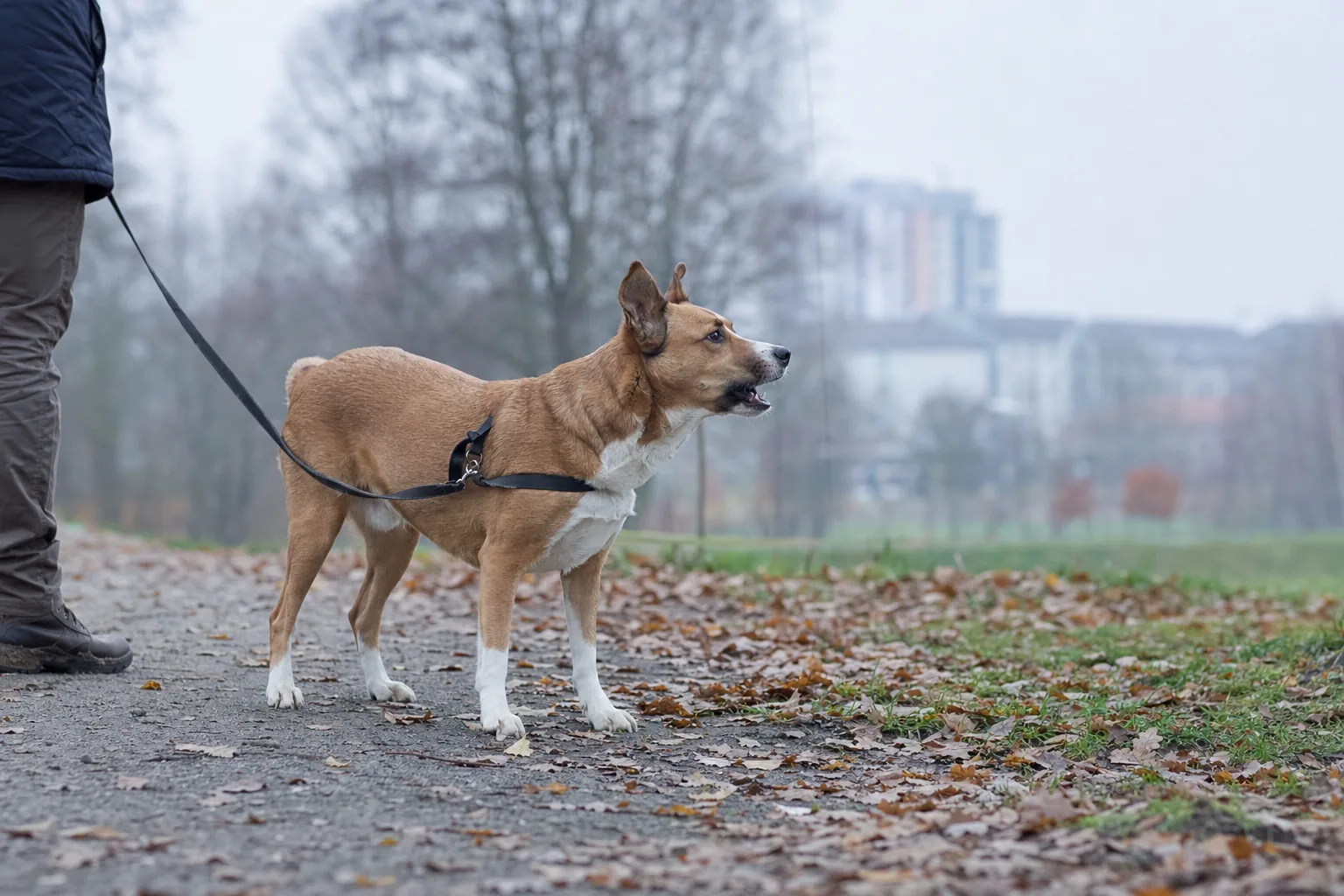
By the time you reach the corner of the block, your dog has swallowed a crust of bread, a chicken bone from under a bench and a napkin with ketchup on it. You walk with your eyes on the pavement, ready to pounce, and he has learnt to be quicker than you. At home socks keep vanishing, and once you found a pebble in his sick. Eating things off the ground is about as normal as dog behaviour gets. It is also one of the most dangerous habits a dog can have: cooked bones, stones, socks and poisoned baits regularly end up on the operating table. Below is why your dog does it and what you can change from tomorrow, so that a walk stops feeling like a hunt.
Why does my dog eat everything off the ground?
Dogs spent thousands of years living alongside people, on whatever people left behind. That nose finds a slice of pizza under the snow and a banana skin under the leaves. To a dog the street is a laid table, and every find makes him search harder. On top of the instinct, your own dog and his history count for a lot.
Puppies and young dogs explore the world with their mouths, the way toddlers do with their hands. In puppies almost anything goes in, and it usually eases off after the first year, unless it has turned into a game along the way.
Chase me. He picks something up, you jump, shout and run after him. From where he is standing, he has just found the best game in the house. Next time he takes a sock exactly when you are on the phone.
Swallowing on the run. If things have often been prised out of his mouth by force, he learns to swallow before your hand gets there. That is how some dogs end up swallowing stones and whole socks without chewing them at all.
Hunger. A dog on a diet, one who is not getting enough, or one from a breed famous for its appetite (Labradors, Beagles) hunts more persistently. Look at how you hand out his daily ration too: from toys, on a snuffle mat, split into several small meals.
Boredom. If his nose and brain have too little to do during the day, he finds his own job on the walk. Sniffing and eating are the easiest one going.
Stress. In some dogs chewing and swallowing objects goes up when they are unsettled: left alone, moved to a new home, something changed around them.
A medical cause. Sometimes a dog eats things that are not food (stones, soil, plastic, plaster) because something is wrong inside. Vets call it pica. There is more on it in the medical section below.
What does not work (and why it looks as if it does)
Grabbing things out of his mouth. It seems logical, and sometimes you have to. Make it the rule, though, and you teach him to swallow fast. Plenty of dogs who swallow whole socks learnt it from people chasing them.
Shouting and telling off. It stops the moment and leaves the habit intact. He learns to pick things up when you are not looking, or to run off with them.
Shock collars, sprays, lead jerks. They spoil the walk, frighten him and can damage his trust in you without teaching him what to do instead. A dog who is scared of his lead can start reacting badly to people or dogs. We do not recommend them.
Chilli or "surprises" left out in the street to teach him a lesson. He does not connect the taste with the lesson you had in mind. He just gets warier, which means quicker.
Waiting for him to grow out of it. Sometimes puppies do. An adult who has been hoovering up the pavement for years, and found something good every time, will not give it up on his own, because each find spurs him on to look for the next.
A short lead and pulling. You stop him, but you give him nothing to do, and a walk that is all lead tension is frustrating for both of you.
The plan, step by step
1. Keep him safe while he learns
This step keeps him alive while you work on the rest.
- At home: a bin with a lid or shut away in a cupboard, socks and children's toys picked up, cables off the floor. What he cannot reach, he cannot swallow.
- Out and about: walk him in cleaner places, at times of day when there are no leftovers from café tables or tipped-over bins. Steer clear of spots with rat bait and places where people feed pigeons or cats.
- A basket muzzle: for dogs who swallow stones, bones or rubbish, it is the safest protection while he learns. Pick one he can pant, drink and take treats through. Introduce it slowly over a few days, with good treats inside and plenty of praise, until he pushes his nose in by himself and looks pleased about it. It becomes ordinary kit to him, like his harness.
2. The swap game
He learns that if he gives up what is in his mouth, something better turns up, and sometimes he even gets the thing back. Start at home with a toy. While he is holding it, put a really good treat right under his nose and say "give". The moment he lets go, he gets the treat and a big, happy fuss, then you hand the toy back. Ten times a day, with more and more interesting objects. After two or three weeks "give" works in the street too, and he stops running off with what he finds.
3. "Leave it"
This teaches him to leave something alone and look at you instead.
- Hold a treat in your closed fist. He sniffs, licks, nudges with his nose. You wait. The second he pulls back, however slightly, give him a better treat from your other hand and praise him.
- Once he pulls back without hesitating, say "leave it" just before you show him the fist.
- Put the treat on the floor under your palm, then uncovered, with your foot ready to cover it.
- Move the exercise to the garden, then the pavement, using treats you have planted there beforehand, with him on lead.
- Only after a few weeks do you try it on real rubbish.
The good treat always comes from your hand and never from the ground. That is how he learns where the good things are.
4. Checking in with you, unprompted
On every walk, whenever he looks at you without being asked, say "good" and give him a treat. A dog who checks where you are a lot is a dog you can call away before he reaches the bone.
5. Somewhere his nose is allowed
He is not going to stop searching. All you can do is give him places where searching is allowed. Feed his meals at home from toys, on snuffle mats, scattered in the grass or hidden round the house. On the walk, on a clean patch, say "find it" and toss a few treats into the grass. Searching becomes something you do together, on your cue.
The first week
| Day |
What you do |
| 1 |
Tidy the house: lidded bin, socks put away. Pick cleaner routes. |
| 2 |
Start getting him used to the muzzle, if he swallows dangerous things. |
| 2–7 |
The swap game, ten times a day, at home. |
| 3–7 |
"Leave it" with the fist and the palm, twice a day, five minutes each time. |
| 4–7 |
Meals from toys and snuffle mats. Praise every glance he gives you on walks. |
| 7 |
Take stock: how many things he has still picked up, how easily he gives up what is in his mouth. |
When it is a medical problem
Take him to your vet before you start on any training plan if any of the following applies:
- he eats things that are not food: stones, soil, plaster, wood, plastic, clothing;
- the habit has appeared suddenly in an adult dog who never had it;
- at the same time he is much hungrier than usual, losing weight, drinking a lot, has diarrhoea or is vomiting;
- he licks the floor, walls or furniture obsessively;
- he is an older dog who seems confused and has started eating odd things.
Your vet can look for intestinal worms, stomach and gut conditions that stop food being absorbed properly, anaemia, diabetes, hormonal problems, or the side effects of treatments that increase appetite. If he has already swallowed something dangerous, do not wait: read our page on what to do when a dog has swallowed something.
How nose work helps
A dog who scavenges everything usually has a very good, very busy nose. Search games at home and scent sports such as mantrailing give that nose a clear job, done together with you. In training we see dogs who would otherwise pick up every crust on the pavement work with their heads up on the scent of the person they are looking for, walking straight past leftovers without a glance. It does not fix the problem by itself: back on the street after training, the habit is still there. A dog who is mentally tired, though, scavenges less and listens more readily to "leave it".
When to call in a specialist
- he has already swallowed things that needed surgery or an endoscopy;
- he growls, freezes or bites when you come near what he has found;
- after three or four weeks of consistent work you see no change at all;
- the habit seems linked to stress: being left alone, changes at home, fear;
- you cannot get him used to the muzzle.
A reward-based trainer can help you find the right pace and spot what you are missing. If he growls when you take things from him, start with our page on resource guarding.
A behaviour that appears suddenly or changes for no apparent reason can have a medical cause. For full details, consult your dog's own veterinarian.