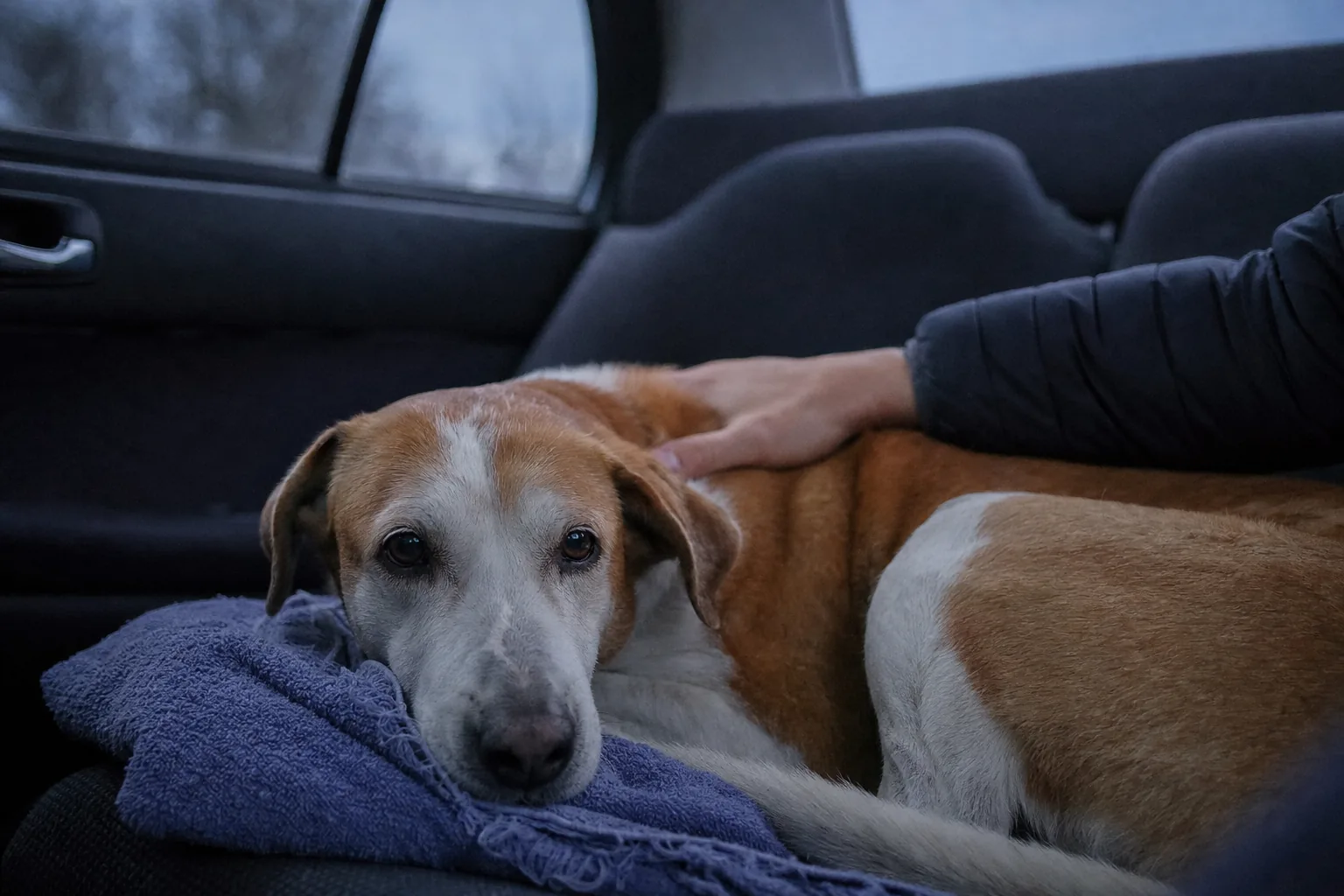
Emergency. Get him away from the bait, bag the leftovers and any vomit without touching them with bare hands, and ring your own vet or an emergency clinic now, even if he still seems fine. Do not make him sick, do not give milk or oil. If he is trembling or seizing, wrap him in a blanket and go.
Noticed something different about your dog? Go straight to their vet.
Call your own vet or the nearest clinic with an emergency service now, and set off. Do not ask a group what to do: every answer you wait for there is time lost for the dog.
- The same sign, dozens of causes. A dog that vomits may have eaten grass or may have an object stuck in the gut. From two lines you typed, nobody can tell which. The vet feels the abdomen, takes the temperature, runs tests.
- Nobody on the internet sees your dog. They see a photo and a story. A diagnosis comes from an examination and investigations, not from a resemblance to someone else's dog.
- In groups you hear from the people whose dog "got better on its own". Those for whom it ended badly rarely post again. What you read there is a selection, not a statistic.
- Doses are calculated by weight and species. Human medicines that look harmless, paracetamol or ibuprofen, are toxic to dogs. "I gave mine half a tablet" is the most dangerous advice you can get.
- Hours matter. With a twisted stomach, a poisoning or a urinary blockage, the time spent asking online is exactly the time that decides the outcome.
- The vet is accountable for what they say. They have your dog's record, history, vaccinations, past treatments. An anonymous account has none of that and answers for nothing.
Use this page to know what to observe, what to note and what to ask at the appointment, not to treat at home. If you still have doubts after a consultation, ask another vet or a specialist (dermatologist, internist) for a second opinion, not a group. And if you do not have a regular vet yet, find one now, while your dog is healthy: how to choose a veterinary clinic.
Early morning, on the path between the flats or along the edge of the park. Your dog pushes his head under a bush and comes out chewing, and you never see what it was. Half an hour later he is drooling and trembling, and he sways on his feet. Or it starts the other way round: the neighbours tell you two dogs on your street died in the same week, and then you find chunks of sausage in the grass with coloured granules pressed into them. Poisoned baits put down on purpose for dogs and cats are a real and recurring problem in Romania, where we train, in towns and villages alike, and they kill much-loved family dogs as easily as strays. Plenty of other countries have the same problem under the name "dog baiting". This page is about the minutes that follow. If your dog got hold of something toxic at home (chocolate, grapes, medicines, a sock), we have a separate page for that.
The next 10 minutes: what to do now
- Stop him and move him away. If he still has something in his mouth and will let you, hook it out with your fingers wrapped in a bag or a tissue. Never touch the bait with bare hands: some poisons go through skin. If he struggles or bites, let it go.
- Take a sample. Bag whatever is left of the bait, with a bit of the soil beside it if it looks stained. If he has been sick, the vomit goes in a second bag. Take two photos of the spot, one close up and one from further back. A minute's work, and nothing you could hand the vet is more useful.
- Ring your own vet or an out-of-hours clinic while you are on the move. Open with "suspected poisoning from a bait". With some poisons the minutes count for more than anything else.
- Do not make him sick yourself. No salt, no soapy water, no fingers down his throat. In a dog who is already trembling or fitting, vomit can end up in the lungs, and some substances burn a second time on the way back up. If his stomach needs emptying, the vet will say so on the phone.
- No milk, oil, eggs, yoghurt or charcoal. Milk does not "neutralise" poison, whatever the local wisdom says, and fats help some poisons into the bloodstream faster.
- Go. If he is trembling or seizing, wrap him in a blanket, carry him and lay him on the floor of the car, clear of hard edges. Do not hold his tongue or put anything in his mouth. Bright light and noise make the seizures worse with some poisons, so keep your voice low and the windows shut.
- Split the jobs. One person drives, the other talks to the vet. On your own, start the call on speaker before you pull away.
What the signs may point to
You will almost never find out what was in the bait. The signs give the vet a direction, so watch them and report them accurately, along with when each one started.
| What you see |
How soon it shows |
What it may be |
| Heavy drooling, vomiting, diarrhoea, pinpoint pupils, tremor, laboured breathing |
Minutes to an hour |
Farm insecticides and pesticides used illegally in baits |
| Rigid muscles, seizures set off by a noise or a touch, dog lying stiff on his side |
Minutes to two hours |
Old, banned rodent poisons that are still around |
| Violent tremor, fever, agitation, seizures |
One to three hours |
Slug and snail bait |
| Nothing for a few days, then lethargy, pale gums, bleeding from the nose or in urine or stool, bruising, laboured breathing |
Three to five days |
Anticoagulant rat and mouse poison |
| Vomiting, thirst, staggering as if drunk, then what looks like a recovery |
Hours |
Antifreeze, sometimes added to water or food on purpose |
| Burnt gums, tongue or skin, bloody drool |
Straight away |
Caustics such as lime or caustic soda |
Use the table to describe what you are seeing; the diagnosis belongs to the vet. Some baits carry more than one poison, and some substances do not fit any row. Our rule of thumb: a dog who eats something off the ground and then changes suddenly has been poisoned until the vet tells you otherwise.
At the vet: what to say and what happens
What to say on the phone
- What happened. For example: "he ate something off the ground in the park, I think it was a bait, and now he is drooling and shaking".
- When. The time, as exactly as you can. Fifteen minutes and an hour lead to different decisions.
- What you can see now. Drool, vomiting, diarrhoea, tremor, seizures, the pupils, gum colour, whether he is conscious.
- What is in the bag. The bait, the vomit. Describe the colour of the granules or powder; some rodent poisons are dyed blue, green or pink.
- His weight, any other conditions, any medicines he is on.
- Where you are and how long you will take to get there.
What the vet does at the clinic
- Stabilises him. If he is seizing or struggling to breathe, the vet stops the seizure and secures his breathing before anything else. You will be asked to wait outside. That is routine.
- Empties the stomach, if the poison went down recently and he is awake. In a dog who is fitting it is done differently, under anaesthetic, with a tube.
- Binds the poison in the gut so less of it is absorbed. This works for many substances.
- Gives the antidote where there is one. A few of the poisons common in baits have one; for the rest it is supportive care until the effect wears off.
- Fluids, oxygen, warming or cooling, depending on how he is.
- Runs tests. Bloods; clotting tests if rat poison is suspected, repeated two or three days later even when the first result is normal; kidney values with antifreeze.
- Sends the sample to a lab, if you brought the bait, or if, sadly, the dog dies. The toxicology report doubles as the evidence you will need later.
- Keeps him in, from one night to several days. With anticoagulant poison the treatment runs for weeks and only stops after a follow-up test.
The legal side
Poisoning animals on purpose is a criminal offence in Romania under the animal protection law, and in most European countries too. Report it even if you caught it in time. The next dog on your street may not be as lucky.
- Ask the vet for a written record of the diagnosis, date, time and treatment. If a sample goes to a lab, keep the report.
- Make a complaint to the police, with the photos of the spot, the time, the sample and the vet's paperwork. Some cities have police units that deal with animal cases; where there is none, go to the station that covers the street.
- Tell the council or local police if the baits are in public places so they can be cleared. If you collect them yourself, wear gloves and double-bag them; when you hand them over, say where you found them.
- Warn the neighbours and put a short post in the local group: where, when, what the bait looked like. No names and no accusations you cannot back up. Accusing someone in public without evidence can land you in trouble and does nothing for the investigation.
Keeping him away from baits
A dog who eats off the ground will try again. That bit of sausage under the bench is the best thing that has happened to him all morning. You have two tools and you need both: teach him to leave things on the ground, and cut off his access wherever you cannot watch every step.
"Leave it", from the kitchen to the pavement
- Closed fist. Hold a dull treat in your fist. He sniffs, licks, shoves with his nose, and you wait. The moment he pulls his head back, say "yes" and give him something far better from the other hand. After ten or so goes, say "leave it" just before you offer the fist.
- Open hand. Same rule with your palm open. If he dives in, close it.
- On the floor. Put the treat down, first under your foot, then uncovered with you standing beside it. When he leaves it and looks up at you, make a fuss of him: happy voice, lots of praise and something from your hand that beats what was on the floor.
- A set-up walk. Someone in the family scatters bits of bread or biscuit along the route beforehand. You walk past with the dog on lead and practise "leave it", with something really good in your pocket.
- The real pavement. Chicken bones, wrappers, scraps. Here you are after one thing: a dog who looks up at you by himself when he spots something on the ground. That takes weeks to build.
However good his "leave it" gets, you still have to watch him. A dog who finds a bait two metres away with his nose deep in the grass has swallowed it before you can get a word out.
The basket muzzle
For dogs who will swallow anything, and in areas where baits have turned up, a basket muzzle is the safest protection you have. A good one lets him pant, drink and take treats through the bars. Fabric muzzles that hold the mouth shut are for a few minutes at the vet and have no place on a walk.
He learns it as a game, over a few days. Hold the muzzle with a tasty treat at the bottom and let him push his nose in to get it. Then he keeps his nose in for a second, then three. Then you do the strap up for a moment and undo it. He only wears it on the street once he sees it as something that brings good things, and a dog who is used to it soon forgets it is there.
On your route
- Short lead near bushes, along the edges of parks, around blocks of flats, by the bins and anywhere people put food out for cats. That is where most baits turn up.
- Eyes on the ground in front of the dog. The walks spent looking at your phone are exactly the ones on which dogs find baits.
- Keep an eye on local groups and council notices about pest control. After rat baiting, give the area a wide berth for a few days.
- Where dogs have died recently: muzzle and a short lead, or a different route.
The phone numbers
Save your own vet's number now, plus an out-of-hours clinic in your town with its address. Put your dog's weight in your phone as well. On the morning he comes out of a bush chewing, you will not have time to look any of it up.
Frequently asked questions
What dog owners search for most often on the internet about this problem, with the short answer. The answers are a guide only: the decision belongs to your dog's own vet, after an examination.
What are the signs of poisoning in dogs?
It depends on the poison. Pesticides bring heavy drooling, vomiting, diarrhoea, tiny pupils and tremor within minutes. Rigid muscles and seizures set off by noise point to the older rodent poisons. With anticoagulant rat poison the dog looks normal for three to five days, then come pale gums, bleeding and lethargy. Any sudden change after he has eaten something off the ground is an emergency.
My dog has been poisoned. What can I give him at home?
Nothing. Milk does not neutralise poison, oil and fats help it into the blood faster, and making him sick with salt or soap can do more harm than the poison itself. At home you collect the sample, ring the vet and set off. The vet decides whether and how to empty the stomach and which antidote to use.
How long does it take for signs of poisoning to show?
With the pesticides used in baits and the older rodent poisons, minutes to an hour. With slug bait, one to three hours. With anticoagulant rat poison, three to five days, by which time the dog has seemed fine for ages. So you ring the vet the moment you suspect something, without waiting for signs.
What can I do legally if someone poisoned my dog?
Poisoning animals on purpose is a criminal offence in Romania and most of Europe. Ask your vet for a written diagnosis and, if possible, a toxicology test on the bait or the samples. Photograph the spot, note the time and report it to the police with all of that. Tell the council so the baits get cleared, and warn the neighbours, without accusations you cannot prove.
How do I protect my dog from poisoned baits?
Practise "leave it" for weeks, first at home and then out on the street, and every time he leaves what is on the ground he gets something better from your hand. In risky areas keep the lead short and your eyes on the ground. For a dog who swallows anything, a basket muzzle taught as a game lets him pant and drink but stops him eating off the floor.
The information on this page is educational and does not replace an examination. For full details and a diagnosis, consult your dog's own veterinarian.