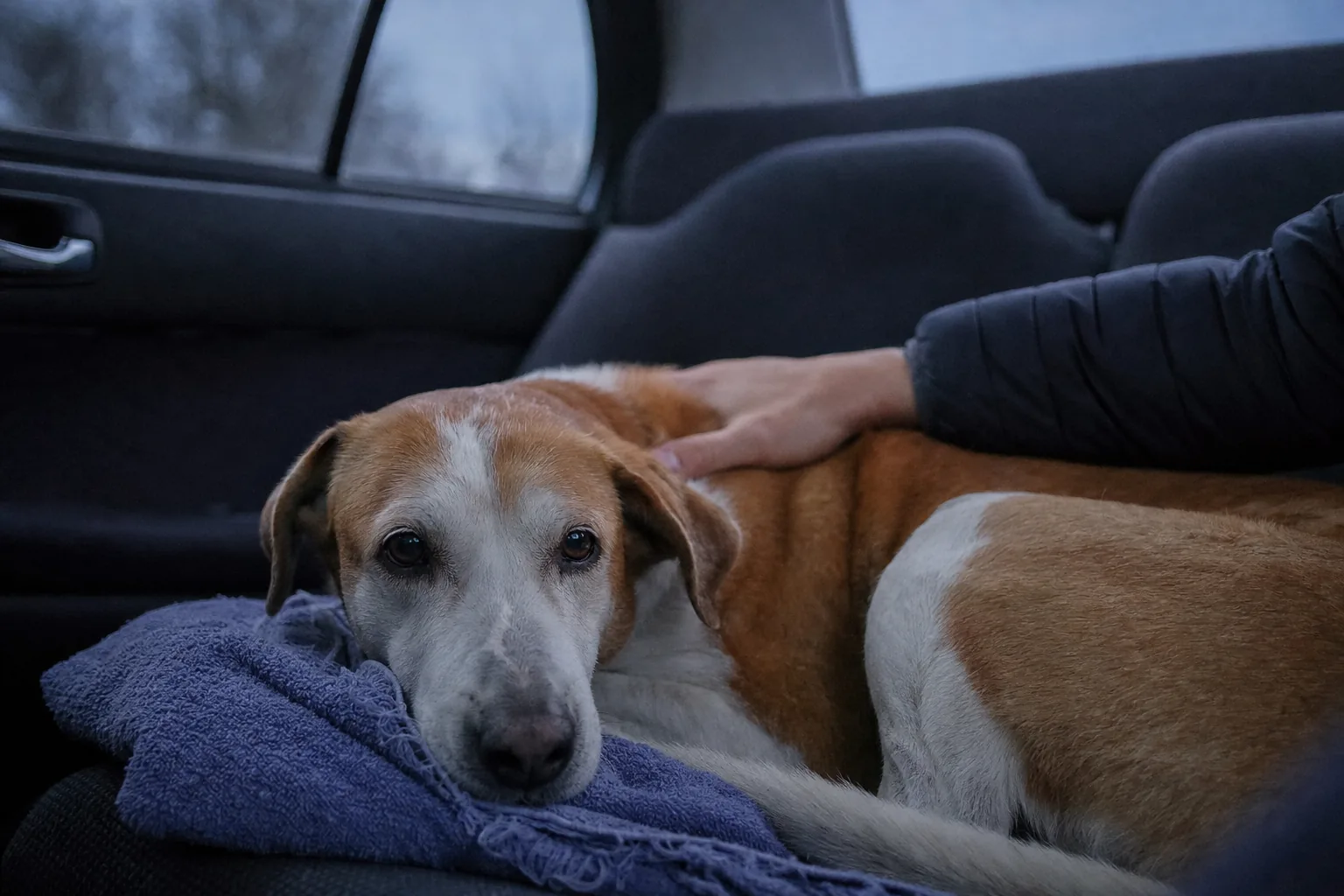
Your German Shepherd had his dinner at seven, wolfed down as usual. By nine he cannot settle. He lies down, gets up, turns round and looks at his belly. Then he tries to be sick: once, twice, five times, and nothing comes up except perhaps a little white froth. The belly behind his ribs looks fuller than normal and feels as tight as a football. If you are seeing this in a big dog, stop reading. Grab the keys, get in the car and ring the 24-hour clinic on the way. A twisted stomach kills within hours, and the only treatment is at the vet's, usually on the operating table. Read the rest of this page later, or have someone read it out in the car while you drive.
What to do now, in the next 10 minutes
- Recognise what you are looking at. Repeated retching that brings up nothing, or only froth and saliva, and a swollen, tight belly, especially high on the left just behind the ribs. The dog is restless, drooling heavily, panting, and keeps looking round at his belly. Later come pale or grey gums, laboured breathing, weakness and collapse. You do not need all of them. In a big, deep-chested dog, unproductive retching on its own is enough.
- Phone while you get ready. Ring your own vet if they are open and can operate; if not, go straight to the nearest 24-hour clinic with surgery. Say in your first sentence: "I think it is a twisted stomach." They will get theatre ready before you arrive.
- Leave now. Do not wait to see if it passes, do not ring round friends, do not search forums. With a twisted stomach (gastric dilatation and volvulus, or GDV), the stomach fills with gas and rotates on itself. Blood stops flowing properly, and the stomach wall and spleen start to die. Every hour of delay cuts his chances.
- Give nothing by mouth. No water, no food, no remedies for wind or bloating. Do not make him sick and do not walk him round "to move the gas".
- Lift him into the car carefully. A 40-kilo dog with a painful belly takes two people: one under the chest, one under the hindquarters, with no pressure on the belly. Let him lie however he wants. A blanket doubles as a stretcher at the clinic.
- Take his vaccination card and note the time of his last meal. And your phone, charged.
At night, a long way from a clinic
You are in the mountains, in the countryside or in a small town, and the nearest clinic with surgery is more than an hour away. Set off for it anyway and phone on the way. If a nearer practice answers, ask whether they can at least stabilise him and let the gas off, to buy time before surgery. Plenty of vets will do that and then send the dog on with a drip in place. The one thing you do not do is stay at home hoping it sorts itself out by morning.
Twisted stomach or just "full of food"?
| What you see |
More likely |
What to do |
| Retching with nothing coming up, tight belly getting bigger, restless, big dog |
Gastric dilatation with a twisted stomach |
Clinic with surgery, now |
| Ate a whole sack of kibble, big but soft belly, sleepy dog, bringing up food |
Stomach overloaded with food |
Phone the vet now; it can turn into a twist |
| Belly growing over days or weeks, not hours |
Fluid in the abdomen, an enlarged organ, pregnancy |
Appointment the same day or the next |
| Vomiting food, soft belly, bright dog |
Upset stomach |
Keep an eye on him and phone if it keeps happening |
The table is there so you do not waste time. The rule is still simple: in a big dog, a swollen belly plus retching means the clinic, even if it turns out in the end that he had simply eaten too much.
What to tell the vet and what happens at the clinic
On the phone and when you arrive, give his breed and weight, when the signs started, when he last ate and how much, whether he brought anything up or only tried, whether he has bloated before, and whether a parent or littermate has had a twisted stomach. Here is what happens at the clinic, in order.
- Stabilising comes before surgery. A dog with GDV is in shock. He gets large volumes of fluid through one or two veins, and oxygen. The vet then takes the pressure off the stomach, either by passing a tube down through the mouth into the stomach or, if the tube will not go, by pushing a wide needle through the body wall into the stomach. The gas comes out with a hiss and the dog breathes more easily straight away.
- An X-ray shows whether the stomach is only distended or twisted as well. A twist has a typical look on the image that vets recognise.
- Blood tests, lactate among them, give an idea of how badly the stomach wall has suffered.
- In surgery, the vet turns the stomach back into its normal position and checks whether the stomach wall and the spleen are still alive. Sometimes part of the stomach or the whole spleen has to come out. Finally the stomach is stitched to the body wall so it cannot twist again. That stitch is called a gastropexy, and without it the twist comes back in most dogs.
- For the first two or three days afterwards he stays in, with his heart monitored. Heart rhythm problems are common after GDV and often only show up the next day. Food is reintroduced gradually, in small portions.
With surgery in time, most dogs recover and go on to live normally. The odds drop with every hour lost and with how much of the stomach has been damaged. Without surgery, GDV is almost always fatal. When the vet talks to you about odds and costs, ask them straight out what they saw on the X-ray and in the bloods. You are entitled to decide with all the facts in front of you.
Can a twisted stomach be prevented?
Nobody knows for certain why GDV happens. The large studies have, though, found a handful of factors that keep turning up.
Dogs at high risk
Large and giant breeds with a deep, narrow chest: the Great Dane (the most at risk), German Shepherd, Standard Poodle, setters, Weimaraner, Dobermann, St Bernard, Akita and their crosses. Risk rises with age and is higher in dogs with a first-degree relative (a parent or littermate) who has had a twist. Lean dogs and anxious, easily stressed dogs also show up more often in the figures.
Preventive gastropexy
For high-risk breeds, many surgical guidelines recommend it. It is the same stitch of the stomach to the body wall, done calmly in a healthy dog, usually at the same time as spaying or castration, sometimes by keyhole surgery with small incisions. The stomach can still fill with gas, but it can no longer twist, and the twist is the part that kills. Talk to your own vet about it while your dog is still a puppy.
Meals
Two or three meals a day instead of one big one. Slow him down with a slow-feeder bowl, a snuffle mat with the food scattered over it, or a stuffed toy. One large study found higher risk in dogs fed from a raised bowl, so in at-risk breeds keep the bowl on the floor unless your vet has a particular reason to raise it.
Calm around mealtimes
Many vets advise an hour's rest before and after the main meal, with no running and no rough play. The evidence here is weaker, but the advice costs you nothing. With working dogs, such as our mantrailing dogs, the big meal comes after training, once they have settled, never before a trail.
Stress
For anxious dogs, big changes (kennels, a house move, a long trip) are worth preparing for. On difficult days, a small meal and a quiet day help more than you might think.
Everyone in the house knows the signs
Tell everyone at home, and whoever looks after the dog when you are away: retching with nothing coming up plus a swollen belly means the clinic, immediately. Save the 24-hour clinic's number in your phone today, not on the night you need it.
The information on this page is educational and does not replace an examination. For full details and a diagnosis, consult your dog's own veterinarian.