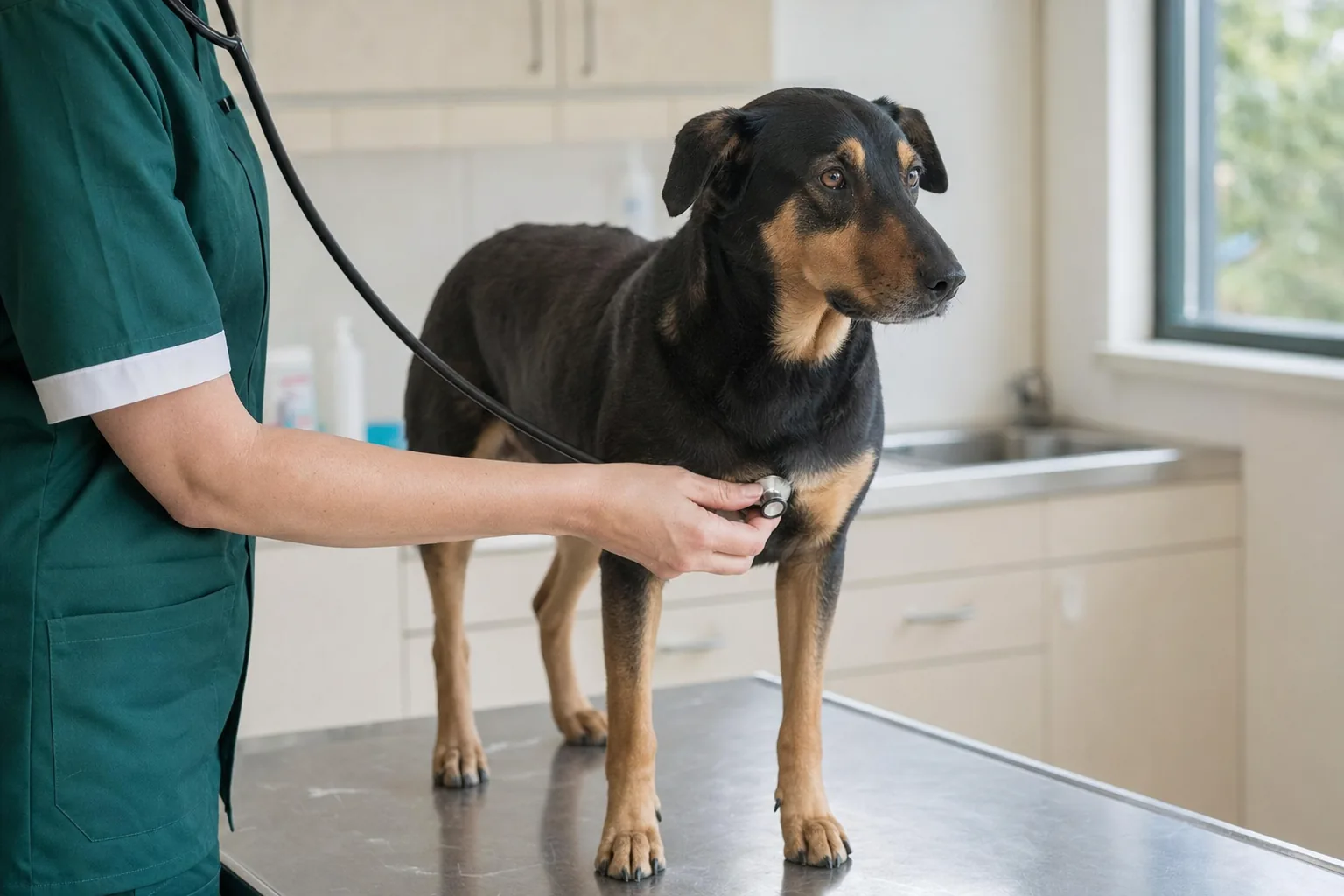
It is evening and the bowl is as full as it was this morning. You changed the water, moved the bowl, called him over. Your dog looked, sniffed once and walked off. Maybe you moved house a week ago and since then he drinks like a cat. Maybe it is winter, he has switched to wet food and you never catch him at the bowl any more. Sometimes "he's not drinking" is just an impression. Sometimes it is the first sign that something is wrong, and you can tell which in a few minutes if you know where to look: how much he should drink, how to check for dehydration, what to try at home and when to ring your vet.
When should you ring the vet today?
A healthy adult dog can drink less for a day and come to no harm. Do not wait, though, in any of these situations; ring today:
- he has not drunk anything for more than 24 hours, or more than 12 hours if he is a puppy, an older dog or a small breed;
- he is not drinking and is vomiting, or not drinking and has diarrhoea. He is losing water two ways and not replacing it;
- he will not drink or eat, and he is flat or hiding away;
- his gums feel dry and tacky, his eyes look sunken, and the skin on the back of his neck, lifted gently, is slow to settle back;
- he has not had a wee for 12 hours or more, or passes very little and it is dark;
- he wants to drink, leans over the bowl and stops, or water dribbles out of his mouth. That is what pain in the mouth or throat, or trouble swallowing, looks like;
- he has been out in the heat or worked hard and now refuses water;
- he has a known condition (kidney disease, diabetes, a heart problem) and the amount he drinks has suddenly changed, in either direction.
Puppies dehydrate fast. A two-month-old puppy with diarrhoea who is not drinking does not wait until tomorrow.
What to check and write down at home
How much he actually drinks
Most people underestimate it, because dogs drink when nobody is watching. For two days, put a measured amount in the bowl each morning using a measuring jug, note everything you top up and measure what is left in the evening. On average a healthy dog drinks around 50 ml per kilo per day. For a 10 kg dog that is roughly half a litre.
The figure varies a lot between dogs. Wet food is 70 to 80% water, so a dog fed on it may drink half as much from the bowl and be perfectly well hydrated. He drinks more in summer and after exercise. Less in winter.
The dehydration checks
They take 30 seconds and you can do them on the sofa. Do them once now, while he is well, so you know what his gums and skin feel like when everything is fine.
- Gums: touch them with a finger. They should be wet and slippery. Tacky or dry means he is short of water.
- Skin: gently lift the skin on the back of his neck or between the shoulder blades and let go. In a hydrated dog it drops back at once. If it stays up like a little tent for a second or two, he is short of water. In older or very thin dogs the test is less reliable.
- Eyes: sunken, dull.
- Urine: how much, and what colour. A small amount of dark yellow wee is an early sign.
What has changed lately
New food? A new bowl, a moved bowl, one made of different material? Have you switched from tap water to bottled, or the other way round? A new house, another dog or a cat near the bowl, a new baby? Colder weather? A vaccination or vet visit yesterday? A new medication?
His mouth
Does he look at the water as if he wants it and still not drink? Chew on one side, drop food, drool, have bad breath? A broken tooth, a sore in the mouth or a foreign body, such as a stick wedged between the back teeth, can make drinking painful.
Age and existing conditions
Older dogs feel thirst less and sometimes simply forget the bowl. A dog with arthritis or a sore neck drinks less often because bending down hurts. A raised bowl at chest height, placed near where he sleeps, often sorts it out. In dogs with kidney disease, heart disease or diabetes, tell your vet about any change in thirst, because the treatment sometimes needs adjusting.
The rest of him
Is he vomiting? Any diarrhoea, coughing, limping? A temperature? Very warm ears and tummy are no substitute for a thermometer, but write them down. Has he stopped bending down to the bowl, as though his neck hurts?
Why a dog may refuse water
| Cause |
What else you see |
How urgent |
| Wet food, cold weather, less exercise |
Nothing else; normal wees, moist gums |
Normal |
| Bowl, water or spot changed |
Started with the change |
Not urgent; try the ideas below |
| Stress (moving house, visits, guests) |
Eats less too, hides |
Watch for 24 hours |
| Nausea (stomach, liver, kidneys, new medication) |
Lip licking, drooling, refusing food too |
Today if it lasts more than a day or he vomits |
| Pain in the mouth, teeth or throat |
Wants to drink then stops, water dribbles out |
Vet within 1 to 2 days; today if he is not drinking at all |
| Neck or back pain |
Will not bend down, holds himself stiffly |
Vet the same day |
| Fever, infection |
Flat, off his food |
Today |
| After a vaccination |
Sleepy for a day |
Normal for a day; if it lasts longer, ring |
What will the vet check?
- How dehydrated he is. Gums, skin elasticity, eyes, pulse, and how quickly colour returns to the gum after a press. From that the vet estimates how much fluid he is short of.
- Why he is not drinking. A look in his mouth (teeth, gums, tongue, throat), his temperature, a feel of his abdomen, a listen to his heart.
- Blood and urine tests. They put a number on the dehydration and show how the kidneys and liver are doing, plus blood sugar and salts. In older dogs, bloods are almost always part of the visit.
- An X-ray or abdominal ultrasound if he is vomiting or in pain, to look for a foreign body or an organ problem.
- Fluids. If he is dehydrated, the vet gives fluids under the skin or into a vein, depending on how much he is missing. That happens at the practice, not at home.
- Treating the cause: the tooth, the nausea, the infection. What and how much is the vet's decision.
Take your notes on the measured water, a list of what has changed in the last few days and, if you can manage it, a morning urine sample.
What not to do at home
- Do not squirt water down his throat with a syringe if he is vomiting, very flat or struggling to swallow. It can end up in his lungs. A dog who cannot or will not drink needs a vet.
- Do not give him human drinks "for the electrolytes": sports drinks, sweetened tea, packet soup. They contain sugar, salt or flavourings that do him no good, and some contain sweeteners that are toxic to dogs.
- Do not give him milk so that he drinks "at least something". Many adult dogs cannot digest it and get diarrhoea, which means losing even more water.
- Do not wait for a puppy or an older dog who has not drunk for a whole day to "perk up".
- Do not hold his muzzle in the bowl. All he learns is that the bowl is unpleasant.
- Do not change everything at once (food, bowl, spot). Change one thing at a time so you know what made the difference.
What to try at home with an otherwise healthy dog
If he seems well and is weeing normally, try the tricks that win over a lot of fussy drinkers. A ceramic or glass bowl instead of the metal one that clangs every time he touches it. Fresh water twice a day. A second bowl in another room, away from his food and from the busy route through the house. A pet water fountain, since some dogs prefer running water. A few ice cubes in summer. A splash of lukewarm water over dry food.
Out on the trail we always carry a bottle and a collapsible bowl, and plenty of dogs drink better from their handler's cupped hand than from any bowl. If after a day of trying he still drinks nothing at all, or any of the warning signs above appear, ring your vet.
The information on this page is educational and does not replace an examination. For full details and a diagnosis, consult your dog's own veterinarian.