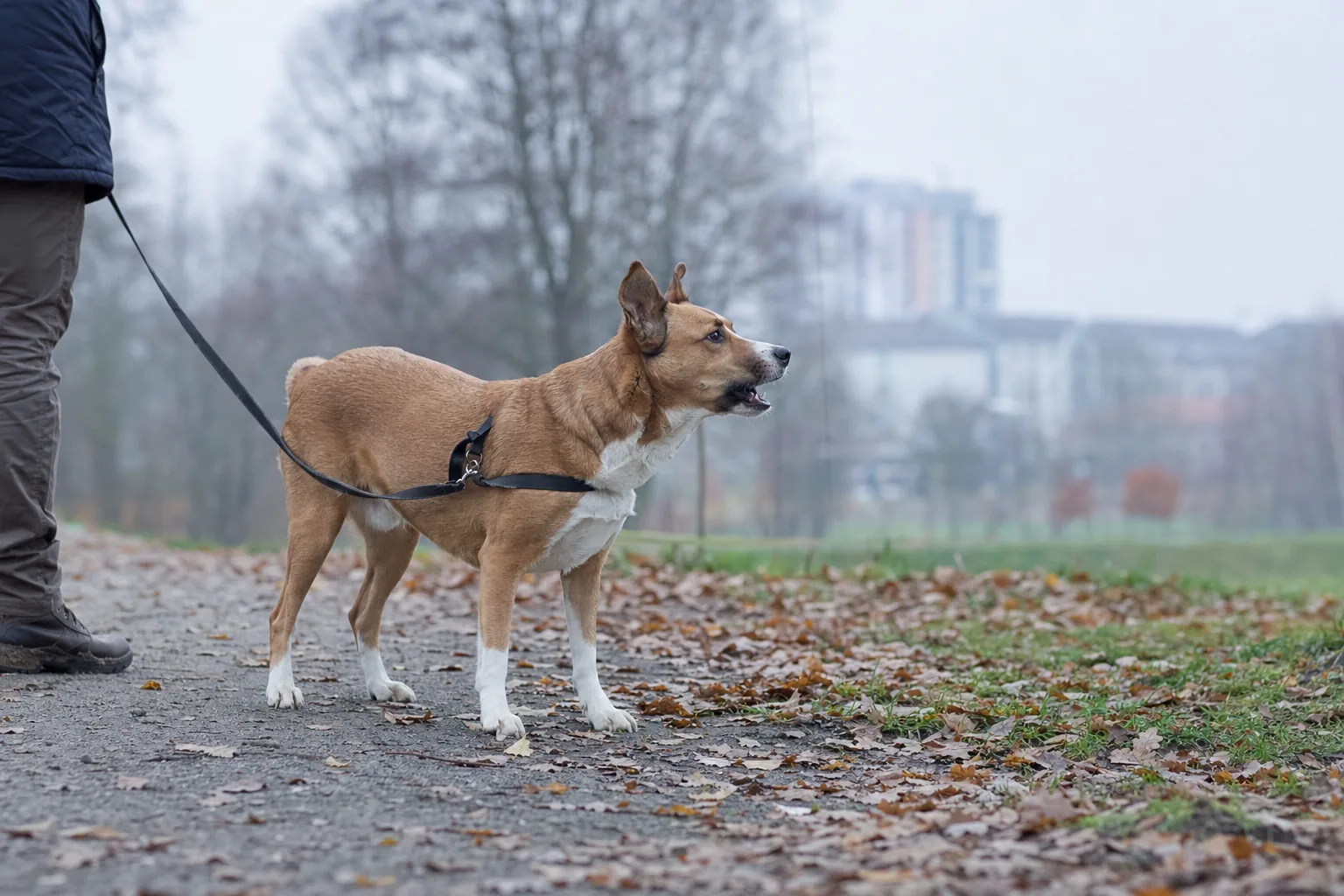
You are walking along the pavement and a man in a hood is coming the other way. Your dog, the one who sleeps at home with his head on your foot, rears up on his back legs, barks and throws himself to the end of the lead. The man steps aside and glares, someone behind you says "control your dog", and you go red and speed up. Another dog only barks at people who stop to stroke him, another only at runners, another only after dark. This page is about the dog who barks and lunges at people in the street: why he does it, what makes it worse, and how to work on it step by step until a walk feels like a walk again.
Why does he lunge at people?
Trainers call it reactivity: the dog reacts far more strongly than the situation calls for to one particular thing, in this case people. From the outside it all looks the same, barking, leaping on the lead, growling. Underneath, the reasons differ, and the plan depends on the reason.
Fear. By far the most common. He did not meet enough different people as a puppy, during the window when he got used to the world easily (up to about 3 to 4 months), or something bad happened to him. He barks to make the person go away, the person does go away, and so next time he barks again. You can tell by the body leaning back, weight on the hind legs, tail low, ears pinned, a high-pitched bark. Sometimes he hides behind you straight afterwards.
Particular people. Plenty of dogs do not react to "people" as such. They react to tall men, to anyone in a hat, hood or with an umbrella, to walking sticks and pushchairs, to children running, to people who stare at them or lean over them. Write down for a week who he barks at and more often than not a pattern appears.
Frustration. This dog wants to get to the person and say hello, and the lead stops him. The tension comes out of his mouth. Tail up and wagging broadly, body tipped forward, barking broken up by whining. Let him off and he would jump up and lick the person's face.
Guarding. He barks mostly near home, on the stairs, at the gate or in the car. Or when you are sitting on a bench and someone comes towards you.
Pain. When his back, hips or ears hurt, a dog has less patience for everything and reacts faster. If reactivity has appeared suddenly in an adult dog who never had it, pain is the first thing to check.
Genes and breed. Some breeds, bred to guard or to keep an eye on strangers, get there more easily. You work with them the same way, just with more patience.
In real life it is nearly always a mix: an unsure dog who has learnt, walk after walk, that barking keeps people at a distance.
What makes it worse, even when it seems to work
Jerking the lead and shouting "no!". He stops for a second because you gave him a fright. What he learns, though, is that when a person turns up, something unpleasant comes from you as well. Next time he is even more on edge.
Prong, shock or choke collars. For a dog barking out of fear, they add pain at the very moment he sees what scares him. Some dogs go quiet, and that is the most dangerous outcome of all: they have learnt not to warn, the fear is still there, and the next step can be a bite with no bark before it. We do not use them and we do not recommend them.
"Let him sniff you so he sees you're friendly." A person walking up to a frightened dog, however kind, puts him right in the situation he fears most. A lot of bites happen exactly then. The dog has no way of knowing the stranger means well.
Taking him into crowds "to get him used to it". The market on a Saturday, the bus stop at rush hour. Vet behaviourists call this flooding. The dog is overwhelmed, and the fear grows instead of shrinking.
Telling him off afterwards. The episode is over and the person has gone. To the dog, the telling-off is connected to nothing.
Not going out at all. He needs exercise and things to sniff, and a bored, wound-up dog reacts faster. What needs to change is the kind of walk.
The plan, step by step
1. Stop the rehearsals
Every bark at a person is practice for the next one. For the first few weeks, the aim is to put him in that situation as rarely as you can:
- Move walks to early morning or late evening, when the streets are empty.
- Choose open places where you can give people a wide berth: parks with wide paths, fields, the edge of town. Leave narrow pavements between parked cars for later.
- Teach the happy U-turn. Say "this way!" in a cheerful voice, turn 180 degrees and walk off briskly the other way, with a tasty treat in your hand for him. Practise at home and on an empty street until you can do it without thinking. Out on the street, use it before the barking starts.
- Put yourself between your dog and people. When someone passes, he walks on the side by the buildings or cars, you on the side nearest the person.
- A well-fitted harness and a 2 to 3 metre lead, not an extending one. You have control without pulling on his neck.
2. Find the distance at which he stays calm
Sit on a park bench with a bag of really good treats (cooked chicken, cheese) and watch people go by from a long way off. You are looking for the distance at which he notices a person, looks at them, and can still eat and still turn back to you. It might be 15 metres, it might be 60. That is your working distance. If he stiffens, stops taking food or barks, you are too close, so you back off, no telling-off.
3. Link people with good things
From the working distance, every time a person appears, he gets something really good from you. Person appears, treats arrive. Person leaves, treats stop. Specialists call it desensitisation and counter-conditioning: you get him used to the scary thing gradually and link it with something he enjoys.
A version a lot of people like is "look at that". When he looks at the person, you say a word ("look!") and hand him the treat. After a while he sees a person and turns to you on his own, as if to say "seen them, where's my treat?". When that happens, you know the change has started.
Over a few weeks the distance shrinks by itself. You do not push it. Move a few metres closer only after he has been relaxed at the current distance for several days in a row.
4. A muzzle, if there is any risk of a bite
If he has ever tried to bite, or you are not sure, get him used to a basket muzzle he can pant, drink and eat in. Introduce it slowly over a few days, with treats dropped inside, until he pushes his nose in by himself. The muzzle does nothing for the fear. What it gives you is the calm you need to work, and dogs pick up on your calm.
5. What to say to people
"Please don't stroke him, we're working on something." One short sentence, no long apologies. Some people put a yellow harness or lead on the dog, or a patch saying "I need space". In many countries yellow is known as the "please keep your distance" signal, but do not count on everyone knowing it.
The first week
| Day |
What you do |
| 1–2 |
Diary: who he barks at, from how far, at what time. Walks moved to quiet hours. |
| 1–7 |
The happy U-turn, 5 times a day at home, then on an empty street. |
| 3 |
First bench session, 10 minutes, to find the distance at which he stays calm. |
| 4–7 |
One short session a day at the working distance: person appears, tasty treat. Sniffing walks on a long line in places with no people. |
| 7 |
Read the diary. How many episodes? From how far? If nothing has changed, or he has bitten, call a specialist. |
When it is a medical problem
If the reactivity came on suddenly or got worse quickly, see your dog's vet first. Pain (arthritis, back, teeth, ears), thyroid problems and failing sight or hearing all make a dog easier to frighten and quicker to react. A dog who sees poorly only notices a person when they are right next to him, and the surprise scares him. For very anxious dogs, the vet may suggest treatment to bring the fear down so the dog can learn. That is decided at the consultation, not at home.
How nose work helps
Sniffing settles a dog. A dog nosing slowly through the grass has a lower heart rate than one scanning the street. Long sniffing walks in quiet places and search games at home drain off some of the tension that builds up. At our mantrailing sessions we see something more interesting too. A dog who reacts to people learns to search for a person, find them at the end of the trail and get his favourite treat from them. For many dogs, the person at the end of the trail is the first stranger who brings something good. It is not a treatment in its own right and it does not replace the steps above. It does help, though, and you can see it.
When to call a specialist
- he has bitten or tried to, even if he "only nipped";
- he barks and lunges at people in the house too, or at visitors he knows;
- the distance at which he stays calm is so big you cannot get out of the building without an episode;
- after four weeks of steady work, the diary shows no improvement;
- you have started to dread walks.
An assessment with a trainer or a vet behaviourist starts from your dog and your diary. Afterwards you know exactly what sets him off and how to carry on.
A behaviour that appears suddenly or changes for no apparent reason can have a medical cause. For full details, consult your dog's own veterinarian.