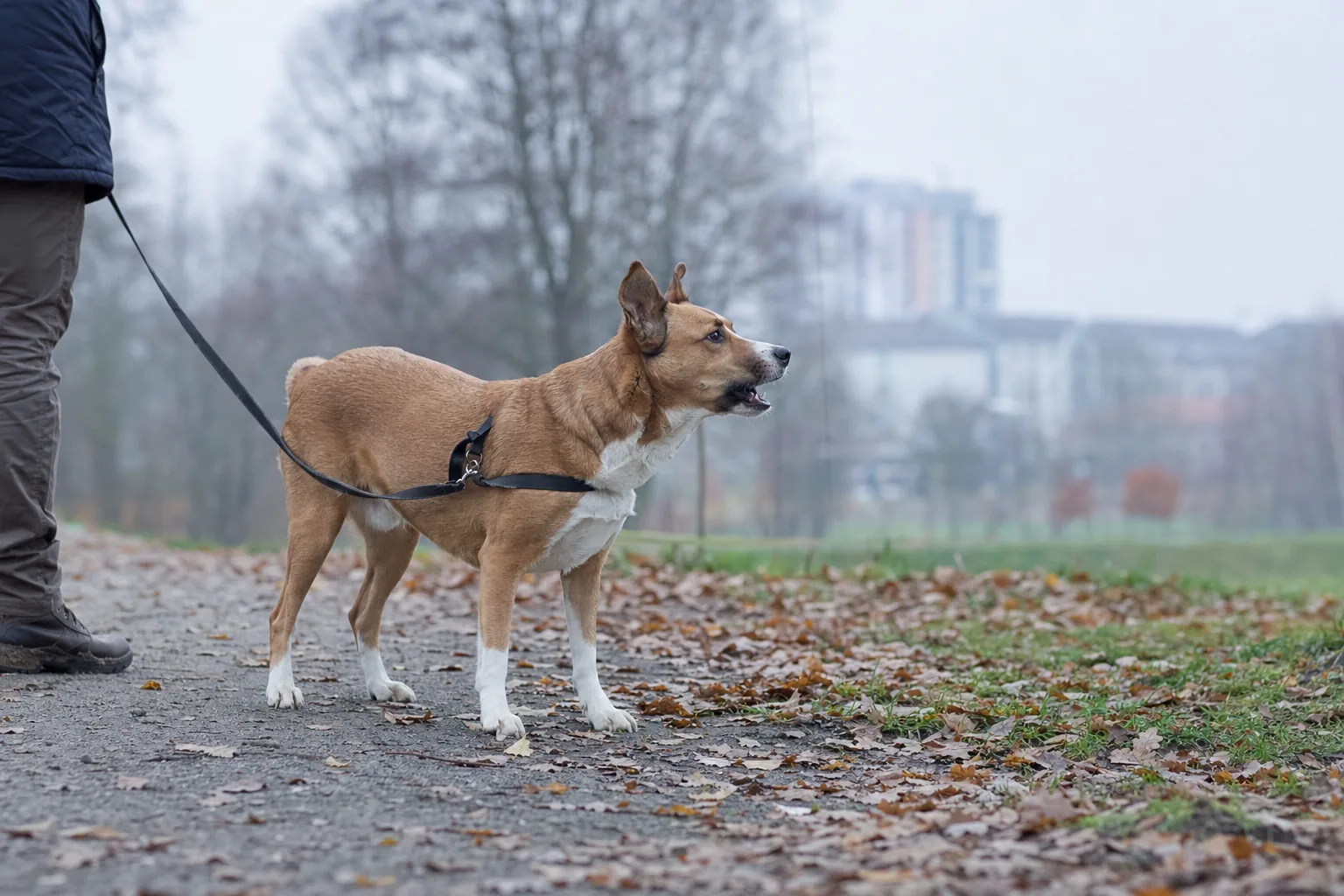
The doorbell goes, a friend walks in, and your dog has already vanished under the bed. He comes out once the visitor has gone, sometimes an hour later. Another dog sits next to you on a bench but barks and backs off the moment anyone reaches towards him. A third, adopted a year ago, is fine with the women in the house, yet the sight of a man in a hood flattens him to the pavement, shaking. Then there is the well-meaning passer-by who bends right over him saying "let him sniff me" while you are still working out how to stop them. This page is about those dogs: where fear of people comes from, what makes it worse without you noticing, and what a plan looks like that the dog can cope with, at his own pace.
Why is my dog afraid of people?
Too few people early on. Between three and twelve to fourteen weeks a puppy builds his picture of what is normal. A pup raised in a yard with one person, or kept indoors until four months old "until he has finished his jabs", missed meeting a range of people at exactly the age when it sticks easily. To him, a new person is an unknown. Unknowns are scary.
Genetics. Some dogs are born more cautious. If the mother or father was wary of people, the odds go up. You can still work with these dogs; it just goes more slowly.
A bad experience. A smack, a child who squeezed too hard, a vet visit where he was held down, a punishment. Once can be enough, especially if it landed in a sensitive period.
His earlier life. Street dogs and shelter dogs have often learned that a person coming towards them means a catch pole, a stone or being grabbed.
Why men in particular. Plenty of fearful dogs are more frightened of men. Men tend to have deeper voices, bigger bodies and heavier footsteps, wear beards or caps more often and look at a dog more directly. Sometimes the explanation is simpler: the pup spent more time with women. The same goes for people in hats, people with umbrellas or crutches, and children running about and shrieking.
Pain. A dog in pain, especially in the back, the hips or the ears, will avoid hands, including the hands of people he knows well.
What fear looks like before the barking
Most dogs say "I'm scared" several times over before they bark or growl. The signs come roughly in this order, smallest first:
- lip licking, yawning, looking away;
- turning the head or the whole body away, shaking off as if wet when he is dry;
- ears pinned back, tail lowered, body sinking towards the ground;
- freezing on the spot with the whites of the eyes showing;
- backing off, hiding behind you;
- growling, showing teeth, barking while retreating;
- biting, usually quickly, as a warning.
A dog whose small signals have been ignored learns to skip straight to the big ones.
What makes fear worse, even though it seems to help
"Let him sniff you." The stranger bends over, pushes a hand under the dog's nose and waits. For a fearful dog this is the exact picture he dreads: an unfamiliar person looming over him with a hand right by his face. Some dogs sniff the hand to be polite and then bite the moment it moves towards their head.
Treats from a stranger's hand. A hungry or curious dog comes in for the food and suddenly finds himself ten centimetres from the person who frightens him, with no way out. He takes the treat, then panics at how close he has got. Do it the other way round: the person tosses the treat away from themselves and the dog chooses how near he comes.
Flooding him with crowds. "I'll take him into town so he gets used to it." A dog overwhelmed by fear does not get used to it. He learns the world is even scarier than he thought. Sometimes he looks calm when he has really shut down.
Telling him off for growling. The growl is his warning. Punish it and the growling stops, the fear stays exactly where it was, and next time he bites without notice.
Punishment, shock collars, lead jerks. They add pain at the very moment he sees a person. He links people even more firmly with bad things.
Stroking him to calm him down. It does not make the fear bigger, but it does not do much good either. What helps at that moment is more space.
How to help a fearful dog gain confidence, step by step
1. Take him out of the situations that frighten him
While you are working on this, stop putting him in situations he cannot cope with. In practice:
- on walks, pick quiet routes and quiet times; when someone heads your way, cross the road;
- have a line ready for people who want to stroke him: "He's in training, please don't touch him"; a yellow ribbon on the lead is the international sign for "give me space", even if not everyone knows it;
- at home, give him a place of his own where nobody bothers him: an open, covered crate or a corner with his blanket in a quiet room.
2. The visitor routine
Give visitors the rules over the phone, before they arrive. People stick to them more easily when they already know than when you correct them on the doorstep with the dog beside you.
- They do not look at the dog, talk to him or touch him. As far as they are concerned, he is not there.
- They sit down quickly. A seated person is far less frightening than one standing.
- They keep a few good treats in a pocket and now and then, without looking at the dog, toss one away from themselves, never towards him.
- If the dog comes over to sniff, they let him. No reaching out, no stroking, no sudden movements.
- When they leave, they stand up slowly and you keep the dog on a lead or in another room.
The dog may stay in his spot for the whole visit. After each visit where nothing bad happened, he comes a little closer.
3. Getting him used to people from a distance
Behaviour books call this desensitisation and counter-conditioning. In plain English: you get him used to people slowly, from a distance at which he is still calm, and make people mean something good.
- Find the distance at which he can see a person and still eat and look at you. For some dogs that is 5 metres, for others 50.
- Every time a person appears at that distance, he gets a really good treat straight away: cheese, boiled chicken, whatever he loves most. The person leaves, the treats stop.
- Repeat for days on end, from a park bench, outside a shop, wherever your walks take you anyway. One day he sees a person and turns to you on his own, looking for his treat. That is when you move a metre closer.
- If he barks, backs away or stops taking food, you were too close. Back off and start again from further away.
4. The "come and go" game with someone he knows
A friend the dog tolerates sits on a chair and tosses a treat well behind the dog, who goes off after it. The next one lands nearer the person; the dog comes in to get it and is immediately sent away again by a treat tossed far off. He approaches and retreats on his own, as often as he likes, and learns that this person will not grab him.
5. Touch, and only at the end
If the day comes when the dog goes up to the person on his own and asks for contact, the person strokes him for three seconds on the side of the chest, not the head, then stops. Should he stay or nudge the hand, he gets another three seconds. Should he walk off, he is allowed to. The dog decides.
The first week, day by day
| Day |
What you do |
| 1 |
Start a diary: which people scare him, at what distance, what he does. Choose quiet routes. |
| 1–2 |
Set up his own spot at home. Write down the visitor rules. |
| 2–7 |
Distance work, 5–10 minutes a day, in the park or on the street, with his favourite treats. |
| 4–7 |
A short visit from a calm friend, following the rules. The "come and go" game, only if he is relaxed. |
| 7 |
Read back through the diary: has the distance shrunk? If not, give it another week at the same distance. |
When there is a medical cause
Fear of people is rarely an illness. Sometimes, though, an illness makes it worse, and then a visit to your own vet is worth it:
- the fear came on suddenly in a dog who used to be sociable;
- he flinches mainly when touched in certain places: back, hips, ears, mouth;
- other things have changed too: he sleeps a lot, has put on weight, his coat has thinned (the thyroid), his sight or hearing is going;
- he is an older dog who seems confused and no longer recognises people he knows.
Some dogs are so frightened they cannot learn anything because they live in a state of panic. For them, your vet or a veterinary behaviourist can talk through treatment to bring the anxiety down far enough for the plan above to become possible.
How nose work helps
In mantrailing the dog follows a person's scent and finds them. For some fearful dogs that is a real help. The dog works the trail at his own speed, reaches the hidden person, and the person simply stays still and drops a few good treats on the ground. No outstretched hands, no eye contact, the person never steps towards the dog. Search after search, he learns that finding a stranger means something good and that he still decides how close he gets. It is not suitable for a dog in panic and it does not replace behaviour work. For a cautious dog it can be a good step, with an instructor who knows from the outset that they are working with a fearful dog.
When to call in a specialist
- he has bitten someone or tried to;
- he growls at people in his own household or is afraid of them too;
- the fear is so strong he cannot leave the house or will not eat outside;
- you have worked consistently for four to six weeks and the distance is not shrinking;
- there are children at home and he is afraid of them.
At an assessment, the instructor or behaviour specialist starts from your dog and your diary. You come away with a plan built around his pace and with someone who can see from the outside what you no longer notice from the end of the lead.
A behaviour that appears suddenly or changes for no apparent reason can have a medical cause. For full details, consult your dog's own veterinarian.