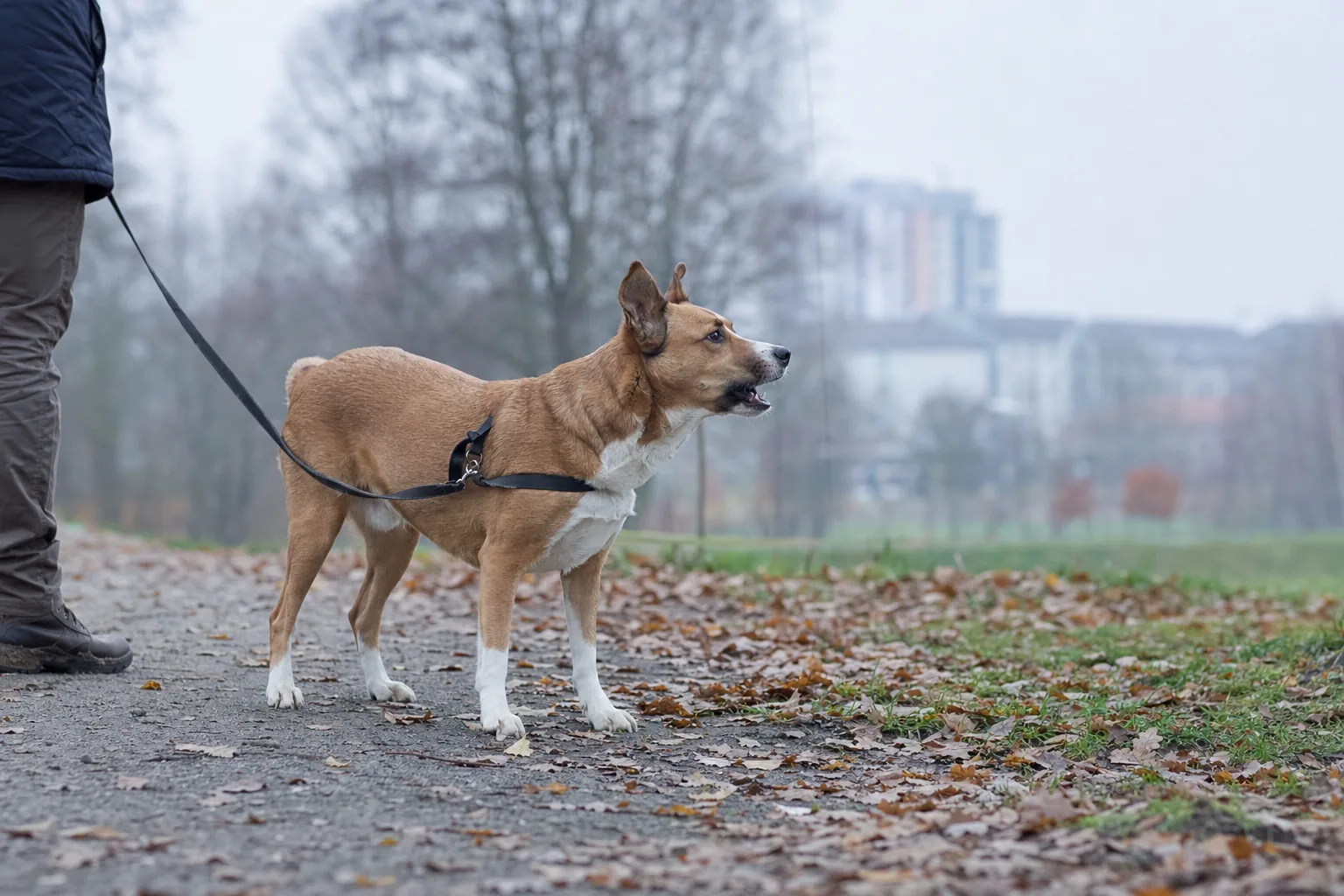
On Saturday evening a friend bent down to stroke him on the head and the dog caught his wrist. A second, no blood, but the whole table went quiet. You have not had anyone round since. Or you have a four-year-old who, since he started limping, bares his teeth when you lift him onto the sofa. Or your child walked up to the dog's bed, got a short growl, and you froze with a plate in your hand. If you are reading this, you are probably a little afraid of your own dog and have nobody to tell. Aggression towards people is the hardest thing we deal with, and no web page fixes it. What this page can do is show you what the dog is telling you before he bites, where it comes from almost every time, what makes it worse without you noticing, and what you start today so that nobody else is bitten before you reach a professional.
Where does aggression towards people come from?
A dog bites for the same reason he growls: he wants something to move away. The hand, the person, the child. He has learnt that it works, and he uses what works. He almost never goes straight to the bite. There is a ladder, and he climbs it rung by rung, sometimes in two seconds: turns his head away, licks his lips, yawns, freezes, shows you the whites of his eyes, growls, bares his teeth, takes a step forward, grabs without squeezing, bites. At assessments we often hear about dogs "who bite without warning". Almost every time, someone spent years punishing the lower rungs, and the dog gave them up. If you keep one thing from this page, keep this: a dog who growls is still talking to you. Silence him and you are left with the teeth.
Where it comes from, in the order we meet it:
Fear. By a long way the most common. The stranger reaching down from above, the child wrapping both arms round him, the man in a hat, the person leaning over him. Look at the body: weight back, tail low, ears flat. He bites because there is nowhere to go, or because he has tried to leave a hundred times and nobody let him.
Pain. The dog who bites when touched on the hip, when lifted, brushed or woken. The dog who "turned nasty" at seven. Arthritis, a tooth, an ear, the back. Pain shortens his patience for everything, and a dog who has suffered in silence for weeks bites one day over a touch he put up with yesterday.
Guarding something. The bowl, a bone, a toy, the sofa, the bed, a person in the house. We have a separate page on resource guarding, because it is one of the most predictable forms and among the easiest to keep under control.
Territory. The fence, the front door, the car, the garden. The postman leaves anyway, and the dog learns every day that he saw him off.
Redirection. The dog is wound up at another dog, at the fence or at the doorbell, you grab his collar, the teeth land in your hand. They were not meant for you. They hurt just the same.
A bite that worked. He bit once, the person backed off, the lesson stuck. He has skipped the rungs ever since.
And the thing that is not a cause, although you hear it most: "dominance". The idea that you have to be the "alpha" comes from old studies of wolves kept in captivity, which their own authors have since retracted, and the veterinary behaviour associations say plainly that it should be dropped. The dog who growls when you move him off the sofa is not trying to run the family. He wants the sofa. Or his hip hurts when he jumps.
When you get to the professional, it helps to know how hard he bit. Behaviour work uses a few levels: snapped at the air, no contact; touched without puncturing (a bruise, a tooth scrape); one to four shallow punctures from a single bite; deep punctures with bruising, where the dog clamped or shook; several deep bites. Most of the cases we see sit at the first two levels. A dog who stopped before puncturing is controlling his jaws, which professionals call bite inhibition, and that counts for a great deal in what comes next.
What does not work, even though it seems to
Telling him off for growling. He growls, you shout, he goes quiet. Looks solved. You have taken away his warning signal and left the cause exactly where it was: the fear, the pain, the bone. Next time he skips the growl. It is the mistake we find most often in the history of dogs "who bit out of nowhere".
Rolling him onto his back, grabbing the scruff, "showing him who is boss". They stop the behaviour on the spot, through fear. In a study of dogs brought to a behaviour clinic, confrontational methods set off an aggressive response in a quarter to a half of the dogs, depending on the method. With a dog who already bites, you are pouring petrol on it.
A shock collar or a prong collar. The pain lands at the exact moment the dog sees what frightens him, and confirms that he was right to be afraid. The person holding the remote becomes a source of pain too.
"Let him sniff you, he will get used to it." The frightened dog, held on the lead, while the stranger walks up with a hand out. He cannot leave. One exit remains. Most dogs who bite visitors have been through that scene dozens of times before the first bite.
Reaching for a dog who is backing away. We all do it. To a frightened dog, a hand coming from above is a threat. The hand stays down by your side. If he wants to, he comes to it.
A telling-off five minutes later. He does not connect it to the bite. He connects it to you.
"It only happened once." The first bite is nearly always the second or third you did not see; the rungs before it were there. Waiting for a second one means waiting for someone to be hurt worse.
The plan, step by step
The order is not up for discussion: first nobody else gets bitten, then the vet, then the work on the emotion, alongside a professional. This page gets you to the professional with your homework done; aggression does not get fixed off the internet, and you know that.
1. Safety, from today
The dog no longer ends up in the situation where he bit. If he bites visitors, he is in another room with something to chew before the doorbell goes. If he bites when touched, nobody touches him there any more. If he growls at the child near his bed, the bed moves to where the child cannot reach it, and the child is never alone with the dog, not even for two minutes. A child gate, a lead worn around the house, the bed in another room. It feels like giving up. It is the first treatment.
2. The diary
Every episode, growls included: who, where, what was happening one second before, what the dog did, the bite level if there was one. In two weeks you have a pattern: "unfamiliar men coming through the door", "touched on the back while asleep", "the child near the bowl". The pattern is the first thing the professional asks for, and the first thing that tells you where not to put him any more.
3. The muzzle, taught as a game
A basket muzzle: the dog can pant, drink and take treats through it. You do not put it on him on day one. For the first two days the muzzle appears, the dog gets a treat, the muzzle disappears. On the third and fourth days the treat sits inside it and the dog puts his own nose in after it. From the fifth, the nose stays in for two or three seconds, then five. In the second week the strap closes for a second, then longer, then the dog walks round the house in it for five minutes. A dog who puts his nose into the muzzle of his own accord can go to the vet, go out in the street and start work with the professional without anyone being in danger.
4. The vet, diary in hand
A full examination, including the joints and the teeth. Tell your vet exactly what you wrote down: "bites when touched on the left hip", "started three months ago". Many cases of aggression "out of nowhere" in dogs over six are closed by treating the pain.
5. Working on the emotion, from a distance
With a behaviour professional, the dog learns that the person who used to frighten him now predicts something good. The stranger appears 15 metres away, the dog gets the best thing in his world, the stranger leaves. No approach, no outstretched hand, for weeks on end. The distance shrinks when the dog asks for it, not when the people get bored. Touch is worked the same way: the hand comes a hand's width closer to the sore spot, a tasty bit and a kind word follow, the hand leaves. The dog also learns to say "stop" with a gesture, for instance by lifting his chin off your hand, and you stop every single time. A dog who knows he is listened to no longer needs his teeth.
6. The second he growls
You stop. No approaching, no shouting, no punishing. One step back, give him room, and when he relaxes call him from another part of the room in a normal voice. Write it in the diary. The growl has just saved you a bite, and the dog has to see that it works. Otherwise he replaces it.
The first week
| Day |
What you do |
| 1 |
Close off every situation in the history: gate, lead indoors, bed moved, visitors warned. Open the diary. |
| 2 |
Book the vet, diary in hand. Buy the basket muzzle and leave it in the bag for now. |
| 3–4 |
Muzzle appears, treat, muzzle disappears, ten times a day. The whole household learns the rule: the growl is not punished. |
| 5–7 |
Nose in the muzzle for a few seconds. Look for a behaviour professional and ask what methods they use before you book. |
When it is a medical problem
With a dog who bites, the medical check is in the plan from the start. It becomes urgent when:
- the aggression appeared suddenly in a dog who was gentle for years;
- he bites when touched in one particular place, when lifted, when jumping up or down, when woken;
- his gait has changed, he struggles to get up, refuses the stairs, licks one joint;
- he shakes his head, rubs his ears, has bad breath, chews on one side;
- his sight or hearing is going and he startles at things he used to ignore;
- he is old and seems disorientated and restless in the evening or at night;
- he started a new treatment and the aggression came after it.
A dog in pain is not a bad dog. Until the check-up, treat any bite on being touched as pain he has no other way of telling you about.
When to call a professional
For a dog who has bitten or tried to bite a person, the answer is now. All the more so if:
- there are children or elderly people in the house;
- he has bitten with a puncture, however small;
- he bites without the warning signs he used to give;
- he growls at family members when touched or near his bed;
- after two weeks of the diary you see no pattern at all;
- you are afraid of him and it is changing how you move around your own home.
Ask the professional what methods they use before the first session. If the answer includes "correction", "dominance" or a collar with a remote, look elsewhere. A good professional starts with your diary, the vet check and a plan that makes the house safe for everyone, and tells you honestly what to expect: with aggression the talk is of keeping it under control and making it smaller, rarely of making it disappear. In most countries a dog who has bitten a person is reported and placed under veterinary observation for rabies, usually around two weeks, and the owner may be required to keep him muzzled and on a lead in public; check the rules where you live. A dog who learnt his muzzle as a game goes through all of that without stress. One who has it forced on does not.
A behaviour that appears suddenly or changes for no apparent reason can have a medical cause. For full details, consult your dog's own veterinarian.