You notice it one evening under the kitchen light: a bluish sheen in your dog's eyes that was not there before. Or your nine-year-old has walked into the table leg twice this week and stopped dead at the top of stairs he has climbed all his life. Or your two-year-old has a pearly white spot right in the middle of the pupil. All three owners end up asking the same thing: is it a cataract, and is he going blind? The answer varies a lot from dog to dog. A bluish eye in an older dog is usually an age change he sees through almost normally. A white spot that keeps growing is a different matter. Treatment is your vet's call, often together with a veterinary eye specialist; your part is spotting what is urgent, keeping useful notes and making life easier for the dog.
When a cloudy eye is an emergency
A cataract does not hurt and will not have you driving to the clinic at midnight. Some conditions that look like it, or grow out of it, will. Call today if you see:
- a red, watery eye that he keeps half closed or rubs on the carpet (it hurts);
- one eye that looks bigger than the other, or a cornea (the clear front layer) that turns blue-grey like frosted glass within hours;
- blindness that comes on over a day or two, with wide pupils that do not shrink in the light;
- a white eye that has developed over a few weeks in a dog who is drinking and peeing far more than before (the classic sign of diabetes);
- an oddly shaped pupil, or a shadow that seems to have dropped inside the eye, after a knock.
Behind these can be glaucoma (high pressure inside the eye), a luxated lens (the lens slipping out of place) or inflammation inside the eye. Glaucoma can destroy sight in hours. Phone, describe exactly what you see, and if your vet has no equipment to measure eye pressure, they will send you to someone who does.
Cataract or just age: what to watch at home
Behind the pupil sits the lens, normally crystal clear. A cataract is that lens turning cloudy and then white, rather like egg white in a hot pan. Less and less light gets through. First the dog sees as if through a steamed-up window, then not at all.
The confusion comes from a second change that nearly every dog over 7 or 8 gets, and which looks much the same to an untrained eye: nuclear sclerosis. The lens hardens with age and goes slightly hazy. The eye looks bluish and milky, especially in flash photos. The dog sees almost normally and needs no treatment at all.
The differences at a glance
| What you see |
Nuclear sclerosis (age) |
Cataract |
| Colour |
Even blue-grey, like smoke |
Chalky white, sometimes with spots or lines |
| Both eyes |
Almost always, equally |
Often, but one tends to go first |
| Age |
Over 7 or 8 |
Any age, including puppies and young dogs |
| Sight |
Almost normal |
Gets worse, from hesitating to blindness |
| Speed |
Years |
Months, or weeks with diabetes |
Use the table as a rough guide. The vet makes the call, and can tell the two apart in seconds with a light and a magnifier.
Three simple tests that will not frighten him
Put an empty box in his usual route through the house and watch whether he steps round it early or bumps into it. Try it once in daylight and once in the evening with the lights low. Plenty of dogs with early cataracts manage fine in sunshine and get lost at dusk.
Toss a ball of paper or a cotton wool pad across his line of sight, without a sound. A sighted dog follows it with his eyes.
Do not flick your hand at his face to see whether he blinks. He feels the air move and blinks anyway, so it tells you nothing.
What to write down
When you first saw the white, and in which eye. Whether it has grown. How he moves around the house, on the stairs and in the park, by day and by night. Whether he is drinking more: for a few days, measure what goes in the bowl in the morning and what is left at night. Any weight loss, any knock to the head or eye. His breed and, if you know, whether his parents or littermates had eye problems.
Once a month, photograph his eyes in natural light, straight on and slightly from the side. No flash: with flash almost any dog's eye comes out white or green and you have nothing to compare.
At the clinic: what the vet checks
- The history. How old he was when the white appeared, how fast it has grown, his breed, whether he drinks a lot, any illnesses and current treatment. Your notes make this quick.
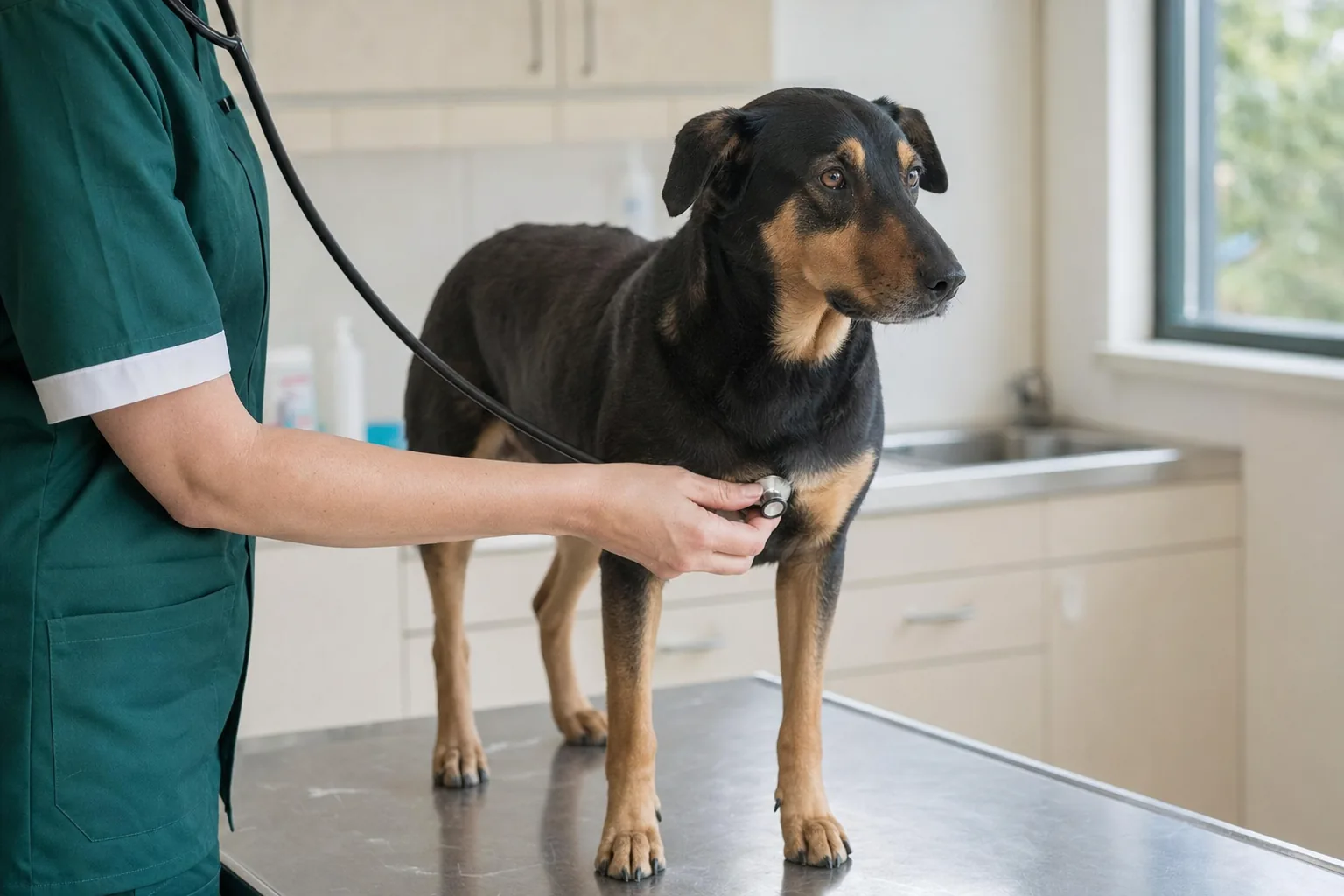
- The eye exam. How the pupils react to light, whether he blinks at a gesture, then a look inside with a lamp and magnifier (an ophthalmoscope) once the pupils have been dilated with drops. That shows whether the white is in the lens or somewhere else, how big it is and whether the retina at the back can still be seen.
- Eye pressure. A small device touches the cornea lightly after a numbing drop. It does not hurt. It matters, because a cataract can inflame the eye and lead to glaucoma.
- Blood and urine tests, if diabetes is suspected or if he is an older dog who might go on to surgery.
- Referral to a veterinary eye specialist, if the cataract is affecting his sight and he could be a candidate for surgery. Before an operation there is usually an eye ultrasound and an electroretinogram, a test that shows whether the retina still works. If the retina is diseased, for example by an inherited condition that slowly destroys it, surgery on the lens will not bring his sight back.
- The decision. Only surgery restores sight: the cloudy lens is broken up with ultrasound and removed, and usually replaced with an artificial one. Not every dog is suitable. Age alone does not rule him out; his general health, his temperament and the aftercare count, with drops several times a day for weeks, a cone and check-ups. If he is not operated on, the vet checks the eye at regular intervals and treats any inflammation so it does not turn into a painful eye.
Before you leave, ask three things: how fast it is growing, which signs of pain mean coming straight back, and when the next check-up is.
Mistakes to avoid at home
- Drops that "dissolve cataracts". They are sold online with big promises. Nothing shows that any drop makes a dog's lens clear again. You lose time, and while you wait for results you may miss the eye starting to get inflamed.
- Leftover drops from another treatment, yours or another pet's. Some make damage you cannot see worse.
- "It's just his age", and putting off the vet. Sometimes it is. But a white eye in a dog who drinks a lot can be the first sign of diabetes, which needs treating quickly, and a growing cataract can inflame the eye.
- Moving the furniture. A dog who is losing his sight keeps himself safe with the map of the house in his head. Leave it as he knows it.
- Off lead near roads, deep water or steep drops. He may come back beautifully when called and still not see the danger.
- Touching him without warning. A dog who sees poorly startles when touched out of nowhere and may snap by reflex. Talk to him before you reach him.
As his sight fades
Dogs cope with losing their sight far better than we fear. Their world is built mostly from smell and sound. Help him with a mat of a different texture at the top of the stairs and by the door, a few simple words you always use ("careful", "step", "wait"), a bell on the other dog's collar and a scent dabbed on dangerous corners. Outside, a long line and the same route.
On the trail we see it again and again: the eyes go, the nose stays exactly as it was. Treats hidden round the house or a short track through grass are things he can do as well as he ever did. And an old dog who has found what he was looking for on his own is a different dog for the rest of the day.
The information on this page is educational and does not replace an examination. For full details and a diagnosis, consult your dog's own veterinarian.