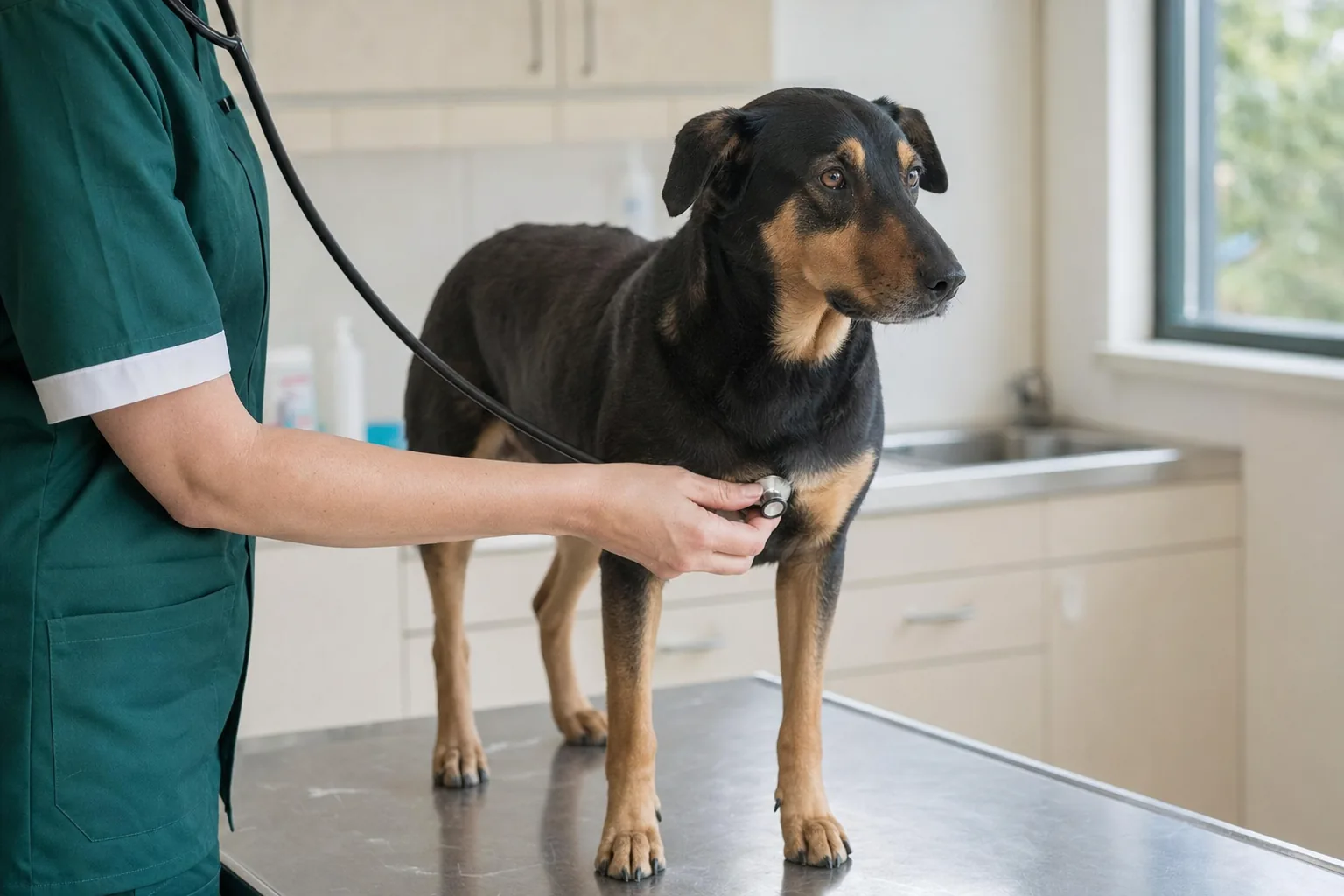
Caution. Hearing gone from one day to the next, a head tilt, wobbling or circling, flicking eyes, a sore or discharging ear, or worse hearing after new ear drops: see your own vet the same day. Put nothing in the ear until the vet has looked at it.
Noticed something different about your dog? Go straight to their vet.
Do not look for the answer in a Facebook group, on TikTok or on a forum. Look for someone trained for this: your dog's own veterinarian, the only person who can examine, investigate and treat them.
- The same sign, dozens of causes. A dog that vomits may have eaten grass or may have an object stuck in the gut. From two lines you typed, nobody can tell which. The vet feels the abdomen, takes the temperature, runs tests.
- Nobody on the internet sees your dog. They see a photo and a story. A diagnosis comes from an examination and investigations, not from a resemblance to someone else's dog.
- In groups you hear from the people whose dog "got better on its own". Those for whom it ended badly rarely post again. What you read there is a selection, not a statistic.
- Doses are calculated by weight and species. Human medicines that look harmless, paracetamol or ibuprofen, are toxic to dogs. "I gave mine half a tablet" is the most dangerous advice you can get.
- Hours matter. With a twisted stomach, a poisoning or a urinary blockage, the time spent asking online is exactly the time that decides the outcome.
- The vet is accountable for what they say. They have your dog's record, history, vaccinations, past treatments. An anonymous account has none of that and answers for nothing.
Use this page to know what to observe, what to note and what to ask at the appointment, not to treat at home. If you still have doubts after a consultation, ask another vet or a specialist (dermatologist, internist) for a second opinion, not a group. And if you do not have a regular vet yet, find one now, while your dog is healthy: how to choose a veterinary clinic.
Your dog is eleven and no longer comes when you call him from the kitchen. He sleeps more deeply, has stopped reacting to the doorbell and jumps when you touch him while he is asleep. At first you put it down to old age and a stubborn streak. Or you have an eight-week-old Dalmatian pup who plays just like his littermates but does not turn his head when you clap behind him. Deafness usually creeps in so slowly that the family are the last to notice. And a deaf dog lives a perfectly good life once you change a few habits.
A dog loses his hearing by one of these routes, and the route decides what can still be done:
- Born deaf. Usually inherited and linked to coat colour. It is more common in dogs with a lot of white on the head or a merle coat (mottled, marbled), especially in pups from two merle parents. Affected breeds include the Dalmatian, English Setter, Australian Shepherd, white Bull Terrier and Australian Cattle Dog. The puppy is born hearing, but the cells of the inner ear die off in the first few weeks.
- Deaf with age. It comes on gradually, usually after ten, and high-pitched sounds go first.
- A blocked ear, from wax, chronic ear infections or a canal thickened by years of inflammation. This one can improve, sometimes a lot.
- Damage to the inner ear from some infections, from certain medicines or ear drops used on a perforated eardrum, from a blow to the head, or from very loud noise such as gunfire for working gundogs.
When to call the vet today
A dog whose hearing gets a little worse each year needs an appointment, not an emergency visit. Call the same day if:
- he stopped hearing suddenly, from one day to the next;
- he holds his head tilted to one side, wobbles, falls over to one side or walks in circles;
- his eyes flick rapidly from side to side or up and down;
- the ear hurts (he yelps when you touch it, rubs his head on the floor), smells bad or is discharging;
- his hearing got worse after new ear drops;
- he has had a knock to the head;
- on top of the deafness, he is vomiting or cannot stay on his feet.
A head tilt, wobbling and flicking eyes mean his balance is affected too. The inner ear handles both. Some causes, such as a middle or inner ear infection, respond better the sooner treatment starts.
How to check his hearing at home
The tests
Do them when he is awake and calm but not asleep, without him seeing you, feeling you or feeling the air move. Deaf dogs compensate very well with their eyes and their feet, so the test has to leave sound as the only clue.
- From behind, without vibration. Stand behind him, two or three metres away, on a rug (on wooden floors he can feel your steps). Jingle a bunch of keys, squeak a toy, rustle the treat bag. A dog who can hear turns his head or at least swivels an ear towards the sound.
- From the left, then the right. A dog who hears with one ear only will react, but he turns the wrong way or searches for the sound at random.
- High sounds and low sounds. A thin whistle, then a low knock on the door. In old age the high notes go first, so he may still react to a deep voice and to the door.
- While he sleeps. Say his name from a metre away, then louder. Note whether he wakes.
Repeat a few times on different days. A dog who is fast asleep or has his nose in a good smell can ignore sounds even with perfect hearing.
What to write down
- when you first noticed the change, and whether it came on gradually or suddenly;
- which sounds he still reacts to (doorbell, voice, whistle, clapping) and which he does not;
- whether he seems to hear better on one side;
- what the ears look like: scratching, head shaking, smell, lots of wax, redness;
- balance: wobbling, head tilt, bumping into things;
- other changes: barking louder, startling more often, sleeping more, seeming lost at night;
- any drops or treatments put in his ears in recent months (keep the boxes).
What it might be
| What you see |
What it might be |
How you recognise it |
| Puppy who does not react to sounds, breed with lots of white or merle |
Congenital deafness, in one or both ears |
From the first weeks; confirmed by a hearing test |
| Old dog hearing less and less, year by year |
Age-related deafness |
Gradual, high-pitched sounds first |
| Scratching, smell, wax, sore ear |
Ear infection, blocked canal |
Can improve after treatment |
| Sudden deafness with head tilt and wobbling |
Infection or disease of the middle or inner ear |
Urgent, affects balance too |
| Old dog who "won't listen" and seems lost |
Deafness, but also an ageing brain |
Wanders, gets stuck in corners, sleep pattern changes |
What the vet will do
- Listen to you. Tell them what your home tests showed, when and how it started, his breed and age, and what has gone into his ears.
- Look into the ears with an otoscope. They check for wax, pus, foreign bodies and a narrowed canal, and look at the eardrum, whether it can be seen and whether it is intact. If the ear is very painful, this is sometimes done under sedation.
- Neurological examination if he is wobbling, tilting his head or his eyes are flicking: reflexes, gait, cranial nerves.
- Cytology if the ear is inflamed. A sample of wax or discharge goes under the microscope to look for bacteria, yeast or mites.
- Hearing test (BAER). It is the only objective way to measure a dog's hearing. A few fine electrodes go under the skin of the head, clicks are played into each ear, and the machine records how the brain responds. It takes a few minutes, sometimes under light sedation, and shows how well each ear hears separately. It is usually done at neurology referral centres or vet schools, and in puppies from 5–6 weeks. In at-risk breeds, good breeders test every pup before it leaves.
- Imaging (X-ray, CT or MRI) if they suspect a middle ear infection, a tumour or a problem in the brain.
- Treatment depends on the cause. A blocked or infected ear can be treated, and hearing sometimes comes back partly. Congenital and age-related deafness cannot be treated, but dogs adapt remarkably well. Hearing aids for dogs do exist, but they are rarely used and few dogs put up with them.
Living with a deaf dog
A deaf dog who is raised or helped to adjust properly has as good a life as any other dog. A few things change.
- Hand signals. Teach him one gesture for each thing: an open palm facing up for "good", an arm drawn in to your chest for "come", a flat palm held down for "stay". Dogs often pick up gestures faster than words. The "good" signal followed by a treat or a stroke becomes your way of telling him he got it right.
- Getting his attention without sound. A gentle stamp on the floor (he feels the vibration), a torch switched on and off in the evening, a hand placed lightly on his shoulder. Every time he looks at you of his own accord, give him the "good" signal and be pleased with him. A deaf dog who checks in with you often is a safe dog.
- Waking him gently. Do not touch him suddenly while he sleeps. Put your hand in front of his nose so he can smell you, or touch him lightly in the same spot every time, on the shoulder. Deaf dogs woken suddenly get a fright, and that fright is behind a lot of bites.
- On lead outside. He cannot hear cars, bikes, horns or you calling him. Off lead only in enclosed spaces, or on a long line.
- A tag on his collar saying "I am deaf" with your phone number.
What not to do at home
- Do not put anything in his ears until the vet has looked: no oil, no hydrogen peroxide, no alcohol, no leftover drops from last year's ear infection. If the eardrum is perforated, some of these can damage the inner ear and make the deafness permanent.
- Do not clean his ears with cotton buds pushed into the canal. You push the wax deeper and can rupture the eardrum.
- Do not tell him off for "not listening". If he cannot hear, scolding only confuses and frightens him. Check his hearing first.
- Do not use shock collars as a signal for a deaf dog. Pain is no way to talk to him. Some handlers use collars that only vibrate gently, patiently taught to mean "look at me, something good is coming". If you are considering it, do it with a trainer.
- Do not let him off lead near roads or in open spaces, however well he responds to hand signals.
- Do not put off the vet if the deafness came on suddenly or with wobbling. A few days can matter.
A deaf dog can do sport too. Mantrailing suits a deaf dog very well: everything happens through the nose and the lead, and the dog does not need to hear commands to follow a trail.
Frequently asked questions
What dog owners search for most often on the internet about this problem, with the short answer. The answers are a guide only: the decision belongs to your dog's own vet, after an examination.
How can I tell if my dog is deaf?
Stand behind him on a rug, where he cannot see you or feel your steps, and make a sound: jingle your keys, squeak a toy, say his name. A dog who hears turns his head or at least flicks an ear. Try both sides, on different days. The definite answer comes from a BAER hearing test at a specialist clinic.
Why do old dogs go deaf?
Over the years the cells and nerves of the inner ear slowly wear out, and high-pitched sounds go first, usually after the age of ten. Just as often, though, hearing drops because of wax, chronic ear infections or a thickened canal, and those can improve. Get him checked before you put it down to age.
Can deafness in dogs be cured?
It depends on the cause. If the ear is blocked by wax or infection, some hearing sometimes comes back after treatment. Deafness from birth and age-related deafness cannot be cured, but dogs cope very well with their eyes, their nose and vibration. Hearing aids for dogs do exist; few dogs put up with them.
Which dog breeds are most often born deaf?
Breeds where coat colour is tied to particular genes, meaning lots of white on the head or a merle coat: Dalmatians, English Setters, Australian Shepherds, white Bull Terriers, Australian Cattle Dogs and others. The risk is high in pups from two merle parents. Good breeders have the litter's hearing tested before the pups go to new homes.
How do I communicate with a deaf dog?
With hand signals, one per thing, followed by a tasty treat or a stroke, plus vibration (a tap on the floor) and light (a torch flicked on and off). Wake him gently, hand in front of his nose, and keep him on lead outside. Dogs pick up signals quickly, sometimes faster than words.
The information on this page is educational and does not replace an examination. For full details and a diagnosis, consult your dog's own veterinarian.