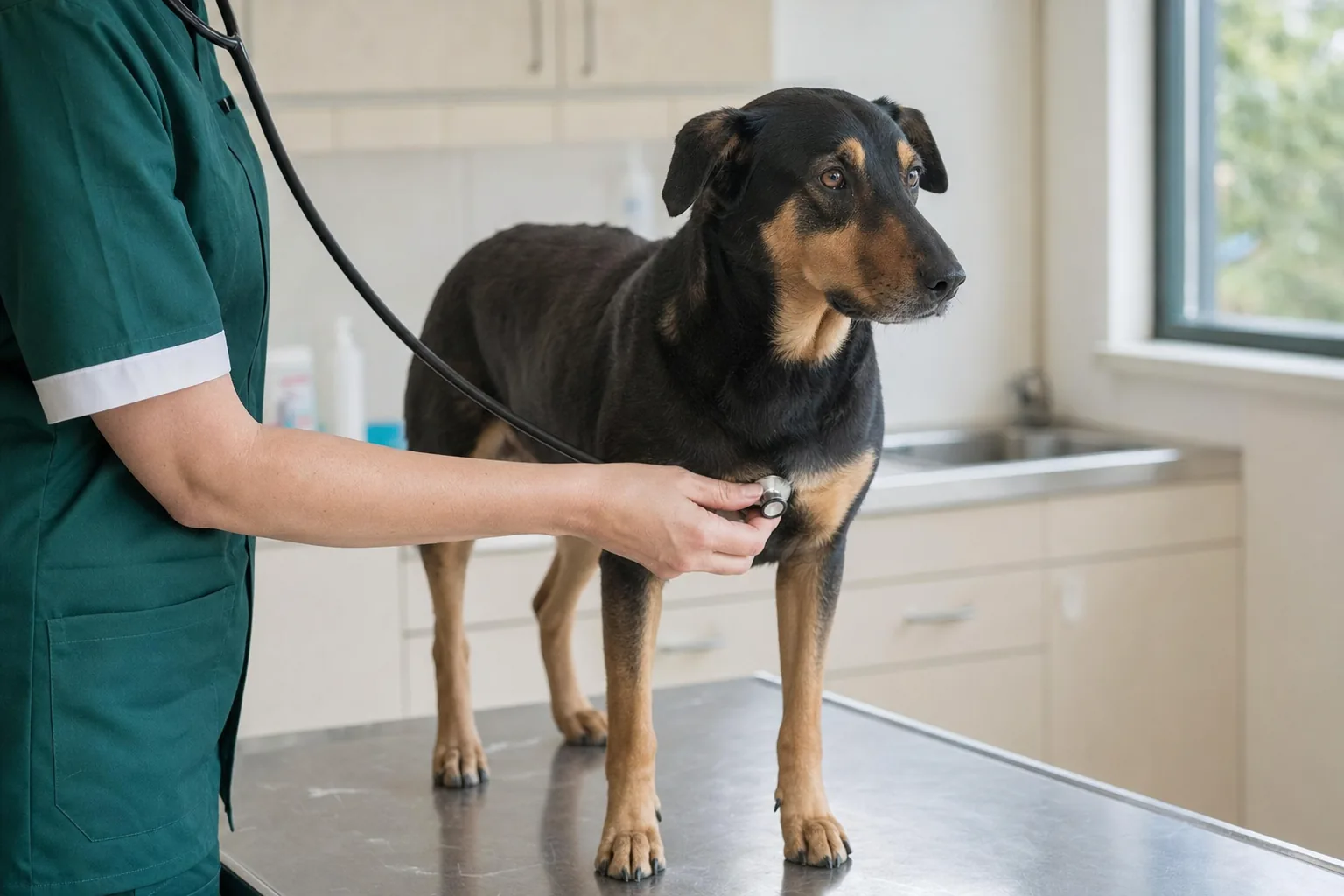
Caution. Dandruff with heavy itching, sores, round hairless patches, damp smelly skin, weight loss or great thirst, flakes that move, or itchy bumps on people in the house: book your own vet today or tomorrow, before you try another shampoo.
Noticed something different about your dog? Go straight to their vet.
Do not look for the answer in a Facebook group, on TikTok or on a forum. Look for someone trained for this: your dog's own veterinarian, the only person who can examine, investigate and treat them.
- The same sign, dozens of causes. A dog that vomits may have eaten grass or may have an object stuck in the gut. From two lines you typed, nobody can tell which. The vet feels the abdomen, takes the temperature, runs tests.
- Nobody on the internet sees your dog. They see a photo and a story. A diagnosis comes from an examination and investigations, not from a resemblance to someone else's dog.
- In groups you hear from the people whose dog "got better on its own". Those for whom it ended badly rarely post again. What you read there is a selection, not a statistic.
- Doses are calculated by weight and species. Human medicines that look harmless, paracetamol or ibuprofen, are toxic to dogs. "I gave mine half a tablet" is the most dangerous advice you can get.
- Hours matter. With a twisted stomach, a poisoning or a urinary blockage, the time spent asking online is exactly the time that decides the outcome.
- The vet is accountable for what they say. They have your dog's record, history, vaccinations, past treatments. An anonymous account has none of that and answers for nothing.
Use this page to know what to observe, what to note and what to ask at the appointment, not to treat at home. If you still have doubts after a consultation, ask another vet or a specialist (dermatologist, internist) for a second opinion, not a group. And if you do not have a regular vet yet, find one now, while your dog is healthy: how to choose a veterinary clinic.
White flakes have turned up on your dog's black coat, mostly along the back and at the base of the tail. When you stroke him, a fine dust is left on your palm. Maybe it started when the heating came on, maybe after you washed him with your own shampoo "because it's gentler", maybe after a week in kennels. Sometimes dandruff is just dry skin and sorts itself out with brushing and less dry air indoors. Sometimes it is the first visible sign of an allergy, a parasite or a hormonal disease. This page helps you tell "let's give it another week" from "let's ring the vet", and shows you what to write down so your own vet can get to the cause quickly.
Vets call skin that flakes too much "seborrhoea". A few breeds have an inherited form (cocker spaniels, West Highland terriers, bassets and German shepherds among them), which shows up when the dog is young and lasts for life. In most dogs, though, dandruff comes from somewhere else: the skin is reacting to something, and if you only treat the flakes they keep coming back.
When to ring the vet
Dandruff on its own, in a happy dog who is eating and playing, isn't an emergency. Ring today, or tomorrow at the latest, if you see:
- heavy itching: he scratches, chews or licks so much that he can't sleep, or he has made himself sore;
- hairless patches, round or irregular, with crusts, redness or inflamed edges;
- damp skin that smells bad or weeps;
- dandruff along with weight loss, great thirst, listlessness, nosebleeds or nails growing oddly fast;
- flakes that seem to move when you look closely on black paper (the Cheyletiella mite, known as "walking dandruff");
- itching and red bumps on people in the house too, especially on the arms and tummy;
- a puppy under six months with dandruff and hairless patches.
Don't sit on the last three, because some causes of dandruff (parasites, ringworm and other fungi) pass from dog to people or to the other animals at home.
What to check and note at home
The black paper test
Stand your dog on a sheet of black paper or a dark T-shirt and brush him briskly for two minutes along the back and at the base of the tail. Then look at what has fallen, with a magnifying glass if you have one.
White flakes that stay put are skin shedding. Flakes that crawl slowly are mites. Black specks that leave a reddish smear on a damp tissue are flea dirt. Take photos to show your vet.
A skin diary
For a week, write a few lines a day, on paper or in your phone:
- where the dandruff is: all over, just the back, the base of the tail, face and ears, paws;
- what it looks like: small dry flakes, or greasy yellowish scales stuck to the hair with a rancid smell;
- itching on a scale of 0 to 10, where 0 means no scratching at all and 10 means scratching through the night until he is sore;
- the coat: shine, shedding, thinning patches, skin going darker or thicker;
- what has changed in the last two months: new food, new shampoo, more baths, the heating on, kennels, another animal at home, a new dog he plays with on walks;
- the rest of him: appetite, weight, thirst, energy, whether he feels the cold more than he used to.
Weigh him. If he is losing or gaining weight without any change in food, write that down too, because it points towards hormonal disease.
Causes and signs at a glance
| Cause |
What it usually looks like |
What sets it apart |
| Dry skin (dry winter air, frequent baths, the wrong shampoo) |
Small white flakes, not much itching |
Improves when you change the air and the bathing |
| Cheyletiella (mites) |
Lots of dandruff on the back, itching varies |
The flakes move; caught from other dogs; itchy bumps in people |
| Fleas |
Itching at the base of the tail and the back of the thighs |
Black specks that turn red on a damp tissue |
| Allergies (environmental, food) |
Itchy paws, ears, belly, face; dandruff follows |
Comes back with the seasons or after certain foods |
| Fungal skin infection |
Round hairless patches with crusts |
Catching for people too; more common in puppies and young dogs |
| Hormonal disease (thyroid, adrenal glands) |
Thin dry coat, thin or darkened skin, little itching at first |
Comes with other changes: weight, thirst, energy |
| Inherited seborrhoea |
Greasy scales, smell, from a young age, in certain breeds |
Starts early and lasts for life |
| Extra weight, arthritis |
Dandruff on the back and rump |
The dog can no longer reach to groom there |
| Leishmaniosis (where the disease occurs) |
Fine scaling, mainly round the eyes and on the ears, weight loss |
Carried by sand flies; confirmed with blood tests |
The table won't give you a diagnosis. It shows why a shampoo off the pet shop shelf rarely fixes things for good.
What your vet will do
So you know what to expect, at an appointment for dandruff the vet will usually:
- Ask how long it has been going on, where it is, how much he scratches, what has changed, which products you have used and whether anyone else at home is affected. Your diary and photos save a lot of time here.
- Examine all of the skin, not just the flaky bits: paws, ears, belly, between the toes, the lymph nodes. They comb through the coat with a fine comb looking for parasites.
- Do a tape test (sticking tape on the coat and putting it under the microscope) and a skin scrape (gently scraping the surface layer of skin) to look for mites, their eggs or other parasites.
- Take a cytology sample from the skin to check for bacteria and yeasts, which multiply easily on unhealthy skin.
- Check for fungi with a special lamp, with hairs under the microscope, or with a culture that takes a few days.
- Suggest blood tests if the picture points to a hormonal or general illness: a full blood count, biochemistry, thyroid hormones, sometimes tests for the adrenal glands or for leishmaniosis.
- Possibly propose a trial parasite treatment for every dog in the house, even if no parasites have been seen, since some hide very well.
- If things still aren't clear, take a skin biopsy or suggest an elimination diet for a few weeks, if a food allergy is suspected.
The vet chooses treatment according to the cause. It may be a change in grooming routine, a parasite treatment, or long-term treatment for a hormonal disease. Ask how to bath him with the recommended product (how long the lather stays on, how often) and when the follow-up is. With skin, results take weeks, because the top layer renews itself roughly every three weeks.
What you can do every day meanwhile
Brush him a few times a week with a brush that suits his coat. Brushing spreads the skin's natural oils and lifts out flakes and dead hair. In winter keep the air at home less dry, with a bowl of water on the radiator or a humidifier. Make sure his food is complete and right for his age.
And go easy on the baths. Quite often, fewer baths means less dandruff.
What not to do at home
- Don't wash him with human or baby shampoo, or washing-up liquid. A dog's skin has a different pH and thickness from ours, and our shampoos dry and irritate it.
- Don't bath him more often to get rid of the flakes. Frequent baths, especially in hot water, make dry skin worse.
- Don't rub in kitchen oils, human creams or recipes off the internet. They can clog pores, feed yeasts and mask the signs before the appointment. He will also lick them off and swallow them.
- Don't use parasite products meant for another species or another weight. Some dog products are highly toxic to cats, and the wrong dose is dangerous for any animal. Let the vet choose them, for every animal in the house.
- Don't start supplements or a new food on your own in the hope that the skin will mend. Changing food in the middle of the investigation muddles any diet trial later on.
- Don't shave him "so his skin can breathe". In many breeds a shaved coat grows back slowly or differently, and the exposed skin dries out even more.
- Don't ignore itching in people. If someone at home has itchy bumps, tell their GP there is a dog with skin problems in the house.
Plenty of internal illnesses show on the skin first, and dandruff is often the first sign. An hour at the vet's does more than a third change of shampoo.
Frequently asked questions
What dog owners search for most often on the internet about this problem, with the short answer. The answers are a guide only: the decision belongs to your dog's own vet, after an examination.
Why does my dog have dandruff?
Most often dry skin (dry winter air, frequent baths, human shampoo), parasites (the Cheyletiella mite, fleas), allergies, fungal skin infections or a hormonal disease such as an underactive thyroid. A few breeds also have an inherited form. If two weeks of brushing and fewer baths don't clear it, the cause needs finding at the vet's.
What is walking dandruff?
It's the common name for a mite, Cheyletiella, that lives on the surface of the skin and looks just like dandruff flakes, except that it moves. You see it best on black paper with a magnifying glass. Dogs pick it up easily from other dogs, cats and rabbits, and it can give people itchy bumps too.
Can I use my own shampoo on my dog?
No. Dog skin has a different pH and is thinner than ours, and human or baby shampoos dry and irritate it, which can make dandruff worse. If you wash him, use a shampoo made for dogs and, if he has a skin problem, the one your vet recommends.
How often should I bath a dog with dandruff?
It depends on the cause. With dry skin, fewer baths often help more than extra ones. With seborrhoea or infections, the vet may recommend a particular product at a particular frequency and show you how long to leave the lather on. Between baths, brushing a few times a week does any coat good.
Can dandruff be a sign of illness?
Yes. Hormonal diseases, an underactive thyroid for example, often bring a dry, thin coat and flaky skin, along with weight gain, tiredness or feeling the cold. Where leishmaniosis occurs, fine scaling round the eyes can be a sign. If the dandruff comes with other changes, ask for blood tests.
The information on this page is educational and does not replace an examination. For full details and a diagnosis, consult your dog's own veterinarian.