He hasn't been since yesterday morning. On the walk he stops, hunches up, strains with his whole body and trembles a little. Nothing comes out, or a small hard whitish piece does, and then he trots on as if nothing happened. The internet has told you about oil, pumpkin and enemas, and now you are wondering whether you ought to do something yourself. Most of the time constipation in dogs is a small problem: something he ate, too little water, the bone he chewed on Sunday. Sometimes, though, it hides a blockage, an enlarged prostate or something that has nothing to do with the bowel at all. Here is how to tell them apart and when to ring the vet today.
When to ring the vet today
A healthy dog skipping a day isn't an emergency. Ring your own vet today if:
- he is straining hard, nothing comes out, and he is also vomiting or off his food;
- his belly is swollen and hard, or he whimpers when you touch it;
- it has been more than 48 hours without a stool and he is quieter than usual;
- he strains and only a little liquid with mucus or blood comes out (sometimes this is really diarrhoea with an irritated colon, which looks just like constipation from a distance);
- you know or suspect he has swallowed something: a cooked bone, a sock, a toy, fruit stones, corn cobs;
- he is male and you aren't sure he is straining to poo. A dog who hunches and can't pass urine may have a blocked urethra. That is an emergency measured in hours, and from a few metres away it looks exactly like constipation;
- he is an old dog who seems to hurt when sitting down or getting up;
- there is a swelling beside the anus, on one side or both;
- he is a puppy who hasn't passed a stool for a day, especially if he is also listless.
On the phone, say when the last normal stool was, what he has eaten in the past two days and whether he is weeing normally. Every vet asks that last one, so check before you call.
What to watch and note at home
Constipation is hard to judge from memory. A few days of notes tell your vet more than any description given in the doorway of the consulting room.
His normal rhythm
Most adult dogs go between one and three times a day. What matters is your dog's own pattern. A dog who has gone once a day for six years and now skips a day is a different case from one who used to go three times and now goes once.
What comes out
Hard, dry, in small pellets? White and crumbly, like chalk? That nearly always means bones. Hair, grass, bits of plastic or fabric? Blood on the surface from straining? Take a photo, however odd it feels.
The straining, and the weeing
Watch how long he stays hunched, how hard he pushes, whether he cries or turns to look at his back end, and whether anything comes out. Ten seconds of video shows the vet straight away whether it is poo, wee or something else. With a male who is straining, the first question is always the urine: is he passing it normally, how much and how often.
Food, water and exercise
Write down everything he has eaten in the last 48 hours, including what other people gave him: a bone, barbecue scraps, a new chew. Check whether he has drunk his usual amount. Dogs switched from wet to dry food, and dogs who drink little in winter, get constipated more easily.
Exercise counts too. A week of short walks, rest after an operation, back or hip pain that makes him avoid the position: all of these slow the gut down or make the squat hard to hold.
The hair under the tail
In long-coated dogs, faeces can stick to the coat until the anus is completely covered. The dog "isn't going" simply because there is no way out. Put gloves on and have a look under the tail.
Common causes and what they look like
| What is going on |
What you usually see |
| Bones, especially cooked or a lot of them |
White, hard, crumbly stool, heavy straining, sometimes blood on the surface |
| Too little water or a sudden switch to dry food |
Small, hard, dry stool; dog otherwise bright |
| Ate hair, grass, fabric, toys |
Visible bits in the stool; if it gets stuck, vomiting and a painful belly |
| Matted coat over the anus |
Tries and cries, strong smell, area stuck together |
| Enlarged prostate, in older entire males |
Flattened, ribbon-like stool, repeated straining |
| Hip, back or knee pain |
Avoids squatting, stands up halfway through |
| Full or inflamed anal glands |
Scoots on his bottom, licks the area, pain when passing stool |
| Little exercise, rest after surgery, anaesthetic |
A few days without a stool, then back to normal |
The table is there so you can describe what you see. The cause is your vet's job.
What your vet will do
- Ask about his normal rhythm and the last normal stool. Then about food, bones, anything missing from the house. They will want to know whether he is weeing, and about any recent medication or surgery. Your notes cut that conversation in half.
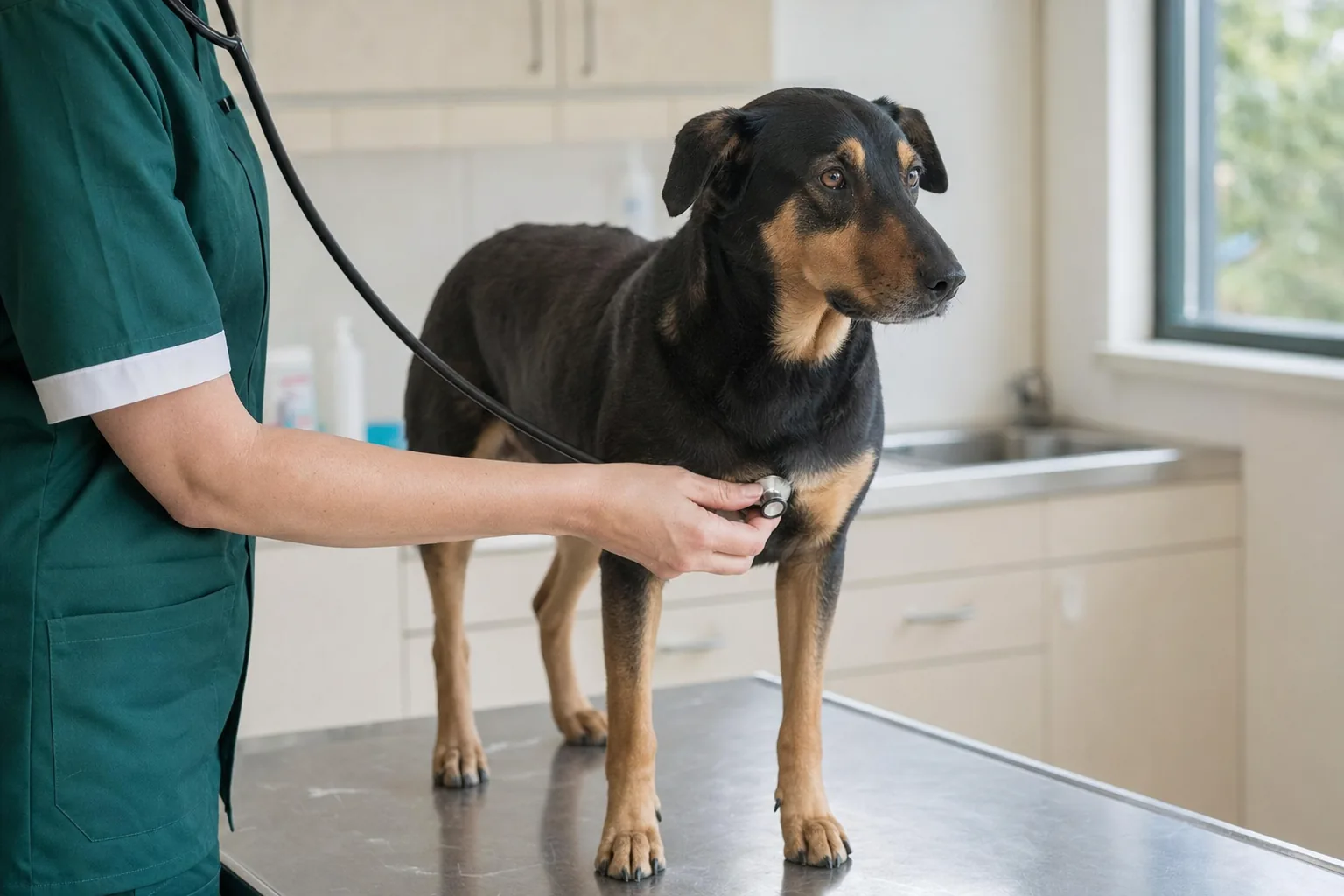
- Examine him: hydration (does the skin on the scruff spring straight back?), temperature, gum colour, and a feel of the belly to find where it hurts.
- Do a rectal examination with a gloved finger. It tells them whether hard stool is stuck and how far up, whether the prostate is enlarged, whether the anal glands are full and whether there is a hernia next to the anus. The dog hates it, but it gives the vet a great deal.
- X-ray him if they suspect a foreign body, bones or a blockage, or to see how much stool has built up in the colon.
- Scan him (ultrasound) to look at the prostate or the gut, or when the X-ray doesn't settle it.
- Run bloods, especially in older dogs or when it keeps coming back: hydration, kidneys, calcium, sometimes thyroid. An underactive thyroid or kidney disease can slow the gut or dry the stool out.
- Choose treatment according to the cause: fluids, emptying the colon at the practice when the stool is very hard, a change of food, more fibre or, for a blockage, endoscopy or surgery. They will also tell you what you may and may not do at home.
If he gets constipated often, ask what you can change long term: food, water, walks, bones. Before you leave, ask for a clear threshold too. After how many hours without a stool do you come back, and which signs bring you back the same day? Put the answers in your phone, next to the photo of the stool. At three in the morning you won't remember a word of it.
What not to do at home
- Don't use pharmacy enemas made for people. Some contain ingredients that can badly poison dogs, small ones especially, by throwing the minerals in their blood out of balance. If an enema is needed, the vet gives it.
- Don't give human laxatives, or "something from the chemist", without talking to your vet. If there is a blockage, a laxative drives the gut against something that can't get through.
- Don't pour oil into his mouth. When a dog struggles or swallows the wrong way, oil goes into the lungs, and aspiration pneumonia is far more serious than a day without a stool.
- Don't pull at anything hanging from his bottom, whether it is string, a blade of grass or a piece of fabric. The other end may still be caught inside.
- Don't put anything into his anus to "help".
- Don't give bones again to a dog who has once produced chalky stool.
- Don't wait for day three if he is vomiting, not eating or has a sore belly.
- Don't take constipation for granted in a male who is straining. Check first that he can wee.
What helps once your vet has ruled out anything serious
Water always available, with a second bowl in another room. Part of his food moistened, if your vet agrees. Walks at his usual pace, with time to sniff: plenty of dogs go after ten minutes of calm walking, hardly ever after two. In long-coated breeds, the hair under the tail kept short.
And one more habit. Glance at what comes out, every day, for a few seconds. It is the cheapest health check you have, and usually the first to tell you something has changed.
The information on this page is educational and does not replace an examination. For full details and a diagnosis, consult your dog's own veterinarian.