Sunday lunch, and a plate of chicken bones is still on the table. By the time you have seen the guests out, it is empty. Or your mum has been giving the dog the bones out of the stockpot for years, "because all our dogs had them". Or you picked up a big smoked beef bone at the pet shop, and the next day your dog has a cracked tooth. "Can I give my dog bones?" has a messier answer than it looks, because it depends on the bone, on the dog and on how he eats. Below is what to watch for after he has swallowed one, when to ring your own vet, and why plenty of vets would rather never see a bone in the bowl at all.
When to ring the vet today
Most dogs who swallow a few small cooked chicken bones come to no harm. In some, though, the bones get stuck or do damage, and the signs can show within minutes or not until two or three days later. Ring today if:
- he is choking, coughing, pawing at his mouth, drooling heavily or swallowing on nothing: the bone may be stuck in his throat, between his teeth or in the oesophagus;
- he vomits repeatedly, especially if he cannot keep water down, or retches with nothing coming up;
- his belly is hard and sore to touch, and he stands hunched or with his bottom up and chest down;
- he strains to pass a stool and nothing comes, or only a little, hard, chalky, white-grey stool;
- there is blood in his stool, red or black, or blood from his mouth;
- he is flat, off his food, hiding away or running a temperature in the three days after eating the bones;
- a ring of bone (a slice of marrow bone, say) has got stuck over his lower jaw behind the canines. Do not pull at it, just go.
When a dog is choking or vomiting over and over, do not wait to see "if it passes". A bone stuck in the oesophagus is easier to get out the sooner it comes out.
What to watch and write down at home
If he shows none of the signs above, you have three days of keeping an eye on him. Write down:
What and how much. Note the kind of bone (chicken, pork, beef), whether it was cooked, raw or smoked, how many, how big, and what your dog weighs. A 30 kilo dog who swallowed two chicken wings is a very different case from a 4 kilo dog who ate a whole drumstick. That is exactly what you tell the vet on the phone.
The time. When he ate them. The vet may ask how many hours the bone has been in his stomach.
Three days of stools. Every one, its shape and colour. Digested bone makes stools hard, crumbly and pale. Two normal stools in a row usually mean the bones have gone through.
Food and water. Whether he is eating normally, drinking, and keeping it down.
How he is. Playing, keen for his walk, stretching out as usual, or curled up tight, hunched, head low?
His teeth. After a hard bone, open his mouth and look: a tooth with a broken edge, a pink or brown spot in the middle of a tooth, blood on the gum. The big upper molar he uses for shearing is the one that breaks most often.
Vets have no single rule for a dog who has eaten cooked bones, so ask yours over the phone. Some will want an X-ray; others will tell you to watch him at home. Your part is the detail above.
What each kind of bone does
| The bone |
The risk |
What vets usually say |
| Cooked chicken, poultry or pork bones |
Splinter into sharp shards, lodge in the throat or gut, cause injury |
Never |
| Bones from the stockpot, boiled for hours |
Crumble, cause constipation with chalky stools, blockages |
Never |
| Smoked or dried bones from shops |
Broken teeth, chunks swallowed whole, vomiting |
Many vets advise against them |
| Large raw beef marrow bones |
Broken teeth, a ring of bone stuck on the jaw, diarrhoea from the marrow |
Only if you know your dog and stay with him, and even then many say no |
| Soft raw bones (necks, wings) in a raw diet |
Bacteria (salmonella and others), blockage in dogs who gulp without chewing |
Talk to your vet before changing the way he eats |
Veterinary dentists use the thumbnail rule: if you cannot leave a mark in it by pressing with your thumbnail, it is too hard for your dog's teeth. A beef bone never passes.
At the practice: what your vet does
If you ring with warning signs, or the vet asks you in after hearing what happened, this is roughly what follows:
- Questions. Which bone, how much, when, and what has happened since. Your notes from the first few hours are a real help.
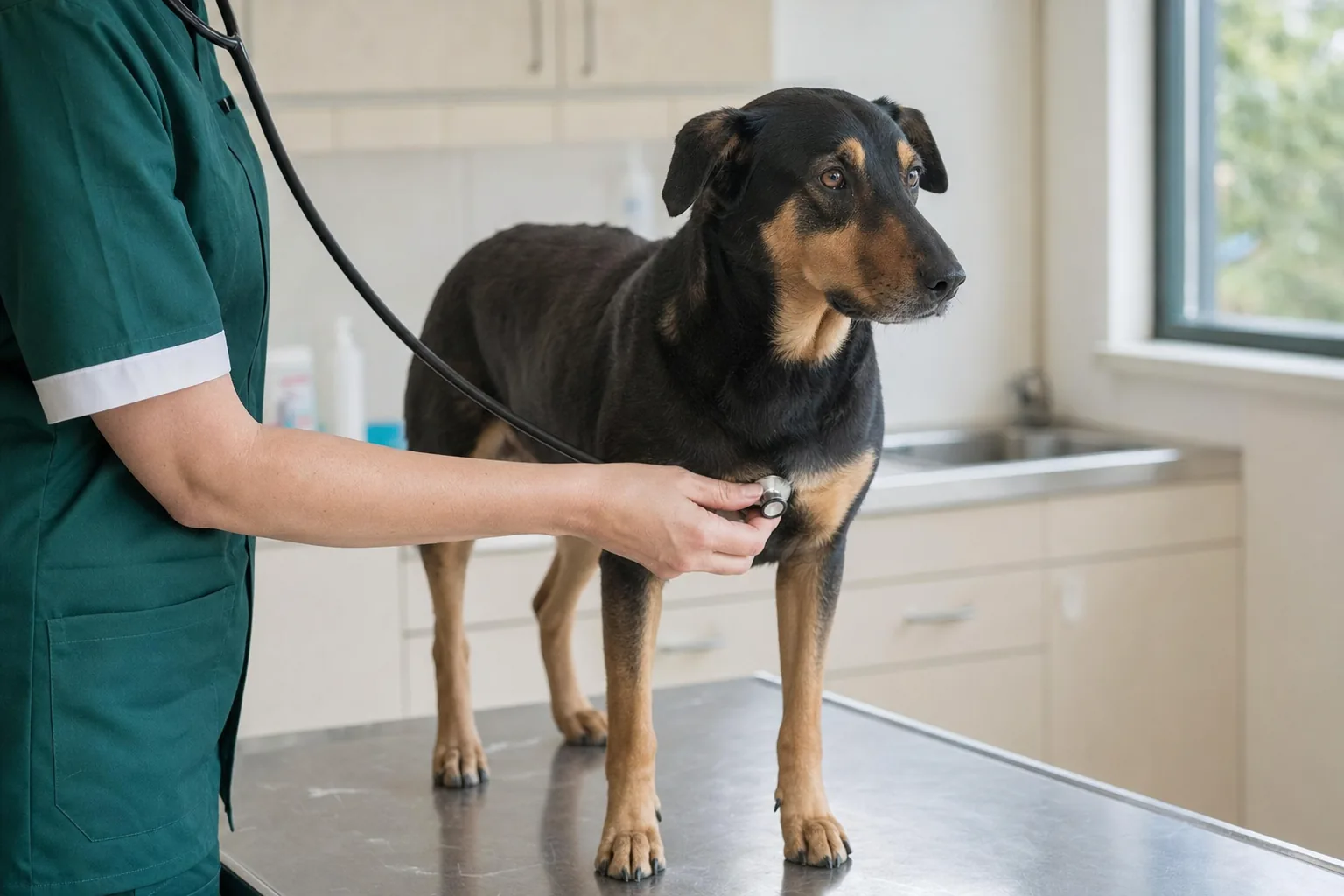
- An examination. The mouth (bone wedged between the teeth or across the roof of the mouth, broken teeth), the throat, a feel of the belly, temperature, gum colour, how dehydrated he is.
- X-rays. Bone shows up clearly, so this is the first step for almost any suspected blockage. The vet can see where the bone is, how big it is and whether gas is building up in the gut in front of it.
- Ultrasound, sometimes, to look at the intestine and check for fluid in the belly.
- Getting it out. A bone in the oesophagus usually comes out with an endoscope, under anaesthetic. If it has reached the stomach and will not move on, endoscope or surgery. If it has punctured anything, surgery.
- Constipation from bones is usually dealt with at the practice, with a drip and an enema given by the vet, not at home.
- Teeth. A broken tooth with the pulp exposed hurts and gets infected. Your vet will tell you whether it can be saved (root canal treatment) or needs to come out, and may refer you to a vet who does dentistry.
- Bloods, for a dog who has been vomiting for a day, to see how dehydrated he is and whether any organ has taken a knock.
Before you leave, ask what he can safely chew from now on. Nearly every vet has a short list of chews and toys they are happy with.
What not to do at home
- Do not make him sick after he has swallowed bones. Shards that went down the oesophagus once can tear it on the way back up. If your vet thinks making him vomit would help, they do it at the practice.
- Do not pull at a bone stuck in his throat or on his jaw. A ring of bone wedged behind the canines gets cut off at the practice, with the dog sedated.
- No oil, petroleum jelly or laxatives "to help it slide through". They do not help and can do harm, especially if the gut is already injured.
- Do not feed bread, potato or rice "to wrap the bone" without asking first. Some vets suggest a soft meal, others do not. Yours may say something different from your neighbour's, and in a dog who is vomiting an extra meal makes matters worse.
- Do not wait longer than three days if he is not passing stools or is not himself. Constipation from bones gets harder to deal with the longer it sits.
- No cooked bones, ever, of any kind. Not as a treat, not "just a small one".
- Do not leave him alone with a bone or a hard chew, even a shop-bought one. Greedy dogs swallow the ends whole.
What he can chew instead
Dogs need to chew, puppies and adolescents most of all. Whatever you give should pass the thumbnail test and be bigger than his mouth, so he cannot swallow it whole.
- rubber toys of the right size, the kind you can stuff with food;
- chews that soften as he works on them, made of dried meat or hide, chosen with your vet if he has a sensitive stomach;
- firm vegetables: raw carrot suits a lot of dogs;
- in summer, food frozen inside a toy.
For teeth, brushing does more than any bone. Dogs given bones "for their teeth" regularly turn up at the vet with a broken tooth, and their teeth are no cleaner either.
If you landed here after the Sunday plate, pick up the phone and ring now. A vet who knows what your dog ate and how much he weighs can tell you in two minutes whether to come in or watch him at home.
The information on this page is educational and does not replace an examination. For full details and a diagnosis, consult your dog's own veterinarian.