Your cocker puppy is six months old and this morning he woke up with a shiny red lump in the inner corner of his eye, about the size of a pea. It was not there last night. He is eating, playing and does not seem bothered, but you cannot stop looking at it. Or you have a bulldog who has already had cherry eye surgery on one side, and now the same lump is starting on the other. It is not something to rush to an out-of-hours clinic for at midnight. It is not something to leave for months either, and a couple of well-meant mistakes at home can damage the eye for life.
Dogs have a third eyelid: a membrane that slides across the eye from the corner nearest the nose and wipes it, like a windscreen wiper. At its base sits a gland that produces a large share of the tears; the veterinary literature puts it at roughly a third, sometimes more. Normally the gland is anchored to the tissue around it and you never see it. When that anchoring is weak, the gland flips up over the edge of the eyelid and swells. That is the red lump, which vets call a prolapsed gland of the third eyelid.
It mostly happens in dogs under two, usually in the first year. Some breeds get it far more often than others: English and French bulldogs, cocker spaniels, beagles, shih tzus, Lhasa apsos, Neapolitan mastiffs, cane corsos and Boston terriers. It is not usually caused by a knock, and you have not done anything wrong. It comes down to how the eye is built.
When is cherry eye an emergency?
If the lump is the only sign, the dog opens the eye normally and is not scratching at it, you are not looking at an emergency. Book an appointment for the next few days. Phone today, though, if:
- he is holding the eye shut or half shut, blinking a lot or the eye is streaming, all signs of pain;
- the surface of the eye looks cloudy or bluish, or has a white spot on it;
- there is thick yellow or green discharge;
- he keeps rubbing the eye with a paw or along the carpet and will not stop;
- the lump has turned dark, is bleeding, or has dried out and looks cracked;
- the lump has appeared in an old dog with no history of it, or after a knock;
- the third eyelid is covering part of both eyes at once, or the eye looks sunken.
Those last two do not usually look like cherry eye. A new lump in an old dog can be a tumour, and a raised third eyelid in both eyes has other causes, from dehydration and pain to nerve problems. Your vet will tell them apart.
What to watch at home until the appointment
Photograph the eye every day, in the same light, from the front and from the side. Especially early on, the gland can pop in and out by itself for a few days, and the photos show your vet how much of the time it is out.
Note when it is out: all the time, only first thing in the morning after sleep, or only when he is excited.
Check the other eye every day as well. Fairly often it starts there too, a few weeks or months later, and caught early it is simpler to deal with.
Look at the eye under the gland. Is he blinking normally? Is the eye clear and glossy, or dull and dry-looking? Is there sticky mucus in the morning?
Watch how he behaves. Is he scratching, rubbing his face on the furniture, holding one eye narrower than the other?
If the breeder has told you that his parents or littermates had the same problem, tell your vet.
What else the red lump in the corner of the eye could be
| What you see |
Most likely |
Why it matters |
| Smooth red lump in the inner corner, young dog |
Cherry eye (prolapsed gland) |
Put back surgically, gland kept |
| Third eyelid folded outwards, edge rolled over, large breeds |
Scrolled cartilage of the third eyelid |
A different problem, a different operation |
| Third eyelid raised in both eyes, dog flat |
Dehydration, pain, general illness |
The whole dog needs seeing, not just the eye |
| Irregular lump, older dog |
Possible tumour |
Biopsy, at the vet |
| Whole eye red and painful |
Conjunctivitis, ulcer, glaucoma |
An eye emergency |
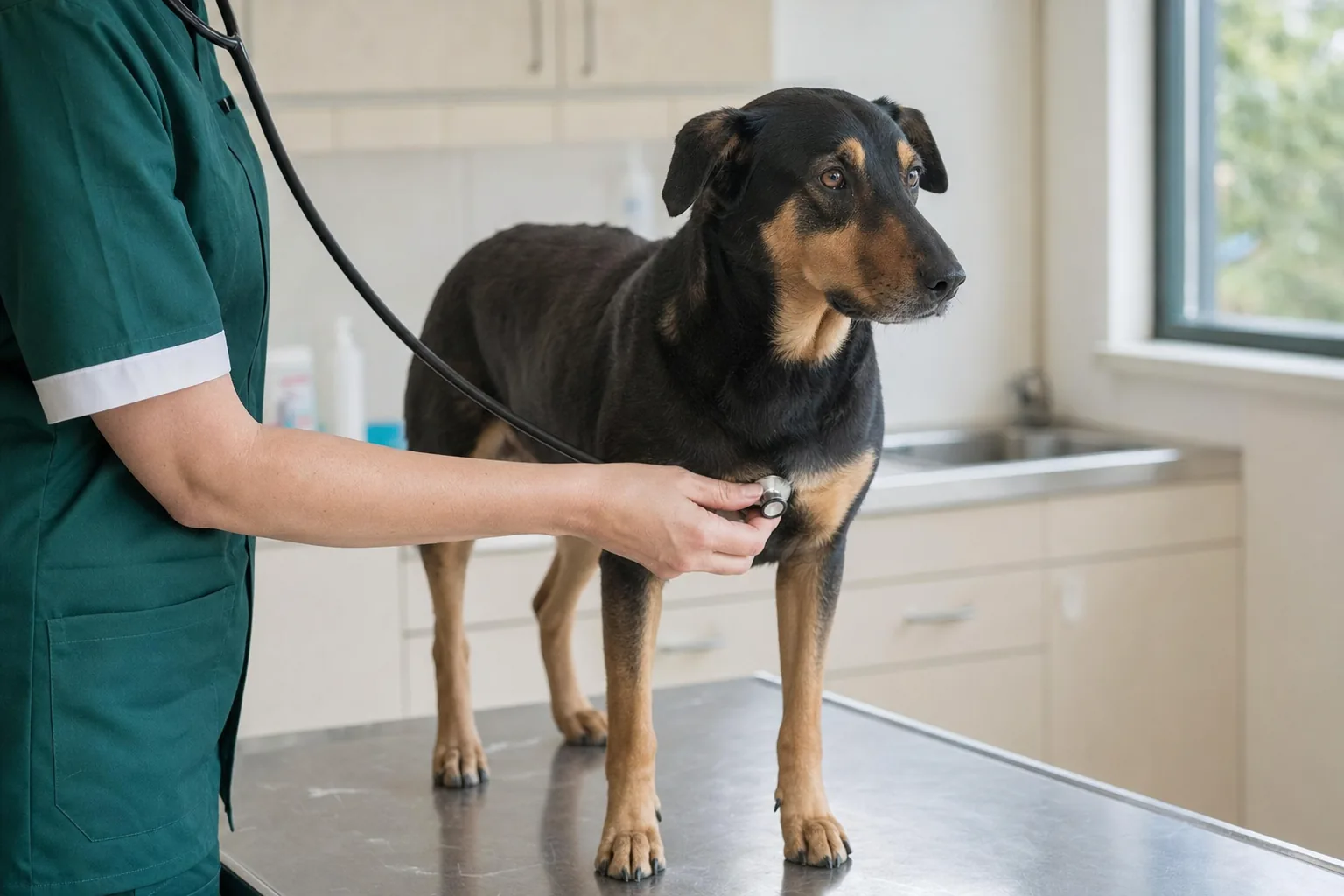
What the vet does and how cherry eye surgery works
- Examines the eye with a light and magnifier, sometimes an ophthalmoscope, looking at the gland, the third eyelid and the cornea.
- Measures tear production. A small strip of paper sits in the corner of the eye for a minute and shows how many tears the eye makes. The test matters before surgery and for the rest of the dog's life, because some dogs with cherry eye go on to develop dry eye.
- Puts a drop of dye on the cornea to show whether the surface is scratched or ulcerated.
- Decides on treatment. Most likely you will be offered repositioning surgery, where the gland is tucked back into place and held there using one of several techniques. The gland stays. A few decades ago it was routinely removed, and many dogs treated that way ended up with chronic dry eye and drops for life. Today the gland is only removed if it is destroyed or diseased.
- Before surgery, the vet sometimes tries to push the gland back in the consulting room, or gives you something to put on the eye to bring the swelling down. That keeps the gland moist and clean, but it rarely stays in.
- Surgery is under general anaesthetic, and most dogs go home the same day. He wears a protective collar for about two weeks and has eye drops. In some dogs the gland pops out again; it is then operated on again, sometimes with a different technique.
- At the check-up, the vet makes sure the gland has stayed put and repeats the tear test, sometimes every year.
Ask which technique they use, how often they see the gland come back out, and whether they would suggest a veterinary eye specialist for your breed. With the most prone breeds, some vets prefer to refer the operation to an ophthalmologist.
What not to do at home with cherry eye
- Do not push the gland back with your finger unless your vet has shown you how and said it is worth doing. With unwashed fingers and a wriggling dog it is easy to scratch the cornea.
- Do not cut it, tie it off or try to "dry it up". People really do suggest this on forums. That gland makes the eye's tears.
- Do not put human eye drops, chamomile tea, leftover drops from another pet or anything else from the cupboard into the eye. Some eye drops contain ingredients that damage a scratched cornea.
- Do not wait months to see whether it "goes back by itself". The longer the gland stays out, the more swollen and dry it gets and the harder it is to put back. With some techniques, the result is better when surgery is done early.
- Do not let him scratch. If he is rubbing the eye, put a protective collar on him until the appointment, either the cone kind or a soft inflatable one that stops his paws reaching his head.
- Do not let him ride with his head out of the car window or sit in a draught or in front of a fan. An exposed gland dries out even faster.
- If you want a puppy from a prone breed, ask about the parents before you commit. It is no guarantee, but it is a fair question for any breeder.
Life after surgery
Most dogs carry on with the eye exactly as before and have no idea anything happened. There is one thing to keep an eye on: if the eye turns dull and sticky, with a lot of mucus in the mornings, it may be dry eye, and caught early it is easier to treat. Mention the operation to your vet at every check-up, even five years on.
Until the operation, he can do nearly everything he did before: walks, play, training. The gland does not usually hurt. Just steer clear of dense undergrowth and long grass, where he could scratch it, and of windy, dusty days.
The information on this page is educational and does not replace an examination. For full details and a diagnosis, consult your dog's own veterinarian.