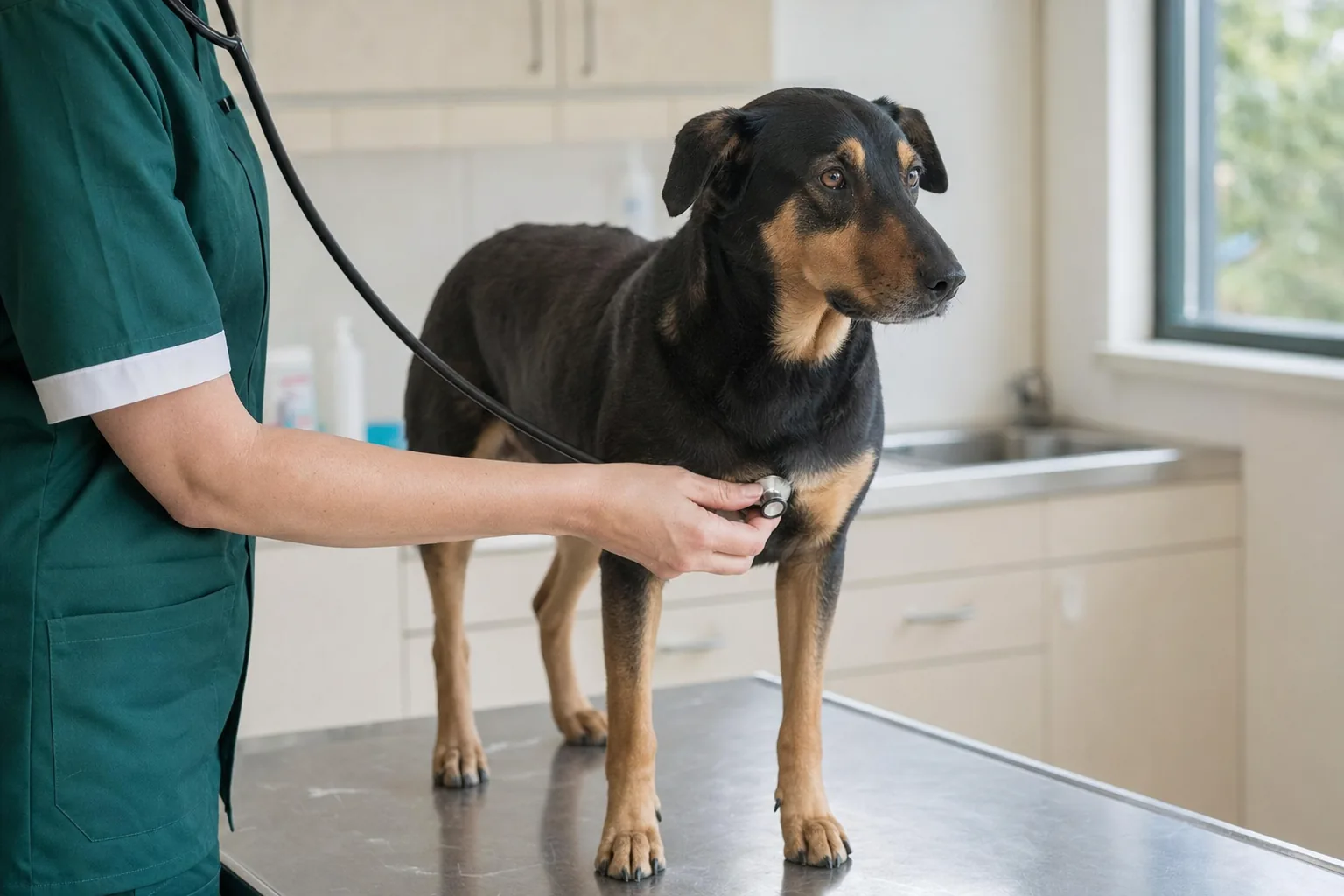
You picked up a three-month-old puppy from a yard on the edge of town. "He's had his jabs," they said, but no vaccination card came with him. A week later he wakes up with gummy eyes, a thick yellowish discharge from his nose and the odd cough. A neighbour says it is a cold and will pass. The other story we hear just as often: an adult dog, not vaccinated for years, who has started blinking oddly and whose face twitches while he sleeps. Distemper can start exactly like a cold and end up in the brain. Below are the signs that mean phoning today, what to gather for the vet, how the visit goes and what not to try at home.
Distemper signs that mean calling today
Distemper (canine distemper virus, sometimes called Carré's disease in veterinary books) is a serious viral illness and spreads very easily between dogs. No medicine kills the virus. The vet keeps the dog going while his body fights it off, and the earlier that starts, the better his chances.
In a puppy, an unvaccinated dog or one whose vaccinations are uncertain, call the same day if you see:
- discharge from the eyes and nose that thickens and turns yellow or green;
- fever: hot ears and belly, flat and sleepy all day;
- coughing, fast or noisy breathing;
- vomiting or diarrhoea, especially alongside the signs above;
- thickened, cracked pads or nose tip, hard as the sole of a shoe (hence the old name "hard pad");
- any nervous sign: a muscle that twitches in a rhythm (an eyelid, a leg, the jaw, as if he were chewing gum), wobbly walking, a head tilt, seizures.
With seizures, a dog who cannot get up or a dog who has stopped drinking, do not ring. Go.
Few owners know that the nervous signs can show up one to three weeks after the "cold" has cleared, sometimes in dogs who seemed to have recovered. A puppy who coughed in October and has a twitching jaw in November is a picture vets recognise straight away.
What to gather and write down for the vet
Tests make the diagnosis. You bring the dog's story, and with distemper the story counts for a lot.
Vaccinations. Find the record card or passport and photograph the vaccine page with the sticker and the date. If the puppy came from a breeder or a rescue, ring them to ask what vaccine he had and when. "He's been vaccinated" without a sticker tells the vet nothing.
Where he came from and who he mixed with. The puppy bought at a market, off the internet or from a yard full of dogs is the most at risk. Note whether he has recently been in kennels, a rescue centre or at a show, and whether foxes or martens come into your garden, as they can carry the virus too.
His temperature, if you have a thermometer kept just for the dog: rectal, with a little petroleum jelly on the tip. Write down the reading and the time. Distemper fever often comes in two waves, with a few quiet days in between, and those quiet days fool a lot of people.
What is coming from his eyes and nose. One photo a day at the same time. From the photos the vet can see how the colour and thickness have changed.
Twitching muscles. If you see a rhythmic twitch, film it then and there. It lasts a few seconds and will not perform on cue in the consulting room.
Food and water. How much he ate and drank today compared with a normal day. A puppy who is not drinking dehydrates fast.
Distemper or something else?
| What you see |
Points towards distemper if… |
Could also be… |
| Cough and runny nose |
an unvaccinated puppy with fever and gummy eyes |
kennel cough, usually without much fever and with a bright dog |
| Vomiting and diarrhoea in a puppy |
they come with a cough and eye discharge |
parvovirus (bloody diarrhoea, a very foul smell), worms, something off he ate |
| Hard, cracked pads |
they appear after a respiratory illness |
allergies, autoimmune disease, old age |
| Twitching and seizures |
in an unvaccinated dog, after a "cold" |
epilepsy, poisoning, other brain infections |
The table helps you know what to say on the phone. Nobody diagnoses from it.
What happens at the vet's
- Questions. His age and vaccinations (with the sticker, if you have it). Where he came from and which dogs he has been around. When the signs started and in what order.
- Isolation. Many practices will ask you to wait in the car or bring you in through another door so the puppies in the waiting room do not catch it. Nothing personal; it protects other people's dogs.
- Clinical exam. Temperature, a listen to the lungs, eyes, nose, pads, how dehydrated he is, and a basic neurological check: gait, reflexes, pupils.
- Tests. A rapid test or, more reliably, a PCR test on eye discharge, blood or urine. A negative result does not rule the disease out at every stage, and in a recently vaccinated dog the test can come back falsely positive. The vet reads it alongside the signs.
- Blood tests and, if he is coughing badly, a chest X-ray to look for the pneumonia that often follows the virus.
- Supportive treatment, decided by the vet: a drip, nutrition, something for the fever, treatment for vomiting and seizures, plus treatment for any bacterial infections that move in behind the virus. Sicker dogs stay in, in isolation. There is no medicine that kills the distemper virus.
- The outlook. Your vet will be straight with you. Some dogs recover fully. Others are left with a twitching muscle for life, or with stained tooth enamel if they caught it as puppies. In some it reaches the brain and cannot be stopped. Sometimes the conversation turns to euthanasia, when the dog is suffering and has no chance left; that is a decision you make with your vet, not on day one.
Ask, too, how long he may keep shedding the virus once he is better. Usually weeks, sometimes a few months. The answer decides where you walk him and who you have round to the house.
The vaccine
Distemper is one of the core vaccines that the international guidelines (WSAVA) recommend for every dog, wherever it lives. Puppies get a course of doses starting at 6 to 8 weeks, repeated every 2 to 4 weeks until 16 weeks or later, then a booster at 6 or 12 months. For adult dogs, your own vet sets the schedule. A properly vaccinated dog very rarely falls ill.
What not to try at home
- The cold remedies in your cupboard. Human fever medicines can be toxic to dogs. Herbal teas and syrups just use up days.
- "Let's see if it passes." In an unvaccinated puppy with gummy eyes and a fever, the days you lose at the start do not come back.
- The dog park and visitors. Keep him away from other dogs and do not invite anyone round with a puppy. The virus travels through the air when he coughs or sneezes, and through shared bowls.
- The other dog at home. If you have a second dog, ask the vet what to do: check his vaccinations and, if needed, give him a booster. Keep him away from any new puppy.
- A new puppy too soon. Do not bring a puppy into a home where a dog has been ill until you have spoken to the vet. The virus does not survive long outside the body (a few hours in the warm, longer in the cold) and ordinary disinfectants kill it, but a recovering dog keeps shedding it for a while.
- Forcing food. If he is vomiting, offer small amounts of water often and tell the vet.
- A puppy without a card. Next time, ask for the vaccination card with the vaccine sticker in it. It is the simplest thing you can do.
Clean bowls and bedding with an ordinary household disinfectant. Then the floor. Wash your hands after caring for him and change your clothes before you touch another dog. The virus will not make you ill; it can make the neighbour's dog ill.
The information on this page is educational and does not replace an examination. For full details and a diagnosis, consult your dog's own veterinarian.