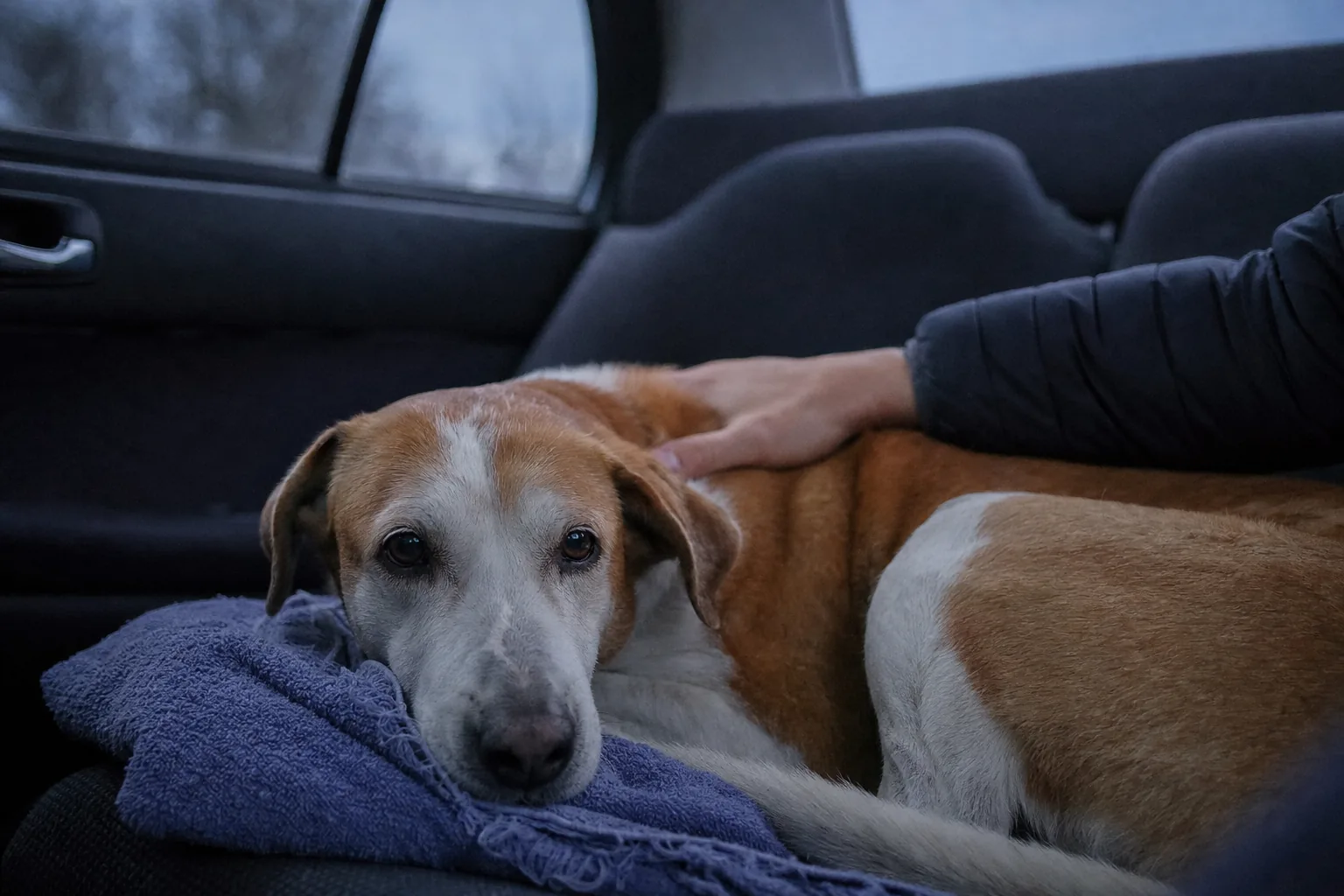
Emergency. Press a clean pad firmly on the tip of the nail for a full five minutes, without lifting it to look. If it's still bleeding after 15 minutes, keep pressing and go to the vet now.
Noticed something different about your dog? Go straight to their vet.
Call your own vet or the nearest clinic with an emergency service now, and set off. Do not ask a group what to do: every answer you wait for there is time lost for the dog.
- The same sign, dozens of causes. A dog that vomits may have eaten grass or may have an object stuck in the gut. From two lines you typed, nobody can tell which. The vet feels the abdomen, takes the temperature, runs tests.
- Nobody on the internet sees your dog. They see a photo and a story. A diagnosis comes from an examination and investigations, not from a resemblance to someone else's dog.
- In groups you hear from the people whose dog "got better on its own". Those for whom it ended badly rarely post again. What you read there is a selection, not a statistic.
- Doses are calculated by weight and species. Human medicines that look harmless, paracetamol or ibuprofen, are toxic to dogs. "I gave mine half a tablet" is the most dangerous advice you can get.
- Hours matter. With a twisted stomach, a poisoning or a urinary blockage, the time spent asking online is exactly the time that decides the outcome.
- The vet is accountable for what they say. They have your dog's record, history, vaccinations, past treatments. An anonymous account has none of that and answers for nothing.
Use this page to know what to observe, what to note and what to ask at the appointment, not to treat at home. If you still have doubts after a consultation, ask another vet or a specialist (dermatologist, internist) for a second opinion, not a group. And if you do not have a regular vet yet, find one now, while your dog is healthy: how to choose a veterinary clinic.
A yelp in the park, then your dog comes back to you on three legs and leaves red spots all over the hall floor. You look at the paw: one nail is bent at a strange angle, or snapped halfway and hanging, or simply gone, with a pink dot where it used to be. Or you trimmed his nails yourself, took a fraction too much, and now it is bleeding like a serious wound. Inside each nail is a living core, the quick, with blood vessels and nerves, so it bleeds a lot and hurts a lot. It looks worse than it is. A broken nail is rarely a serious emergency, and below you'll find how to stop the bleeding, what you can do yourself and when to see the vet.
What to do in the next 10 minutes
- Calm him and keep him still. Pick up a small dog. Lay a big one on his side on the floor, with someone calmly holding him at the chest. Keep your voice low. A dog with a painful paw can whip round and bite, you included, even if he has never bitten before. If he flinches, growls or stares at your hand, put a muzzle on him or loop a wide scarf gently round his muzzle without tightening it, and take it off as soon as you are done.
- Find the nail. Sometimes there is blood all over the paw and you can't see where it is coming from. Wipe with a damp pad, check between the toes, and don't forget the dewclaw, the nail on the inside of the leg above the paw. Dewclaws snag easily and tear often.
- Press. A sterile pad or a folded piece of clean cloth, pressed firmly on the tip of the nail for a full five minutes. Don't lift it every thirty seconds to look, because each time you tear away the clot that was just forming.
- Powder. If you have styptic powder for dogs at home (the stuff in nail trimming kits), dip the tip of the nail into it, or put a pinch on the pad and press again. If you don't, cornflour or plain flour helps the clot form. It will sting a bit and he'll pull his paw away. Hold on to it.
- The hanging piece. If the nail is hanging by a thin strand and he lets you, sometimes it comes away at a touch. If it is firmly attached or he screams when you touch it, don't pull and don't cut. Leave it for the vet, who removes it once the pain has been dealt with.
- A bandage, if you need to travel. Pad on the nail, then a bandage wrapped loosely round the paw, then a clean sock taped above the wrist, not over the toes. You should be able to slide a finger between the bandage and the leg. If the toes swell or go cold, it is too tight: take it off and redo it.
- Check after ten minutes. If it has stopped or only drips now and then, the worst is over. If it is still running, keep pressing and ring the vet.
What you see and what comes next
| What you see |
What you do |
The vet |
| You cut a nail too short at home |
Pressure 5 minutes, powder or cornflour |
Only if it hasn't stopped in 10–15 minutes |
| Tip broken off, nothing hanging |
Pressure, keep it clean, watch for 2–3 days |
If he is still limping after 2 days |
| Nail broken halfway, hanging |
Pressure, bandage, don't pull |
Today |
| Nail ripped off at the base, quick showing |
Pressure, bandage |
Today |
| Torn or detached dewclaw |
Pressure, bandage |
Usually today |
| Bleeding hasn't stopped after 15 minutes |
Keep pressing, set off |
Now |
| Days later, toe swollen, hot, with pus |
Don't squeeze |
Within 24 hours |
| Several nails breaking or coming loose for no reason |
Note which and when |
Appointment, see below |
What to tell the vet and what they will do
On the phone
- Which nail, on which leg, and whether it is the dewclaw.
- How it happened: caught in the carpet, a fence or a crate, running on concrete, or you cut it.
- Whether the bleeding has stopped and how long it took.
- Whether the nail is hanging, missing or just cracked.
- Whether he is putting weight on the leg or holding it up.
- Whether he takes any medication that can affect clotting, or whether there is any chance he got at rat poison. A dog who bleeds heavily from a small wound, and pressure doesn't stop it, may have a clotting problem, and the nail is just where it showed.
At the practice
- Pain first. A broken nail with the quick exposed hurts badly, so most vets give pain relief or light sedation before handling the paw. For the dog, that decides whether he copes with the visit or hates the practice from then on.
- Removing the broken piece. The hanging part is cut off cleanly, as close to the base as possible, so it can't catch again.
- Cleaning the toe and the nail bed.
- The dressing. Sometimes it isn't needed. Other times there is a bandage for one to three days, with exact instructions on when to change it or take it off. Keep it dry: tie a plastic bag over it for walks and take it off straight afterwards.
- Treatment, chosen by the vet: something for the pain for a few days, sometimes something against infection too, especially if the wound is dirty or the nail had been cracked for a while.
- A cone, if he keeps licking the paw. The tongue slows healing and brings in infection.
- A check-up a few days later, if needed. The exposed quick covers over with a hard layer in about a week, and the nail grows back over a few weeks, sometimes slightly crooked.
When it isn't just an accident
If several nails on several feet break or come loose over a few weeks without being caught on anything, that is a different conversation. It may be a disease of the nail bed (there is an autoimmune condition that does exactly this), a fungal or bacterial infection, or a nutritional problem. Note which nails, when, and how they looked beforehand, then book an appointment. The vet may ask for blood tests and cultures, and sometimes sends a nail off to the lab.
How to prevent it
Most broken nails are nails that were too long. A long nail catches in carpets, crate bars, gaps in wooden floors and wire fencing, and the dog injures himself pulling free.
You can see the right length when he stands square on a hard surface: the nails barely touch the floor, or don't touch it at all. If you can hear them clicking on the tiles, they are too long.
- Trim regularly, every two to four weeks, a little each time. The quick slowly recedes when the nail is shortened often. A nail left long for months can't be brought back in a single session without bleeding.
- Dewclaws never touch the ground, so they never wear down by themselves. Check them every time you trim; in some dogs they curl round and grow into the toe.
- Black nails are the hardest, because you can't see the quick. Take one thin slice at a time and look at the cut surface. When a darker, moist dot appears in the middle, stop.
- A nail grinder is a good alternative for dogs who can't stand clippers. It takes off a little at a time and rounds the edge, so the nail catches less easily.
- Getting him used to it saves you the wrestling match. Touch the paw, a tasty treat, done. Hold a toe, another treat. Show him the clippers, another one. Trim one nail a day and make a proper fuss of him at the end. With a dog who is already scared, a few weeks of small steps achieve more than one session of holding him down, after which he won't let you near his paws for a year.
- Look at his surroundings. Swap a wire-floored crate for one with a solid floor or lay a thick mat over the grid, keep long-loop rugs away from a dog who plays rough, and check the wire fence.
- Walking on varied surfaces wears down the front nails naturally in many dogs. In our training sessions, dogs who work a lot on tarmac and gravel rarely have overlong nails, while dogs who live on grass and wooden floors often do.
In the first aid kit at home and in the car, keep styptic powder, sterile pads, a bandage, tape, a clean sock and a muzzle that fits your dog. It all fits in a pencil case and makes the evening of that first yelp a lot easier.
Frequently asked questions
What dog owners search for most often on the internet about this problem, with the short answer. The answers are a guide only: the decision belongs to your dog's own vet, after an examination.
How do I stop the bleeding if I cut my dog's nail too short?
Dip the tip of the nail in styptic powder or, if you have none, cornflour or plain flour, then hold a clean pad firmly on it for five minutes without looking. It usually stops within a few minutes. If it's still bleeding after 10–15 minutes, ring your vet. Next time, take thinner slices.
My dog's nail is broken and hanging. Should I cut it off?
Only if it's hanging by a thin strand and comes away at a touch. If it is firmly attached, he screams when you touch it, or the pink quick is showing, don't pull and don't cut. Bandage loosely and see the vet today: they take the piece off once he has had pain relief or light sedation, clean the nail bed and decide whether it needs a dressing.
Do I need to take my dog to the vet for a broken nail?
Not always. A nail cut too short, or a broken tip that stops with pressure, usually heals at home. Go today if the nail is hanging, ripped off at the base, a dewclaw, still bleeding after 15 minutes, or he won't put weight on the leg. In the days that follow, go if the toe swells or there is pus.
How long does a broken dog nail take to heal?
The exposed quick covers over with a hard layer in about a week, and the pain usually eases within two or three days. The nail grows back over a few weeks, sometimes a little crooked. Meanwhile keep the paw clean and dry and stop him licking it. If he is still limping after a few days, ask for a check-up.
Why does my dog keep breaking nails?
Usually because they're too long and catch on things. If you can hear them clicking on the floor, they need doing. But if several nails on several feet break or come loose without catching on anything, it may be a nail bed disease, an infection or a nutritional problem. Note which nails and when, then book an appointment.
The information on this page is educational and does not replace an examination. For full details and a diagnosis, consult your dog's own veterinarian.