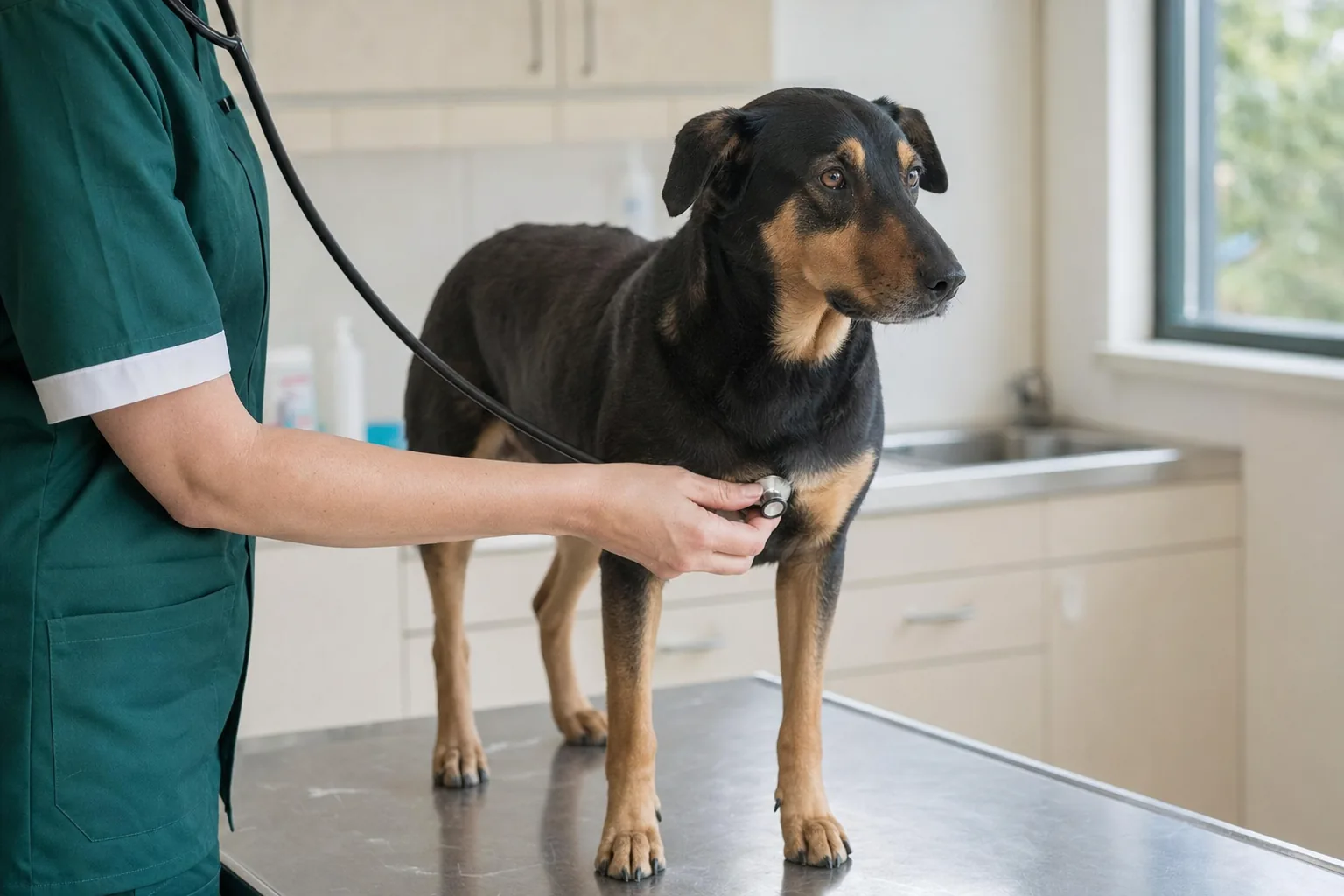
Caution. A lump that came up suddenly between the toes after dry grass, a swollen, warm paw he won't put down, pus or blood, a temperature, lethargy, or all four paws swelling at once: ring your own vet the same day.
Noticed something different about your dog? Go straight to their vet.
Do not look for the answer in a Facebook group, on TikTok or on a forum. Look for someone trained for this: your dog's own veterinarian, the only person who can examine, investigate and treat them.
- The same sign, dozens of causes. A dog that vomits may have eaten grass or may have an object stuck in the gut. From two lines you typed, nobody can tell which. The vet feels the abdomen, takes the temperature, runs tests.
- Nobody on the internet sees your dog. They see a photo and a story. A diagnosis comes from an examination and investigations, not from a resemblance to someone else's dog.
- In groups you hear from the people whose dog "got better on its own". Those for whom it ended badly rarely post again. What you read there is a selection, not a statistic.
- Doses are calculated by weight and species. Human medicines that look harmless, paracetamol or ibuprofen, are toxic to dogs. "I gave mine half a tablet" is the most dangerous advice you can get.
- Hours matter. With a twisted stomach, a poisoning or a urinary blockage, the time spent asking online is exactly the time that decides the outcome.
- The vet is accountable for what they say. They have your dog's record, history, vaccinations, past treatments. An anonymous account has none of that and answers for nothing.
Use this page to know what to observe, what to note and what to ask at the appointment, not to treat at home. If you still have doubts after a consultation, ask another vet or a specialist (dermatologist, internist) for a second opinion, not a group. And if you do not have a regular vet yet, find one now, while your dog is healthy: how to choose a veterinary clinic.
Evening on the sofa, and your dog is licking his paws with a slurping you can hear from the kitchen. The white fur between his toes has gone rusty, the skin underneath is red and warm, and in the morning you catch him chewing at a nail. Sometimes it's quicker than that: one day a red lump the size of a pea appears between two toes and he has been limping ever since. Vets call inflammation of the paw skin pododermatitis. The name only describes what you can see. Behind it there may be an allergy, yeast, a grass seed that has worked its way into the skin, parasites or plain boredom. Below is what to look at and what to write down, so you get to your vet with the information that shortens the road to a diagnosis.
When red paws can't wait
Red paws he has been licking "for a while" usually aren't an emergency. Ring your vet the same day, though, if:
- a lump has appeared suddenly between his toes, especially after a walk through long or dry grass, and he keeps licking the spot or is limping; it may be a grass seed under the skin;
- the paw is swollen and warm, and it hurts too much for him to put it down;
- pus or blood is coming out, or you can see a small hole leaking fluid;
- he has a temperature, is listless or off his food;
- all four paws have swollen at once, perhaps his face too;
- a nail is broken, torn away, or swollen and black at the base;
- he has stepped in something chemical: cleaning products, antifreeze, or road salt that he then licks off.
How to check his paws and what to note at home
Have a close look
Turn the paw over, gently spread the toes and look in good light. The torch on your phone helps. Check:
- skin colour: pink is normal; red, reddish-purple, or dark, thickened skin means the problem has been there a while;
- the fur: rusty or brown staining on light fur comes from saliva, from repeated licking, so don't scrub it thinking it's dirt;
- the smell: a sweetish smell, like biscuits or cheese, often means yeast is multiplying on damp skin;
- lumps: a red bump between the toes, with or without a head of pus, or a soft area that drains and then comes back;
- the pads: cracked and dry, or the opposite, soft and damp;
- the nails: where they meet the skin, look for redness or a brown discharge.
Photograph the paws every two or three days, in the same spot and the same light. Photos show week-to-week change far better than memory does.
What to write in your diary
- when he licks: in the evening, at bedtime, after walks, or when he's left alone;
- how many paws: one paw points to something local (a grass seed, a wound, pain), all four to something general (allergy, yeast, a skin condition);
- the season: only spring and summer (pollen, grasses) or all year round (food allergy, house dust);
- other areas: ears that smell or go red, armpits, belly, around the eyes and muzzle, his bottom; allergies often show this whole picture at once;
- recent changes: food, treats, washing powder, a new park, road salt in winter;
- what he does when nobody's watching: film him in the evening. A dog who licks out of boredom or stress has a different pattern from one whose skin is itching.
What you see and what it might be
| What you usually see |
What it might be |
| All paws red, licking worse in spring and summer, ears and belly too |
Environmental allergy (pollen, dust mites) |
| All paws, all year, sometimes a sore bottom or soft stool |
Allergy to an ingredient in his food |
| Greasy skin, sweet smell, brown staining at the base of the nails |
Yeast multiplying on irritated skin |
| Pus-filled spots, crusts, pain |
Bacterial infection, usually on top of another problem |
| A single lump that appeared suddenly, after dry grass |
Grass seed under the skin |
| Hair loss on the paws, thickened skin, in puppies or old dogs |
Skin parasites (a mite that lives in the hair follicles) |
| Cracked pads in winter |
Salt and de-icers, cold, dry air |
| One paw only, a bored or unsettled dog, no other signs |
Habit licking, boredom, stress, sometimes joint pain |
The table helps you ask the right questions. In real life the causes often come together: the allergy irritates the skin, and yeast and bacteria then thrive on the irritated skin. That's why vets often treat in stages.
What you can do every day without treating anything
After walks, rinse his paws in lukewarm plain water and dry them really well with a clean towel, between the toes too. Damp left between the toes is exactly what yeast likes. In winter, rinsing after every walk on salted pavements makes a real difference. Trim the long hair between the pads so the paw dries faster and doesn't collect seeds.
If you suspect boredom, give his nose a job: games where he searches for his food, long sniffy walks on a long line. A dog who's mentally tired licks less. If the skin is red, he still needs to see the vet.
What your vet will check
- The history. When it started, how many paws, which season, what he eats, what you've changed, what other areas are affected. Your diary and photos cut this part short.
- The examination. Every paw, pads and nails included, and his ears and belly as well. Sometimes they'll watch him walk, if they suspect pain is behind the licking.
- Simple tests done there and then:
- a light skin scrape looked at under the microscope, for parasites;
- a tape strip or glass-slide impression of the skin, to see whether yeast has multiplied;
- a few hairs plucked and checked under the microscope;
- sometimes a sample sent for culture, to find out exactly which bacterium it is and what will stop it.
- Looking for a grass seed. If there's a single lump that came up suddenly, the vet will explore it, sometimes under sedation. Ultrasound helps find seeds that have migrated deeper.
- Working up an allergy. If it looks like allergy, the next step is usually an elimination diet: 8 weeks on a food with proteins he has never eaten, or a specially processed one, and nothing else, no treats and no scraps. For food allergy it's the only reliable method, as blood tests for food allergies in dogs aren't dependable. For environmental allergies there are tests, but they help choose the treatment rather than make the diagnosis.
- Further tests for adult or older dogs where the problem keeps coming back: blood tests, thyroid included, and sometimes a skin biopsy.
- The plan. Usually in stages: the infection first (yeast or bacteria), then the underlying cause. Ask how long each stage lasts and when the check-up is. Many skin treatments run for weeks. Stopping too early, because the paws "look fine", is the commonest reason it comes back.
What not to do at home
- Don't put human creams or ointments on his paws. He'll lick them off, and some ingredients are toxic to dogs. Others keep the skin damp and feed the very yeast you're fighting.
- Don't soak his paws in vinegar, alcohol, hydrogen peroxide or "natural" remedies from the internet. They sting skin that is already sore and slow down healing.
- Don't squeeze or cut lumps between his toes. If it's a grass seed you push it deeper. An infection you simply spread.
- Don't use leftover antibiotics from an old course. If they don't match the bacterium or aren't given for long enough, you breed resistant bacteria.
- Don't tell him off for licking. Itching doesn't stop on command. All he learns is to lick when you're out of the room.
- Don't change his food three times in a fortnight to "see what he's allergic to". An elimination diet means one food, eight weeks, chosen with your vet.
- Don't leave socks or bandages on wet paws for hours. Trapped damp makes the irritation worse. Use a cone or protective boots only the way your vet tells you.
Red paws rarely have a quick fix. You get there sooner with an honest diary, and by finishing the treatment even once the paws look healed.
Frequently asked questions
What dog owners search for most often on the internet about this problem, with the short answer. The answers are a guide only: the decision belongs to your dog's own vet, after an examination.
Why does my dog lick his paws until they are red?
Usually because they itch: an allergy to pollen, dust mites or something in his food, with yeast and bacteria multiplying on top. It can also be a grass seed, skin parasites, road salt, pain or boredom. Look at how many paws are affected and whether his ears or belly are red too.
Why is the fur between my dog's toes brown or reddish?
Saliva. On light fur, repeated licking leaves rusty stains, so the colour tells you he licks a lot; dirt has nothing to do with it. If the skin underneath is red, greasy or smells sweet, yeast has probably moved in as well. Take a photo and get him seen by your vet.
What is the red lump between my dog's toes?
It may be a grass seed under the skin, especially if it came up suddenly after a walk through dry grass and he's limping. It can also be an infected hair follicle, a cyst or, rarely, a tumour. Don't squeeze or cut it. If it's painful or leaking, ring the vet the same day.
What can I put on my dog's red paws?
Until there's a diagnosis, only plain lukewarm water after walks and a clean towel to dry well between the toes. Human creams, vinegar, alcohol and hydrogen peroxide do more harm: some are toxic when licked, others sting the skin. Your vet picks the treatment after seeing under the microscope what's on the skin.
Does pododermatitis in dogs go away on its own?
Rarely, because there's almost always an underlying cause, usually an allergy. The vet treats the infection first, then looks for the cause, sometimes with an eight-week elimination diet. Skin treatments run for weeks, and stopping them as soon as the paws look fine is the commonest reason it comes back.
The information on this page is educational and does not replace an examination. For full details and a diagnosis, consult your dog's own veterinarian.