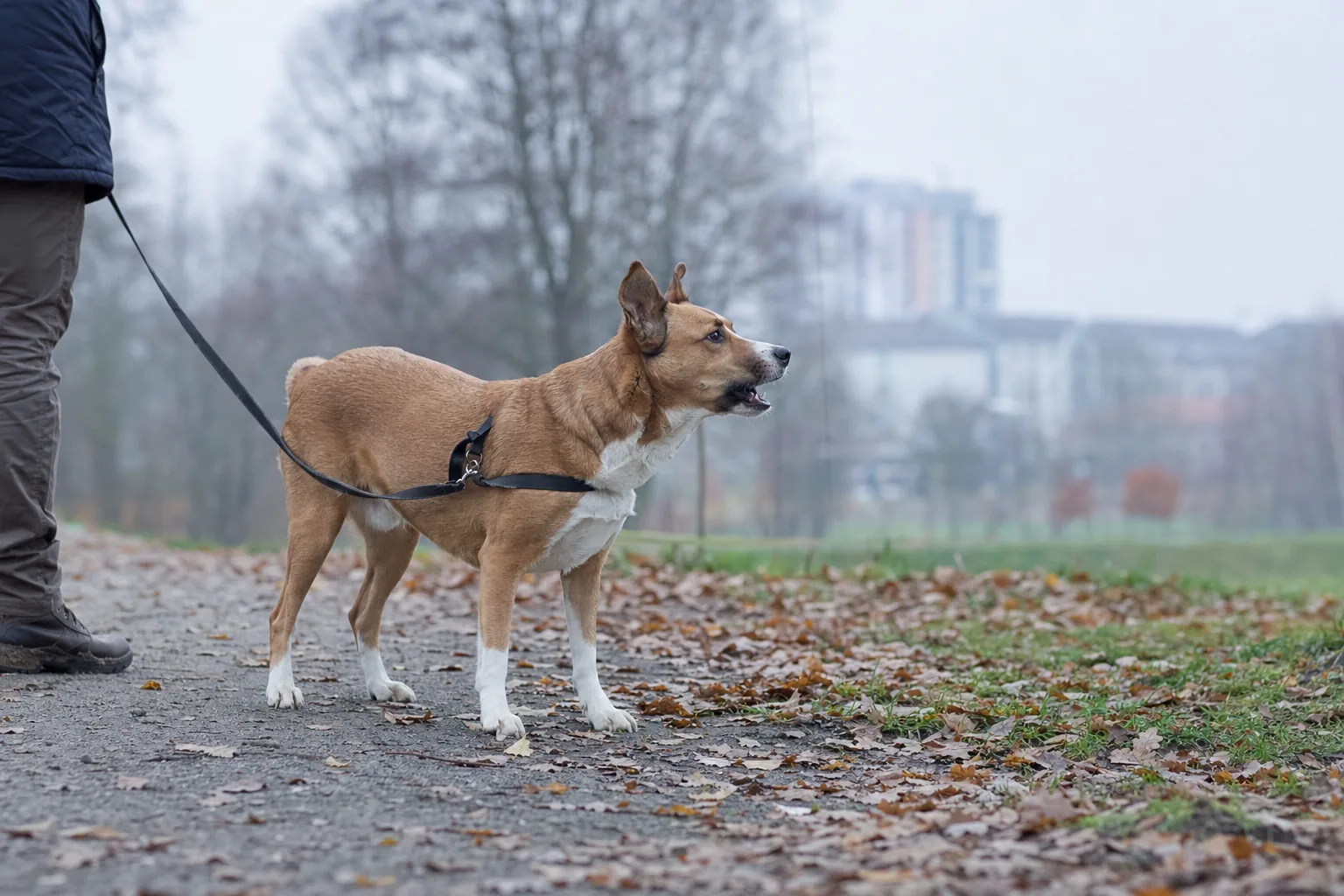
Your dog is four, starts shaking in the waiting room and takes two people to hold on the table. Or you have a five-month-old puppy who bites the nail clippers the moment you pick up a paw. Or a shepherd whose coat is one big mat because he bolts under the bed whenever the brush comes out. It is the same problem each time: the dog has learned that being touched in certain places, or being in certain places, brings something unpleasant he can't get away from. You can undo it at home in two-minute sessions, and this page shows you how. For next week's appointment, when there is no time left to train, step 5 has a few things that help anyway.
Why is my dog afraid of the vet and of being handled?
Dogs learn lessons about pain in one go. The surgery smells of disinfectant and other dogs' fear, the floor is slippery, the table is cold. Strange hands hold him, then comes the needle, then the thermometer. On top of all that, he can't leave. For an animal whose first answer to fear is to run, having no way out is about as stressful as it gets. By the second visit he recognises the car park.
One bad experience
A nail cut too short that bled. An injection that hurt. A dog who lunged at him in the waiting room. Once is enough, and he links the pain to everything around him at that moment: the table, the white coat, the smell, the clippers in your hand.
Never got used to being handled
A puppy who wasn't touched every day between eight and sixteen weeks on his paws, in his ears, round his mouth and at his tail, with something nice straight afterwards, often grows into an adult who flinches at any unfamiliar hand. Heavy-coated breeds end up here a lot, as do dogs whose people "didn't want to bother him".
Pain
A dog who suddenly won't let you touch his back, an ear or a paw is guarding a spot that hurts. In adult dogs who "have changed" it is the most common cause, and it is covered further down under the medical section.
Held with no way out
Held tight, rolled on his back, lifted onto the table with no idea what comes next. A dog who can't leave has two options: freeze or defend himself. Most bites in vet practices come from dogs who froze a few times and then found that biting stops everything instantly.
You, down the lead
You are worried about what he will do. You tighten the lead, breathe fast and talk in a squeaky voice from the moment you are in the car. He reads all of it before you are through the door. If the visit is a big deal for you, it is a big deal for him.
From the clippers to everything else
Fear you don't work on spreads. It starts with the clippers, moves on to anything in your hand, then to your hand coming towards his paw, then to the words "paw, please".
What doesn't work, even when it looks as if it does
Holding him down "until he settles"
The dog who finally goes still hasn't settled. He has given up. Next time he is shaking in the car park, because he has learned something else: at the vet's he loses all control. The method has a name, "flooding" (exposing the dog to the scary thing full on until he stops reacting), and what it leaves behind is well known, from dogs who shut down completely to dogs who bite with no warning at all.
Treats only at the vet's
A dog who is too frightened won't eat. If he refuses the cheese he would snatch out of your hand at home, he is already too scared to learn anything. Today you just want the visit over with as little harm as possible. The training starts at home tomorrow.
The ambush
The brush hidden behind your back, the paw grabbed while he is asleep on the sofa, the clippers whipped out "quickly, while he isn't looking". He learns that even sleep isn't safe and that your hand could do anything. From there it is a short step to a dog who wakes up growling when you sit down beside him.
Telling him off for growling
A growl at being touched is the only warning he gives before his teeth. Punish it and it disappears, and you are left with a dog who bites "out of nowhere". When he growls, stop, note where your hand was and go back a step.
Everything at once
All eighteen nails in one evening, after three months off, with two people holding him. You might manage it. You buy three months of peace and another year of fear.
Vet trips only when he is ill
If every trip to the vet means pain, he has good reason to be afraid. Visits where nothing happens are part of the treatment.
The plan, step by step
The whole approach rests on what is called cooperative care: the dog has a way of saying "yes, carry on" and a way of saying "stop", and you respect the stop every single time. It looks as if you are handing him the control. In practice, a dog who knows he can stop things whenever he likes no longer needs to bite to stop them. Once most dogs understand the game, they lift their chin less and less.
1. His "yes": chin in your palm
Hold your palm out at the height of his chin. When he rests his chin in it, he gets a tasty bit from your other hand and a quiet "good lad". One second at first, then three, then five. If he lifts his chin, everything stops and you wait without a word; when he puts it back, you carry on. Two minutes a day for a week, until he comes over and puts his chin in your hand on his own. If he doesn't like the palm, a rolled towel on a chair works too.
2. The touch ladder
Every difficult area has its own ladder: shoulder, elbow, wrist, paw, one toe, one nail. With his chin in your palm (or on the towel), touch the first rung for a second, give him the treat and take your hand away. Do five repetitions. If his chin stayed down for all five, move up a rung. If he lifted it twice in a row, drop back one and stay there for a day.
Three two-minute sessions a day beat one ten-minute session. Dogs learn in the gaps, and a long session is exactly the kind of pressure you are both trying to get away from.
3. Clippers and brush
The clippers have a ladder of their own. First they just lie on the table during the session (a treat). Then you hold them while you touch his shoulder (a treat and a kind word). You bring them, closed, near his paw, then touch a nail with them without cutting, with something tasty each time. Only at the end do you trim the tip of a single nail, bring out the thing he loves most in the world, sausage or cheese, and celebrate with him as if he had won a trophy. From then on it is one nail a day, not the lot in one evening.
For dogs who can't get past the clippers, a scratch board works surprisingly well. It is a piece of plywood with sandpaper stuck on, held at an angle. The dog learns to scrape it with his front paws, gets a treat for each scrape, and files his own nails. The back ones are usually kept short by pavement walking.
The brush climbs the same ladder. It sits in the room. You touch his shoulder with the back of it. Then one short stroke on the shoulder, where the coat never tangles, then two. Over the following days you work towards the hard bits: belly, tail, behind the ears, the "trousers". Mats that are already there get cut out with scissors, with a comb slid between the mat and the skin. Never pull them: one painful tug sends you back to the bottom of the ladder.
4. Vet visits with no examination
Go for visits where nothing happens. Walk in, weigh him, let reception give him some cheese, walk out. Five minutes, once a week, for four to six weeks, with the practice's agreement; most are delighted, because it makes their examinations easier. At home, alongside this, play on a sturdy chest of drawers with a non-slip mat on top: he hops up, chin in your palm, a few touches, down again and something nice.
Teach a basket muzzle like any other skill, before you need it. Feed cheese through it, a few seconds at first, then minutes. A dog who is relaxed in a muzzle needs less holding, and the examination is over sooner. For a fearful dog it is one of the kindest things you can give him.
5. The real visit, when there is no time left
- Ask for the first appointment of the day or a quiet slot, and wait in the car rather than the waiting room until you are called.
- If the problem allows it, ask for the examination on the floor, on his own mat from home; small dogs can stay on your lap.
- Tell the vet beforehand what you know: where he won't be touched, whether he has ever growled, which treats he takes from strangers. A good vet comes in from the side, doesn't stare at him and starts with the easy bits.
- Ask well ahead, on the phone, whether the vet recommends giving something before the visit for very anxious dogs. Such options exist, the vet prescribes them, and for some dogs they make the difference between an examination and a wrestling match. Never anything from your own medicine cabinet.
- Beforehand, a long walk with plenty of sniffing. In your pocket, whatever he loves most (sausage, cheese). A loose lead and your own mouth shut. That last point is the hardest one on the list.
The first week
| Day |
What you do |
| 1 |
Write down exactly where he won't be touched and what his "stop" looks like: chin lifted, a step back, lip licking, a growl. Book your own vet if the problem started suddenly. |
| 1–7 |
Chin in palm, two minutes, three times a day. No touching the difficult area at all this week. |
| 3–7 |
The clippers and the brush "sit in the room" during sessions, nothing more. |
| 5–7 |
The first rung of the ladder, on the easy area (the shoulder), with his chin down. |
| 7 |
Ring the practice and ask about five-minute visits with no examination. Put the first one in the diary for week two. |
When it is a medical problem
A dog who never shied away from a hand and now starts to usually has a physical reason. Treat the reason and the "behaviour problem" goes away without any training:
- shies away at an ear, shakes his head, holds his head to one side: ear infection;
- won't let you touch his mouth, chews on one side, has bad breath: dental pain;
- shies away along the back or at the hips and is slow to get up in the morning: arthritis, spinal problems;
- guards one paw: a splinter, a torn nail, a cracked pad, itching between the toes;
- shies away everywhere, scratches, has red skin: allergy, parasites;
- startles at any hand, especially from behind, in an older dog: failing sight or hearing.
For that appointment, even if you haven't trained anything yet, use the list from step 5. Tell your own vet exactly where he won't be touched and since when.
When to bring in a professional
- he has bitten or tried to bite, at the vet's or at home, while being held or groomed;
- he can't get the care he needs: a vaccine is overdue, nails have grown into the pads, mats are down to the skin;
- the fear has spread to your hand in general, not just to the clippers or the brush;
- you have worked the ladder for four weeks and he is stuck on the same rung;
- at the vet's he freezes completely, pupils wide, trembling, and won't take any food even afterwards.
Look for a trainer who works with cooperative care and rewards, and a vet practice where frightened dogs are held and handled as gently as possible (some call it "low-stress handling"). More and more practices work this way, so just ask. An assessment starts from your notes and from what the dog does when you reach out to him. From there it becomes clear whether you need a full programme or just patience with the ladder.
A behaviour that appears suddenly or changes for no apparent reason can have a medical cause. For full details, consult your dog's own veterinarian.