Caution. Straining to wee with nothing coming out, especially in a male: go now. Red urine with clots, vomiting, listlessness, bleeding elsewhere, or an unspayed bitch drinking a lot after a season: ring your own vet today. Don't give leftover antibiotics.
Noticed something different about your dog? Go straight to their vet.
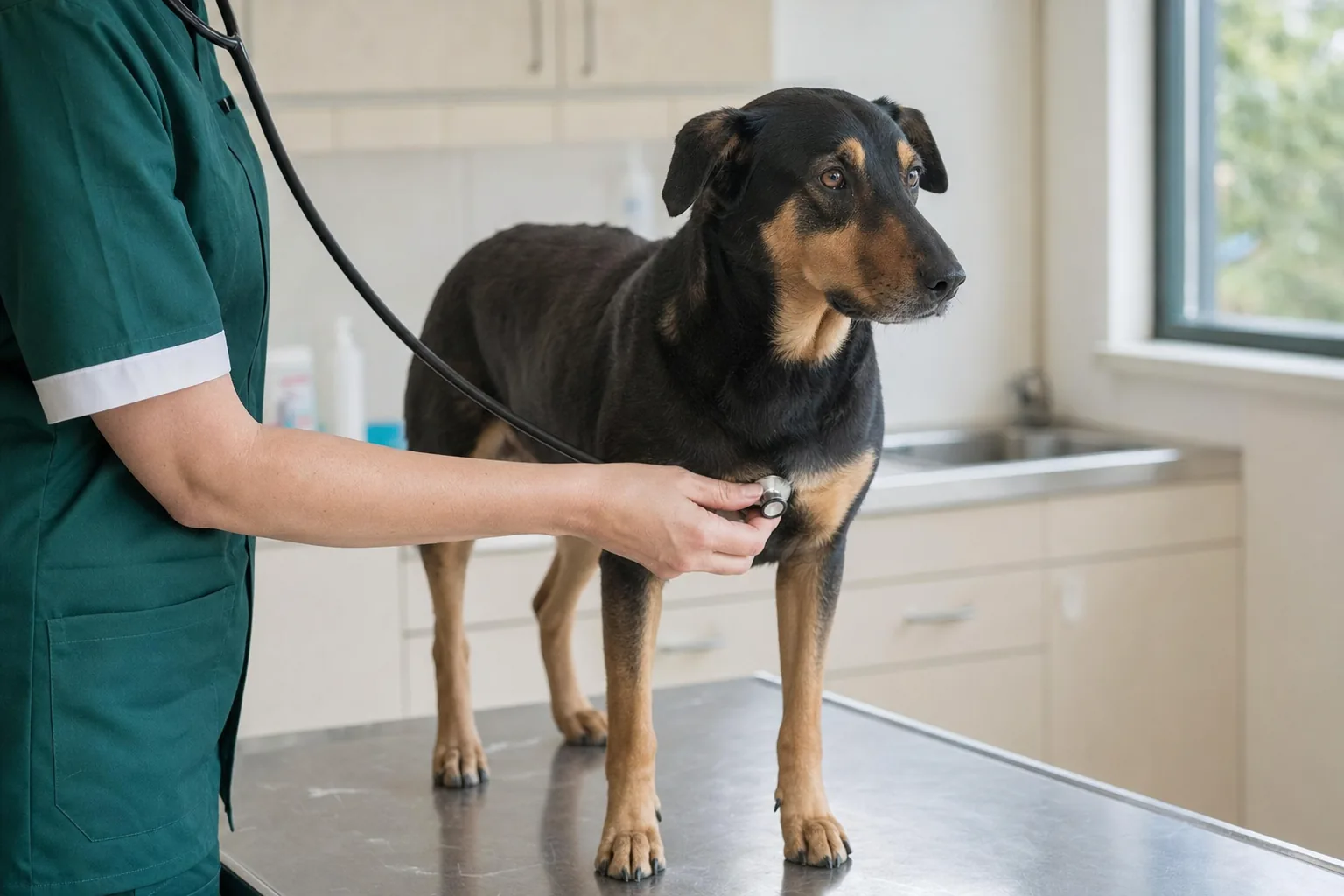
Do not look for the answer in a Facebook group, on TikTok or on a forum. Look for someone trained for this: your dog's own veterinarian, the only person who can examine, investigate and treat them.
- The same sign, dozens of causes. A dog that vomits may have eaten grass or may have an object stuck in the gut. From two lines you typed, nobody can tell which. The vet feels the abdomen, takes the temperature, runs tests.
- Nobody on the internet sees your dog. They see a photo and a story. A diagnosis comes from an examination and investigations, not from a resemblance to someone else's dog.
- In groups you hear from the people whose dog "got better on its own". Those for whom it ended badly rarely post again. What you read there is a selection, not a statistic.
- Doses are calculated by weight and species. Human medicines that look harmless, paracetamol or ibuprofen, are toxic to dogs. "I gave mine half a tablet" is the most dangerous advice you can get.
- Hours matter. With a twisted stomach, a poisoning or a urinary blockage, the time spent asking online is exactly the time that decides the outcome.
- The vet is accountable for what they say. They have your dog's record, history, vaccinations, past treatments. An anonymous account has none of that and answers for nothing.
Use this page to know what to observe, what to note and what to ask at the appointment, not to treat at home. If you still have doubts after a consultation, ask another vet or a specialist (dermatologist, internist) for a second opinion, not a group. And if you do not have a regular vet yet, find one now, while your dog is healthy: how to choose a veterinary clinic.
The patch he left in the snow is pink. Or there is a reddish drop on the kitchen tiles after he came back from a wee outside. Or your bitch is leaving marks on the sofa and you can't tell whether it is blood in her urine or something else. It is rarely that obvious. Usually the urine is just darker, like strong tea, or turns pink towards the end, and sometimes the blood can't be seen at all and only turns up in a test. This page covers the signs that need a vet today, how to collect a urine sample without wrecking your morning, and what your own vet will look for. It won't tell you what to give him: that depends on the cause, and the causes are very different from one another.
When to ring today, and when to go now
The most serious case is the dog who can't get urine out at all. You may not see a single drop of blood.
- He strains to wee and very little or nothing comes out. He holds the position for a long time and tries again and again, whimpering. In males a small stone can block the urethra; a full bladder can rupture and the kidneys shut down. Don't wait on this one: go now.
- The urine is red with clots, or blood drips between wees.
- Listlessness, vomiting, refusing food, a sore belly, a temperature.
- Bleeding from other places too: nose, gums, bruises, black stools. That can be a clotting problem, for example after rat poison.
- An unspayed bitch who, one or two months after her season, drinks a lot, is flat and has discharge from the vulva. That can be an infection of the womb, which is an emergency.
- Urine dark as coffee after ticks, with pale or yellowish gums.
- A puppy or an old dog with any of the signs above.
A little blood in a happy dog who is passing a normal stream can usually wait for an appointment tomorrow or the day after. Ring today anyway, so you know how to bring the sample in.
What to watch and note at home
When in the stream the blood shows
This is the single most useful thing you can bring. Watch closely on snow, on white paper held underneath, or on light-coloured tiles.
- Blood at the start, then the urine clears: it usually comes from the urethra, the prostate or, in bitches, the vagina.
- Blood at the end: it usually comes from the bladder (infection, stones, inflammation).
- Pink or red all the way through: it can be the bladder, but just as well the kidneys or the blood itself.
Frequency, thirst and colour
Note whether he goes more often than usual, a little at a time, whether he is having accidents indoors when he never used to, and whether he keeps licking his genitals. Measure the water: fill the bowl with a known amount in the morning and see what is left at night. Describe the colour in your own words (dark yellow, orange, pink, red, brown) and the smell too: strong, ammonia, fishy. A photo on a white background beats any description.
Bitch or dog
With a bitch, the questions are when her last season was and whether she is spayed. In unspayed bitches the commonest mix-up is exactly this one: the blood is from her season, not from her urine.
With a male, what matters is whether he is neutered. In entire males an enlarged prostate often causes blood at the start of the stream or drops between wees.
Also write down what he eats, whether he has had urinary infections before, what medication he is on, whether he has had ticks, whether he could have got at rat poison and whether he has had a knock.
How to collect a urine sample
- First thing in the morning. The first urine of the day is the most concentrated and tells the vet the most.
- Use a clean container: a sample pot from the chemist, a food tub, an old ladle or a deep plate. Wash and rinse it well so no trace of detergent is left.
- Take him out on the lead, let him start, and slide the container under the stream after the first few seconds. For bitches a flat plate or a shallow tub works better. Nearly every dog startles the first time. Stay calm, and when he has finished give him something tasty and tell him how good he is.
- Pour the sample into a pot with a lid, write the time on it and get it to the practice within one or two hours. If you can't, keep it in the fridge, but only for a few hours.
- Don't collect urine off the ground, the litter tray or the carpet. It is contaminated and the result will be wrong.
For some tests, especially a urine culture (which shows which bacterium is there and what kills it), the vet would rather take urine straight from the bladder with a fine needle, guided by ultrasound. It sounds unpleasant. In practice it is quick, dogs tolerate it well and the sample is clean.
What it might be
| Cause |
What else you usually see |
| Urinary infection |
Weeing often and in small amounts, sometimes accidents indoors, strong smell; more common in bitches |
| Bladder stones |
Blood at the end of the stream, infections that keep coming back; in males, risk of blockage |
| Enlarged or infected prostate (entire males) |
Blood at the start of the stream or drops, flattened stool, straining |
| Season (unspayed bitches) |
Swollen vulva, blood unrelated to weeing, interested males |
| Womb infection |
1–2 months after a season: thirst, listlessness, sometimes discharge |
| Bladder tumours |
Older dog, blood that keeps returning, straining to wee |
| Clotting problem, poison |
Blood elsewhere too, pale gums |
| Tick-borne disease |
Coffee-coloured urine, pale gums, listlessness |
| Knock, accident |
The history says it all |
What your vet will do
- Ask how long it has been going on, what it looks like, what you saw in the stream, how much he drinks and what sample you have brought.
- Examine him: feel the bladder (full and painful, or small?), the kidneys, take his temperature and check his gums. In males they check the prostate with a rectal exam; in bitches, the vulva.
- Test the urine: the dipstick (blood, protein, glucose, pH), the concentration, and the sediment under the microscope, looking for cells, bacteria and crystals.
- Send off a urine culture if infection is suspected, especially one that has come back. The result takes a few days and says exactly what to treat it with.
- Scan him: bladder, stones, bladder wall, prostate, kidneys, womb.
- X-ray him for certain types of stone that show up better that way.
- Run bloods: kidneys, clotting if he is bleeding elsewhere, tests for tick-borne disease.
- Choose treatment according to the cause. That may be treatment for an infection, a diet that dissolves certain kinds of stone, surgery, or castration for prostate problems.
Before you leave, ask when the urine test will be repeated. With infections and stones, the check after treatment is what tells you it is over. Not seeing blood any more doesn't.
What not to do at home
- Don't give leftover antibiotics, whether from an old infection of his or from your own cupboard. The wrong course, or too short a one, breeds resistant bacteria and hides the problem from the test.
- Don't give "bladder" supplements or herbal teas before the test. Some change the pH of the urine and muddle the result.
- Don't give human painkillers. They are toxic to dogs and some damage the kidneys.
- Don't cut his water so he wees less often. Fresh water, always within reach, flushes the bladder.
- Don't wait when he is straining and nothing comes out. A blocked male has hours.
- Don't blame everything on her season when a bitch is drinking heavily and is flat.
- Don't leave him shut in for hours without a chance to go, especially with an infection. Throughout treatment, take him out often for short trips.
Most cases of blood in the urine turn out to be infections or stones. Caught early and checked again at the end, they treat well. Your part is a clean sample and an exact answer to the question "when in the stream does the blood show?"
Frequently asked questions
What dog owners search for most often on the internet about this problem, with the short answer. The answers are a guide only: the decision belongs to your dog's own vet, after an examination.
Why is my dog peeing blood?
Most often a urinary infection or bladder stones. In entire males an enlarged prostate often causes blood at the start of the stream. In unspayed bitches, blood from a season is easily taken for blood in the urine. Less often it is a bladder tumour, a clotting problem, poison or a tick-borne disease. A urine test tells them apart.
How do I collect a urine sample from my dog?
First thing in the morning, with a clean container rinsed free of detergent: a food tub, an old ladle or a deep plate. Let him start, then slide it under the stream. Pour the sample into a pot with a lid and get it to the practice within an hour or two, or keep it in the fridge for a few hours. Never collect it off the ground.
When is blood in a dog's urine an emergency?
When he is straining and passing little or nothing, especially a male, where a small stone can block the urethra; then you go straight away. Same-day visits also cover red urine with clots, vomiting, listlessness, bleeding from elsewhere, and an unspayed bitch drinking heavily one or two months after a season.
Can I give my dog something at home for a urinary infection?
No leftover antibiotics and no human medicines. The wrong course, or too short a one, hides the problem and leaves resistant bacteria behind. Keep fresh water within reach, take him out often and bring a urine sample to your vet, who picks the treatment from the test and sometimes from a urine culture.
The information on this page is educational and does not replace an examination. For full details and a diagnosis, consult your dog's own veterinarian.