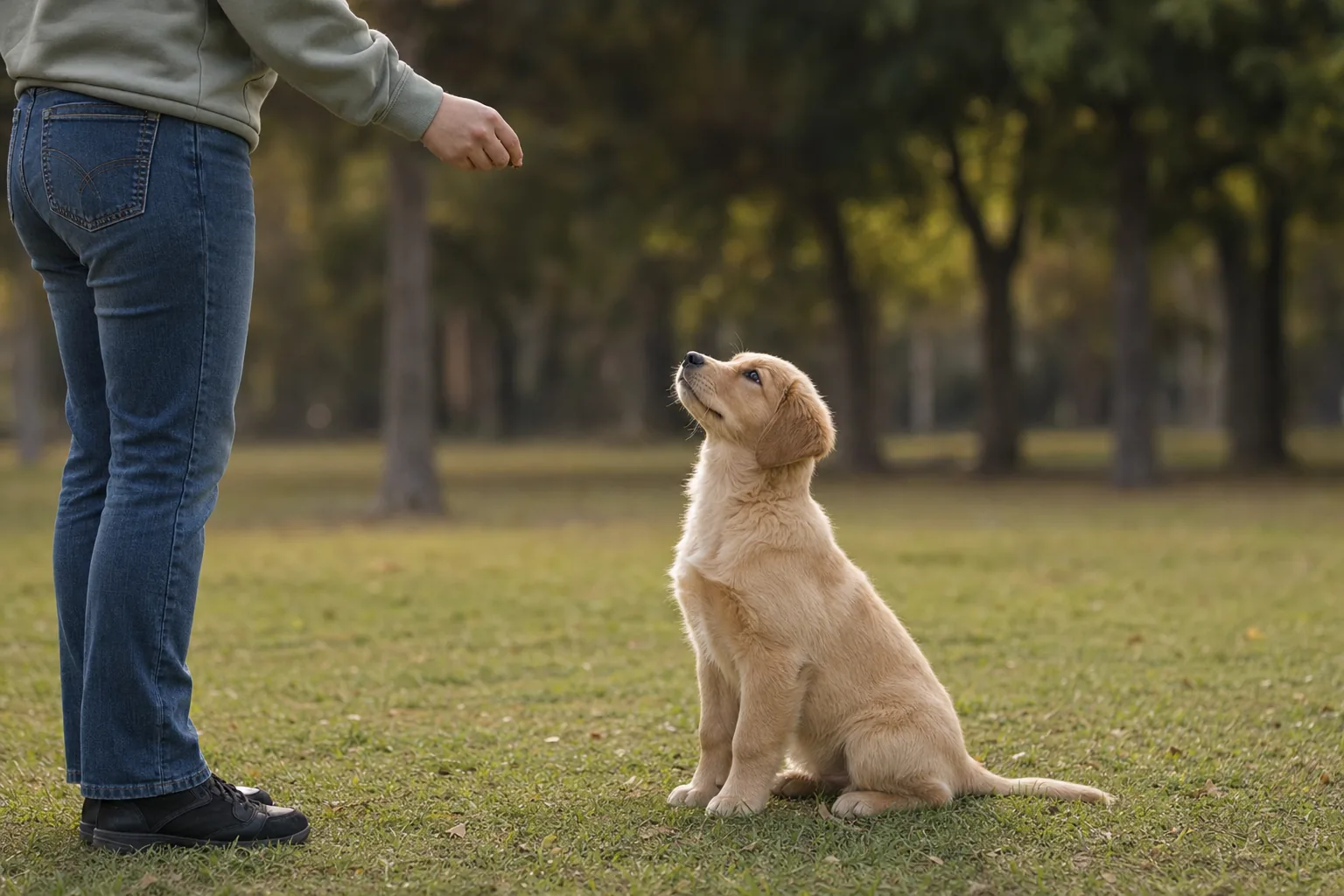
On Saturday you sign the papers at the shelter and take him home. Or you have already taken him in, off the waste ground by the flats where he had been living for a month, and now he lies in the corner of the hall with his ears pinned back: he will not eat, he jumps at the lift door and he looks at you as if you were a stranger. Which, to him, you are. An adopted dog, puppy or pensioner, needs weeks to work out where he has landed and who these people are. Until then, training, trips into town and visits to friends can wait. Below, in order, is what you do from the car to the end of the first month, and then how to tell he has started to feel at home.
What to do, step by step
Before he arrives
- An escape-proof harness and a collar with a tag, engraved with your phone number, fitted while you are still in the shelter yard. The first days are when most adopted dogs get lost: they do not know where "home" is yet, and any loud noise sends them running.
- The lead clipped in two places, to the harness and to the collar. It stays that way for a few weeks.
- A place of his own, in a quiet room, not in the hall and not by the front door: a bed, an open crate with a blanket over it or the corner behind the sofa. Nobody bothers him there, children included.
- The house checked over: cables, the bin, shoes, medicines, plant pots. He has no way of knowing what is allowed.
- The food he was getting at the shelter, for the first few days. You change it gradually, over a week or two.
- A vet chosen and an appointment booked for the first week.
Day 1: the drive and the arrival
- In the car, in a crate or clipped in with a dog seat belt, with someone beside him. He does not get out of the car without a lead. Not even in your own garden.
- The first stop is outside, somewhere quiet near the house, for a wee. Wait as long as it takes. If he goes, praise him softly and give him a treat.
- Indoors he stays on the lead. Walk him slowly through the rooms he is allowed in, take him to his place, show him the water.
- Then leave him be. No calling him over, no picking him up, no kissing, no neighbours popping round "to see him". Sit in the same room with a book. If he comes to you, stroke his chest briefly and let him wander off when he wants.
- In the evening, a short outing on the lead. If he does not eat on day one, that is often normal: leave the food down for 15 minutes, take it away and try again at the next meal.
Days 2 to 3: calm and routine
- The same times for meals and outings, bed at the same hour. Routine tells him this new world is predictable.
- Short outings on the same quiet route, three or four times a day. No park, no other dogs.
- No bath, unless it is really needed. Wash him in a week or two, once you trust each other.
- No visitors. Friends meet him in a few weeks' time.
- Treats from your hand or dropped on the floor beside him, a few a day, asking nothing in return. Your hand becomes a good thing.
The first week: the house, toileting and being alone
- Toileting, from scratch. Even an adult dog may have no idea what a house is. Take him out after every meal and after every sleep, and every time he goes outside you make a fuss of him out loud and give him something good. An accident indoors is cleaned up without a word, with an enzyme cleaner that takes the smell away too.
- Being alone, gradually. Leave the room for a few minutes, then the house for five minutes, then a quarter of an hour. You do not leave him alone for eight hours on day two. If he whines or scratches at the door in the first minutes, stop and read our page on separation anxiety.
- The vet visit: a general check, vaccinations, worming, the microchip read and transferred to your name on the database.
- His name, said often, in a happy voice, followed by something good.
Weeks 2 to 4: the first new things
- New routes, one at a time. A long line, so he can sniff to his heart's content.
- The first simple exercises, indoors, with treats: "sit", his name, coming to you from two metres away.
- The first dogs: calm, known ones, on neutral ground, walking side by side rather than nose to nose.
- One friend visiting at a time, with the visitor rules: no looking at him, no touching, treats tossed away from him.
The first month, in brief
| Period |
What you aim for |
What you avoid |
| Days 1 to 3 |
He eats, drinks, toilets, sleeps |
Visitors, baths, parks, town |
| Week 1 |
Routine, quiet outings, the vet |
Long hours alone, punishment |
| Weeks 2 to 4 |
New routes, simple exercises |
Busy dog parks, letting him off the lead |
| Months 2 to 3 |
Trust, play, a training class |
Believing you already "know" him |
Many adopters go by the "3-3-3" rule: three days to decompress, three weeks to learn the routine, three months to feel at home. It is not a law. It is a fair idea of how much patience you will need.
If you took him in off the street
A street dog may never have set foot inside a house. Stairs, doors that close behind him, the hoover, the television, the lead itself may all be new. Take them one at a time, not all on day one. See the vet in the first few days, before he meets other dogs or children: vaccinations, worming and flea treatment and, if the vet thinks it wise, tests for the diseases common in street dogs (some are carried by ticks and mosquitoes). Have him microchipped and registered in your name.
By age
The adopted puppy (under 4 months). He needs the same quiet days, but the window in which he learns what is normal in the world closes fast. After the first few days you show him the world carefully: different people, sounds, surfaces, cars, from a distance and with good treats. A puppy class with a trainer is the safest place for it.
The adolescent (6 to 18 months). This is the age at which most dogs are returned to shelters, because they come with the energy and the selective hearing typical of their age. Exercise every day, plenty of sniffing games, a basic training class, patience. He is a teenager. It passes.
The adult. He comes with a past you usually know nothing about. Some settle in days, others need months. Adults learn well, just more slowly. Do not compare him with the dog you had before.
The senior. An adopted old dog is often the calmest housemate there is, but he needs a full check-up at the start, a soft bed, rugs on tiled floors and walks that suit his joints.
Common mistakes
- Too much, too soon. Visitors, parks, shopping trips with the dog, a welcome party. An overwhelmed dog either shuts down or explodes.
- Off the lead in the first weeks, because "he stays by me". At the first loud bang he does not.
- Punishing accidents indoors or growling. It breaks trust exactly while you are building it.
- Too much attention. Constant stroking, picking him up, calling him over every minute. A fearful dog needs to come to you himself.
- Left alone for hours in the first week, with no preparation.
- Conclusions drawn from the first days. The dog of the first days is not the dog of three months later, in either direction. Some seem perfect and only show their fears after two weeks; others seem impossible and settle completely.
- Children left alone with him. However gentle he seems, you do not know him yet. Children do not hug him, do not disturb him in his place and do not go near him while he eats.
How long it takes and how you know it is working
Most of the good signs show up in the first three months. Some dogs, especially fearful ones or those who came off the street, need six months or a year to show you all of themselves.
There is no single day on which the dog "has settled". What you see instead are small signs that add up from one week to the next:
- he eats normally and sleeps stretched out on his side, not curled up with one eye open;
- he follows you round the house and greets you at the door;
- he starts to play, sometimes for the first time in his life;
- he toilets outside, with fewer and fewer accidents;
- he bounces back faster after a fright;
- his character starts to show: what he likes, what he does not, how he "tricks" you.
Keep a short diary for the first month: what frightened him, what made him happy. On the hard days, reading it back shows you how far you have actually come.
When to call a trainer
- he growls, lunges or has bitten someone in the household;
- he is so frightened that after two weeks he still will not eat or leave his spot;
- he panics every time he is left alone;
- he does not get on with another animal in the house;
- you want to start on the right foot, with a basic training class or a puppy class.
An assessment with a trainer in the first few weeks tells you what is normal for your dog and what is worth working on early. It is far easier to build things right from the start than to repair them a few months later, once the habits have set.