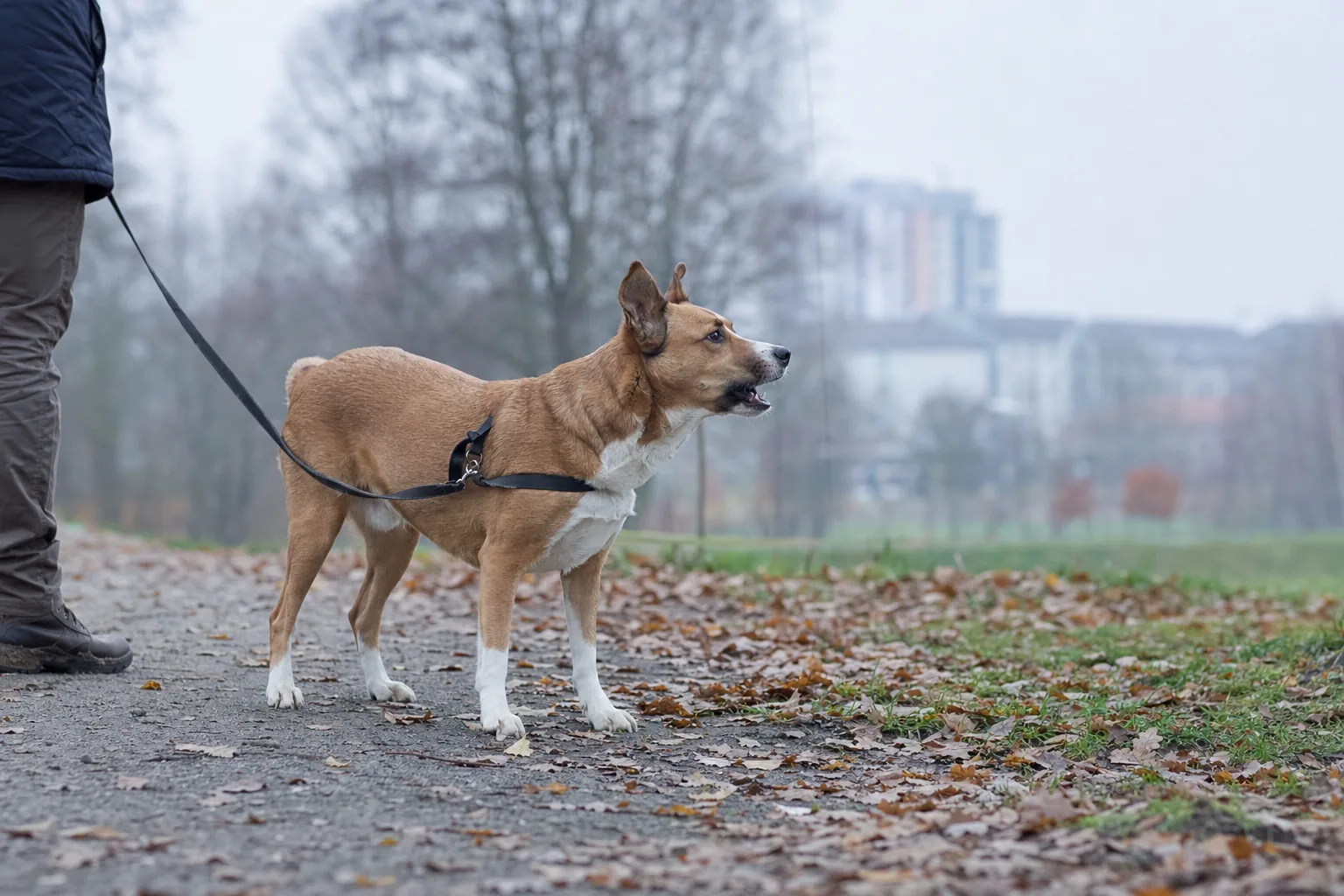
It is getting dark, you are walking home down a side street, and three dogs come out from behind the garages. They are barking and heading straight for you, the boldest one out in front. Or you have your own dog on the lead, you pass a building site, and the dogs that live there all get up at once. Or you are out for an early run in the park and one of them follows you, barking at your ankles. This page is about free-roaming street dogs: community dogs and strays with no home, but also pet dogs that are left to wander. Below you will find why they react the way they do, what to do in the moment so things do not get worse, what to do if you are bitten, and how to plan your routes from now on. We wrote it in Romania, where street dogs are part of daily life in many towns, but it holds wherever dogs roam free.
Why does a street dog go for you?
Most street dogs keep well away from people. The one coming at you barking almost always has one of the reasons below, and what it wants first of all is for you to leave.
It is guarding its patch. Dogs that live in one place, whether that is a building site, a factory yard or the corner of a block of flats where someone feeds them, will defend it. The closer you get to where they sleep, where they are fed or where their puppies are, the louder they bark and the nearer they come. Step back out of their area and most of the time they stop.
It is scared. A frightened dog with no way out may attack first. You can spot it: barking with its weight leaning back, tail tucked, darting in and then backing off.
Something is moving fast. Runners, bikes, scooters and children running set a lot of dogs off chasing. The dog chasing you probably has nothing against you personally. It goes after whatever moves.
There is a group. On its own, a dog tends to be cautious. Put three or four together and they wind each other up and go further than any one of them would dare.
You have a dog with you. Plenty of street dogs put up with people but react to dogs walking into their territory, males in particular, and dogs that stare at them and pull towards them on the lead.
It is hurt or ill. An injured or sick dog, or a bitch with puppies, has a much shorter fuse than usual. Very rarely, a dog that attacks for no reason, staggers, drools heavily or looks paralysed may have rabies.
What does not work, even when it seems to
Running. It is everyone's first instinct and the worst thing you can do. A dog is faster than you, however fit you are, and running turns a dog that was only barking into one that chases and catches.
Staring at it and leaning in. A fixed stare and a body tipping forwards read as a challenge to a dog. That alone can tip an unsure dog into attacking.
Shouting and waving your arms. Now and then the dog gets a fright and leaves, which is why people swear by it. Just as often it winds the group up and starts the attack.
Throwing stones or hitting out. It might stop a dog once. A dog that gets hit becomes more fearful and more aggressive with people, though, and next time it comes in sooner. Hit one dog in a group and the rest may join in.
Grabbing your small dog on reflex. Sometimes you have to, if he is about to be caught. Street dogs can jump up at your arms, though. If you do pick him up, turn your back to them and walk slowly.
Feeding them in the same spot every day "so they get friendly". The food helps the dogs, but the spot where they get it becomes theirs, and they will guard it. If you feed street dogs, do it well away from schools, playgrounds and paths people use.
What to do, step by step
1. When they come towards you
- Stop. No running, no sudden movements. Lots of dogs stop the moment you do.
- Turn a little sideways, shoulder towards them rather than your chest. Keep an eye on them from the corner of your eye instead of looking straight at them.
- Talk calmly, low and firm. The words hardly matter: "stay", "go home", anything, in a flat voice. A quiet voice does not provoke them, and it keeps you breathing.
- Put something between you and them. A bag, a rucksack, an umbrella, your bike, a walking pole held low. It is a barrier. You do not hit with it.
- Back away slowly the way you came, without turning your back on them completely. You walked into their area, and once you are out of it they nearly always leave you alone.
- If you have food on you, throw a few pieces well off to one side. Some dogs stop to hunt for it, and that buys you a few metres.
2. If you have your own dog with you
- Shorten the lead and keep him tight to your side, on the side away from the street dogs. You stand between him and them.
- Do not let him lunge and bark at them. That turns a passing encounter into a fight.
- Change direction early, as soon as you see the group, rather than walking through the middle of it.
- If he is small and things are going wrong, pick him up, turn your back and walk away calmly.
- Never drop the lead so he can "sort it out himself".
3. If they attack anyway
- Give it something to bite: your rucksack, jacket or umbrella, held between you and the dog's mouth.
- Protect your face, neck and chest. If you are knocked over, curl up with your knees to your chest and your hands locked behind your neck, and keep as still as you can. Many dogs lose interest in a person who has stopped moving.
- Shout for help, loudly. Do not scream at the dog.
- Children can learn a simple rule. Standing up: "be a tree", still, hands folded to the chest, eyes down. If they have fallen: "be a rock", curled up on the ground.
4. Reading the dog's body
| What you see |
What it usually means |
What you do |
| Barks from a distance, stays put, tail up |
Telling you not to come any closer |
Go round and keep walking calmly |
| Weight back, tail low, barks and retreats |
It is frightened |
Give it room, do not look at it, move away |
| Stiff body, hard stare, tail high and still, silent |
Getting ready to attack |
Stop, turn sideways, put up a barrier, back away slowly |
| Chases you when you run or cycle |
Going after whatever moves |
Stop, or get off and keep the bike between you |
| A group bunching up and moving forward |
Winding each other up |
Leave the way you came and head for somewhere with people |
5. From now on
- Remember where and when you had trouble and avoid those spots. Street dogs are predictable: they stay where they are fed and where they sleep.
- They tend to be most active in the evening and early in the morning.
- If you run or cycle, pick busier routes.
- Report groups of aggressive dogs to the town hall or whichever local service deals with stray dogs. Give the exact address, the time and, if you can, a photo taken from a safe distance.
- If you know of a pet dog that roams on its own and goes for people, talk to its owners or report it to the local police.
Bites and sick dogs: when to see a doctor
If you have been bitten or scratched
- Wash the wound straight away, for 15 minutes, under running water with plenty of soap. It cuts the risk of infection and of rabies a great deal.
- See a doctor the same day, at A&E or at a rabies clinic where your country has them. The doctor looks at the wound, checks your tetanus cover and decides whether you need rabies vaccination. Rabies is present in parts of Europe, Romania included, mostly in wild animals, so a bite from a dog nobody knows is taken seriously.
- Write down where and when it happened and what the dog looked like. If it can be found and kept under observation, the doctor's decision gets much easier.
- Deep bites, bites to the face or hands, wounds that bleed heavily and wounds that swell and redden over the next few days all need closer attention.
If your dog has been bitten
Take him to his own vet the same day, even if the wound looks tiny. A dog bite often leaves a small hole in the skin and a big wound underneath. Check his records while you are at it: his rabies vaccination should be up to date.
If you see a dog that looks ill
It staggers, drools heavily, snaps at the air or at objects, has a dropped jaw or attacks for no reason. A dog like that may be ill. Do not go near it, do not touch it, keep your own dog well back and alert the local authorities.
When to get a specialist involved
- Your dog has been barking, trembling or pulling back on the street since a bad encounter, or now reacts to every dog he sees. A trainer or behaviour specialist who works with rewards can help him get his confidence back, step by step, from a distance.
- You no longer enjoy your walks, avoid whole streets or have nightmares after an attack. Being afraid after a bite is normal. If it has not eased after a few weeks, a psychologist can help.
- Your child is now frightened of every dog. With patience, calm dogs they already know and, if needed, help from a specialist, that fear can shrink.
- Your dog was the one who attacked a street dog or a person. He needs a behaviour assessment before the next walk.
A behaviour that appears suddenly or changes for no apparent reason can have a medical cause. For full details, consult your dog's own veterinarian.