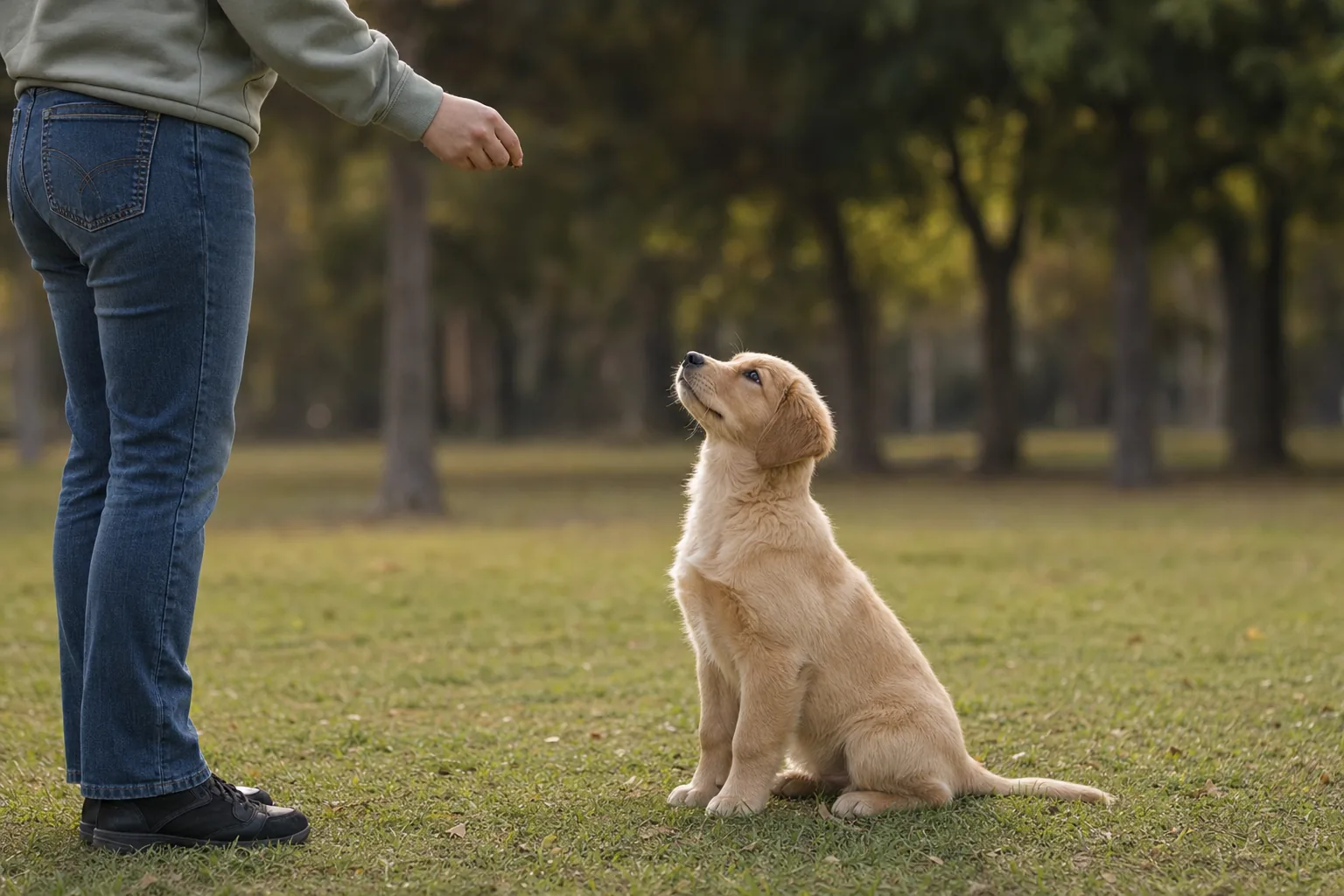
Your one-year-old Labrador meets you at the door with both paws on your chest and pins visitors to the wall. Or you have a four-month-old puppy who leaps at children in the park while everyone laughs, for now. Or a six-kilo dog who jumps at the legs of anyone who stops to chat, and nobody takes it seriously precisely because he weighs six kilos. For all three, the jump is the same thing: a greeting aimed at the person's face, which we have rewarded, without meaning to, every single time. Here is how to swap it for a greeting with all four paws on the floor, with no knees in the chest and no shouting.
How to stop it, step by step
Everyone knows the rule in theory: four paws on the floor bring attention, paws on a person make the person vanish. The hard part is keeping to it at every homecoming, with every person, every day. A dog who jumps twenty times and succeeds once has learnt it is worth trying twenty times.
1. You, at home, for three days
Come in without a word. If he jumps, turn your back, arms folded against your chest, eyes on the ceiling, and take a step back towards the door. The instant all four paws are on the ground, turn round, crouch down and greet him warmly but in a low, calm voice, at his level, with your hand on his chest. If he jumps again, stand up and turn away again. On day one you will do this seven or eight times every time you come home. By day three, once.
2. Good things turn up on the floor
When you come in, have a few treats in your pocket and drop them on the floor by your feet before he has time to jump. With his nose on the floor, his paws stay there too. After a week, a dog who hears you at the door looks down, because that is where good things appear, and a dog looking at the floor does not jump.
3. A different greeting: "sit" or his mat
Sitting in front of a person becomes the only position that earns a fuss. Practise without visitors, ten times a day: walk up to him, say "sit", and when he sits he gets a tasty treat and a proper cuddle; then walk off and come back. For big, very bouncy dogs, a mat two metres from the door often works better. "On your mat" means lie there until someone comes to you, and the distance from the door takes the wind out of the jump by itself.
4. Rehearsals with a pretend visitor
Someone from the household goes out and comes back in ten times in a row, a minute apart, as if they were a visitor. The dog is on a lead and you stand two metres from the door with the lead slack. If he has four paws down as they come in, the "visitor" drops a treat on the floor and crouches to make a happy fuss of him. If he jumps, the "visitor" steps out without a word, shuts the door and comes back after ten seconds. Ten entrances, ten minutes. Three days running, with everyone in the house taking a turn as the visitor.
5. Real visitors
Ask them to text you when they are outside, and give them one sentence before they come in: "Do not touch him until he sits; if he jumps, turn your back." The dog is on a lead, and you stand on it at a length that lets him sit but not jump, without pulling. Treats hit the floor as the door opens. After five minutes, once your guests are sitting down and chatting, let him off. The visitor who says "oh, I don't mind, I love dogs" is entitled to their view. Your dog is entitled to a rule that does not change with each guest, so the lead stays on.
6. Out on the street
When you see someone heading over to talk, shorten the lead before they reach you, ask for a "sit" and praise him and give him a treat before the person stops. If they want to stroke him, it is from a sit only, with your foot on the lead. Children running towards you are the hardest case: step between the dog and the child, with your back to the child, and ask for another sit. After a month of meetings like that, he sits on his own when he sees someone slowing down.
The first week
| Day |
What you do |
| 1 to 3 |
Come in and turn your back as often as needed. Treats on the floor every homecoming. Count the jumps. |
| 1 to 7 |
"Sit" or "on your mat" ten times a day, with nobody at the door. |
| 3 to 5 |
Rehearsals with the household visitor: ten entrances, ten minutes, daily. |
| 5 to 7 |
First real visitor, with the lead, the one-sentence briefing and treats on the floor. |
| 7 |
Compare the jumps on day 1 with day 7. If they have dropped, carry on; if not, go through the list of mistakes. |
By age
The puppy of 8 to 16 weeks. He jumps because that is how puppies lick the mouths of their mother and other adult dogs; it is baby behaviour. It is the easiest age to work on and the age at which everyone ruins it: he is small, he is cute, he jumps and gets picked up. The rule applies from day one, for everyone: crouch to greet him, do not lift him when he jumps, and the treat arrives on the floor. A puppy class gives him rehearsals with strangers that you cannot set up at home.
The adolescent of 6 to 18 months. Maximum energy, minimum self-control. The dog who seemed to have it cracked at five months is jumping again at nine. Lead on indoors when visitors are due, treats on the floor, and a twenty-minute sniffing walk before guests arrive, so he gets to the door with his battery half drained. This stage passes; the rule stays the same.
The adult with an old habit. A dog who has jumped for five years will not stop in three days. In the first week he will jump even harder, because he is trying more insistently what used to work. That is a good sign: a habit that no longer gets him anything fades away gradually, and just before it goes it has one last surge. Allow three to six weeks, with everyone in the house on the same rule.
The senior. Usually stops on his own, because his joints ache. If an old dog still jumps, it hurts him: bring the greeting down to his level, crouch before he reaches you and put his mat by the door. If he has suddenly started jumping in old age after years of not doing it, ask your own vet. Sudden changes in behaviour in older dogs often have a medical explanation.
Common mistakes
- A knee in the chest. It hurts, it can injure him, and to the dog it is still attention: you looked at him, moved towards him, touched him. Some dogs take the knee as an invitation to play and jump higher.
- Yelling "down!". He does not know the word, and your raised voice is exactly the reaction he was after. The jump produced noise and eye contact, so it worked.
- A rule with exceptions. He may jump when you are in your joggers but not when you are dressed to go out. Dogs cannot tell clothes apart. He learns it sometimes works, and "sometimes" keeps him trying harder than anything, like a gambler at a fruit machine.
- "He is only small, he is a puppy, leave him." Six months later he weighs 30 kilos and has the same habit, taught with everyone's blessing.
- Pushing him off with your hands. To him, your hands on him mean play. You push, he bounces back, you push again, and you have invented a new evening game.
- Visitors who egg him on. They clap, bend down, grab his paws. Without a lead, a two-hour visit from someone like that wipes out two weeks of work.
- Punishment from a distance. Water spray, a loud noise, something thrown. He learns that people arriving bring nasty things and starts barking at the door instead of jumping. You have swapped one problem for a harder one.
- Waiting for the jump so you can correct it. Before the actual jump there were two seconds in which you could have dropped a treat or asked for a sit. The whole exercise is about getting in before the jump.
How long it takes and how to tell it is working
With the family, two or three weeks until you can walk in without turning your back at all. With visitors, six to eight weeks, because you get fewer chances to practise, which is why the household rehearsals in step 4 matter so much. For adult dogs with a long-standing habit, double it.
The measure is the number of jumps per homecoming. Note it on day one (eight, say), after a week (three), after two (one, then he sits). The second sign is how long he takes to sit when the door opens: at first you ask, then he does it by himself within two seconds, then he heads for his mat as soon as he hears your key in the lock. The third is the nicest: when someone comes in, he looks down at the floor where he has learnt good things appear.
You will see setbacks after a stay with relatives, a very enthusiastic visitor or a spell without practice, and that is normal. Three days of turning your back at the door and treats on the floor bring him back.
When to call a trainer
- he jumps and grabs clothes or hands, leaves bruises, tears sleeves: here the jumping comes bundled with a dog who gets too wound up and puts his mouth on people, and the two are worked on together;
- he weighs over 30 kilos and there are young children or elderly people in the house he could knock over; safety comes before training, so use a lead and a gate until help arrives;
- he jumps from anxiety rather than joy: he whines, cannot settle for half an hour after visitors leave, pants without having run;
- you have kept the rule for eight weeks, with the whole household, and the number of jumps has not gone down.
A puppy class or a basic course gives you the rehearsals you cannot get at home: ten strangers coming in one after another, at a distance the trainer chooses, and someone on the sidelines who can see you are dropping the treat a second too late.