
Search and Rescue Dogs
The equipment of a canine search and rescue team
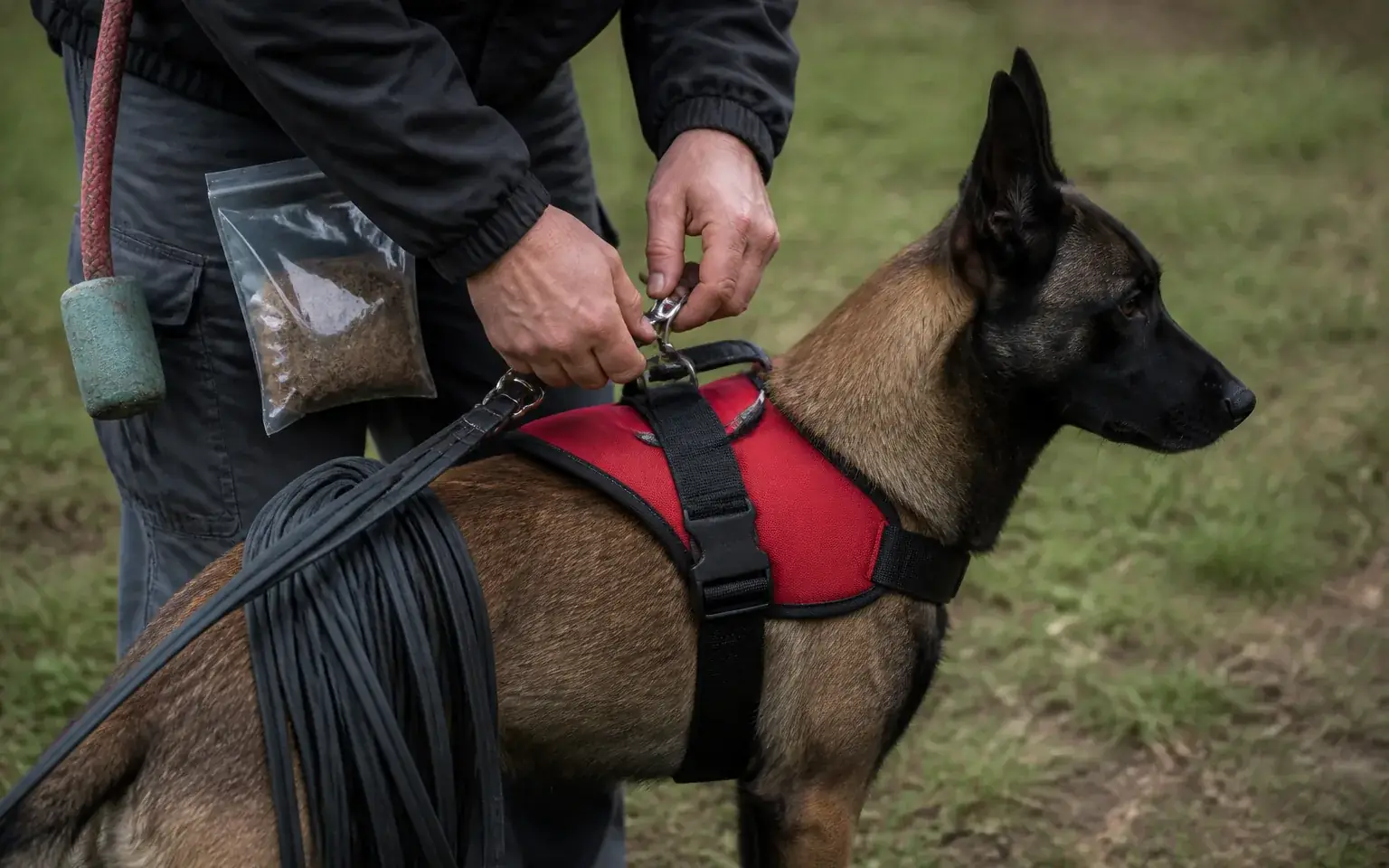
A search and rescue team's equipment centres on: a working harness (which signals to the dog that work is starting), a long line for mantrailing, the scent article, high-value rewards and, for operations, a GPS tracker plus visibility items and the handler's gear. Each piece has a functional role - nothing is decorative.
In short
Simple, but with a precise role
Below we explain each item and link to our detailed mantrailing equipment guides, which underpin any team's kit. For context, go back to the guide on search and rescue dogs.
The working harness
The central piece. It distributes pull evenly across the chest, without pressing on the neck, and - just as important - becomes a signal: when the dog wears the harness, it knows work is starting; when it is removed, it is free. This ritual helps the dog quickly enter a state of focus. Details in our guide on the mantrailing harness.
The long line
Usually 5-10 metres. It gives the dog the freedom to follow its nose and work ahead of the handler, while keeping the connection and control. The material matters: a line that does not absorb water and does not tangle stays light in any conditions. See the guide on the mantrailing leash.
The scent article
The object worn by the searched person, from which the mantrailing dog starts. How it is collected and preserved (without contamination) is essential for success. See the guide on the scent article.
Rewards
The engine of the whole job. A search dog works for a high-value reward - food or toy - and the choice and timing of the reward make the difference between a motivated dog and one that gives up. See the guide on rewards in mantrailing.
GPS tracker, bell and light
For real operations, a dog working free (area search) wears a GPS tracker, so the handler and coordinator can see the covered route. A bell helps with auditory location in dense vegetation, and a light or reflective strip ensures visibility at night.
The handler's gear
The team is not just the dog. The handler needs clothing and footwear suited to the terrain, a first aid kit (for human and dog), water, communication means (radio/phone), a head torch and, on difficult terrain, paw protection for the dog. In summer, a cooling vest helps the dog work without overheating.
Table: piece and role
| Piece | Role | SAR note |
|---|---|---|
| Working harness | Even pull + start signal | Essential in any discipline |
| Long line (5-10 m) | Freedom to work + control | For mantrailing; in area search the dog works free |
| Scent article | Scent starting point | Contamination-free collection |
| Rewards | The dog's motivation | High-value, given at the right moment |
| GPS tracker | Tracking the covered route | Operational, especially for the free-working dog |
| Bell / light | Auditory location / visibility | Dense vegetation, night |
| Handler gear | Safety, first aid, communication | Suited to terrain and weather |
Sport vs operational
For mantrailing as a sport, a harness, long line, scent article and rewards are enough. For operational rescue work, a layer of safety and efficiency is added: GPS, night visibility, paw protection, a first aid kit and a cooling vest. The difference is not one of quality but of context - operational work demands redundancy and safety. See the full mantrailing equipment guide.
Frequently asked questions
Frequently asked questions
01
What equipment does a search and rescue dog need?
Basic: a working harness, a 5-10 metre long line for mantrailing, the scent article, high-value rewards and, for operations, a GPS tracker plus visibility (bell, light). To these is added the handler's gear: a first aid kit, suitable clothing and communications.
02
Why is a special mantrailing harness important?
It has a dual role: it distributes pull evenly across the chest, without pressing on the neck, and it becomes a signal - with the harness on, the dog knows it is time to work; without it, it is free. This ritual helps it quickly enter a state of scent focus.
03
What is the difference between sport and operational equipment?
For sport you need a harness, long line, scent article and rewards. For operational work, safety and efficiency are added: a GPS tracker, night visibility, paw protection, a first aid kit and sometimes a cooling vest for effort in heat.
04
How long should a mantrailing line be?
Usually between 5 and 10 metres. The long line gives the dog the freedom to follow its nose and work ahead of the handler, while keeping the connection and control. A material that does not absorb water and does not tangle stays easy to handle in any conditions.
See the full equipment guide
Harness, leash, scent article, trail and rewards - explained in detail.