
Trail Journal Case 012
The Toy Rabbit
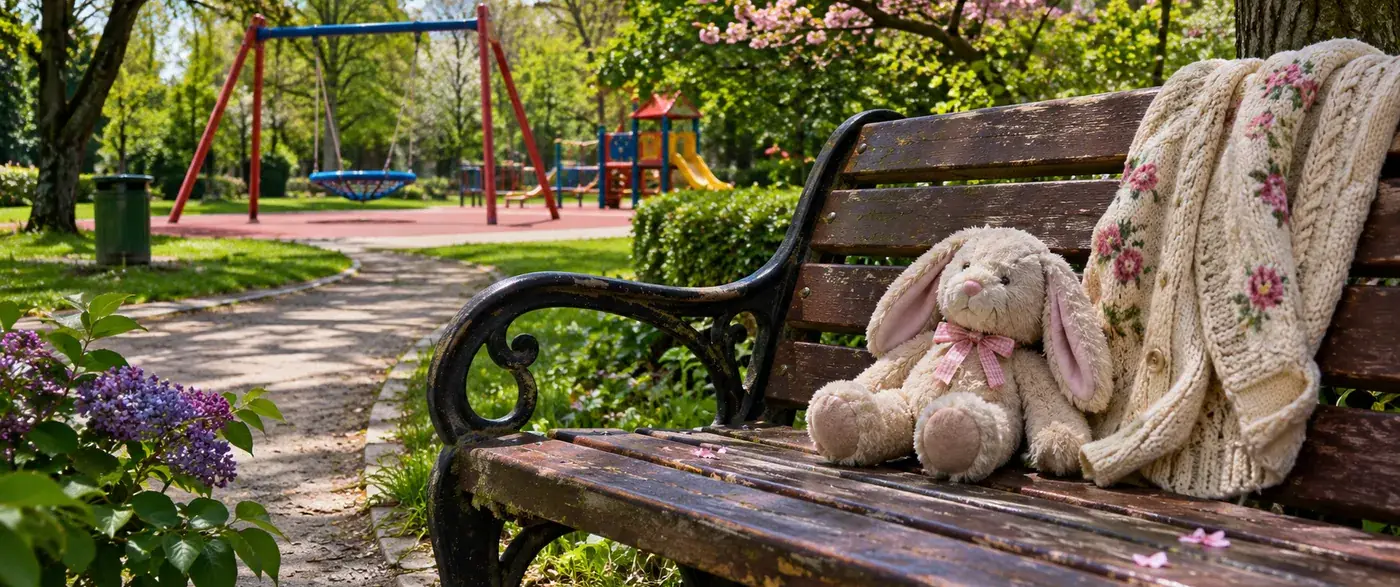
When Grandma gets up from the bench, the rucksack is still there, with the toy rabbit inside. Sofia has gone. Where can the dog pick up her trail again?
Linden District · Saturday
A Rest on the Bench
Sofia is spending today with her grandmother. Her parents have left her there for the day, and the seven-year-old can't wait to try the big swing. On the way, a health problem makes Grandma feel unwell. She sits down on a bench. “Stay with me a minute, Sofia, till I feel better.” The little girl waits a few moments longer, then goes on ahead by herself, set on getting to the playground.
When she realises Sofia is missing, Grandma asks the people around whether they have seen a fair-haired girl of seven in a yellow jacket. Nobody has. Grandma rings the police. The officers arrive with a search and rescue team. Grandma shows them the bench, describes what the girl is wearing and takes out of the rucksack the rabbit Sofia carried in her arms on the way. Nea, a dog trained for mantrailing, sniffs the toy and picks up the trail from the bench.
Nea stops beside a bus shelter. Her handler tells the officers that Sofia may have got on a bus. On the pictures from the camera at the stop, Grandma recognises Sofia by her jacket and by her plaits, tied with blue ribbons. The girl gets on a bus whose number can't be made out. The officers check the times the buses came through and ask for the footage from on board to find out where she got off.
You have three buses and three drop-off frames, each filmed at a different stop. The camera clocks are synchronised. Sofia got on after 10:10 and before 10:20. Match the times to the routes, then each route to the stop in its frame. Which bus did Sofia take, and where can Nea pick up her trail again?
Search log
Field clues
I need a hint
Which of the three times falls between 10:10 and 10:20? That is when Sofia got on.
One more hint
After route 14, two more buses come through. Put them in the order given in the dispatcher's note, then keep the “Bridge” stop for the last one.
Workbook
Deduction grid
The grid is optional. You can use it to organise your notes and see which options you have ruled out. If you already have the answer, go straight to the final report.
Find the 14 row and the 10:10 column. Tap their cell twice to confirm the match from your notes.
How to play: the basics and a worked example
What do I have to do in a case?
- Read the story and the question in the final report: Which route did Sofia take, and at which stop did she get off? That tells you what you have to reconstruct.
- Take the clues one at a time. Look for the two items each sentence links and note in the grid what you have learned. Then tick the clue so you remember you have used it. You can reread it at any time.
- If two clues share an item, follow it through both pairings. When you get stuck, you can open “I need a hint”, then “One more hint”.
- When you have a theory, fill in the two fields of the final report. You can send the report even if you've left the grid empty. Then press “Check the report”. If the answer doesn't match, reread the clues and try again. Once it is confirmed, read the explanation in “The log, reconstructed”, shown below the report.
How do I correct a mark?
Tap the same cell to go through the three states, in order. You start from a dot. One tap puts ×, another puts ✓, and a third brings the dot back. So from ✓, a single tap clears the mark. The other cells only change when you tap them yourself.
How do I read the big grid in a case?
Above the columns you will see categories such as “Stop” and “Time”. The rows are on the left. Follow the name on the row across to the column you are interested in and read the pairing as a question. A dot means you haven't noted the answer yet.
The one-match rule applies within each group of columns. After a ✓ you can put × in the other cells on the row and the column of the same group. In another group, the same row can have one more ✓.
Further down, the rows compare the remaining categories with each other. The hatched areas show pairings already covered elsewhere in the table. On a phone, swipe the table sideways to see the next group.
The example below is a made-up case with two dogs, Luna and Nori, who ended up in different places. The first clue says: “Luna did not finish the trail at the jetty.” Luna gets × under Jetty, so the greenhouse is all that is left for her and she gets ✓ there. The second clue says: “The team that reached the greenhouse used the bandana.”
| Reference | Place | Article | ||
|---|---|---|---|---|
| Jetty | Greenhouse | Bandana | Scarf | |
| Luna | ruled out | confirmed | confirmed | unknown |
| Nori | unknown | unknown | unknown | unknown |
| Jetty | Unused group of cells | unknown | unknown | |
| Greenhouse | confirmed | unknown | ||
On the “Greenhouse” row, the ✓ under “Bandana” comes straight from the clue. On the “Luna” row, the ✓ under “Bandana” is your own conclusion: Luna reached the greenhouse, and the team at the greenhouse used the bandana. The two ticks on Luna's row are in different groups.
Swipe the table to the left to see all the columns.
| Reference | Stop | Time | ||||
|---|---|---|---|---|---|---|
Final report
Which route did Sofia take, and at which stop did she get off?
The log, reconstructed
- Route 14 came through at 10:10, and its frame is from Library. Sofia got on later.
- Of the two buses left, the 26 came through before the 8. Sofia got on at 10:15, so she took route 26.
- The frame from Bridge belongs to the last bus, route 8. That leaves the Linden stop for route 26. On the footage from the bus, the officers see Sofia getting off there.
| Time | Route | Stop |
|---|---|---|
| 10:10 | 14 | Library |
| 10:15 | 26 | Linden |
| 10:20 | 8 | Bridge |
At the Linden stop, Nea picks up Sofia's trail again and leads her team to the playground. She finds her by the big swing, playing alongside other children. None of the parents there had noticed that she had come by herself. When she sees her grandmother at the gate, Sofia runs to her, and Grandma puts the toy rabbit in her arms.
Solve another case
More cases of the same level from the collection.
-
 Case 013
Solved
Five Hours on the Trail
At dawn, the Salvamont rescuers reach the spot four young people rang them from. Beside a rock they find a rucksack. The group has moved on, and their phones have died.
-
 Case 044
Solved
The bell from the sheepfold
Matei has gone out to watch the sheep passing by the house.
-
 Case 045
Solved
The boot in the photograph
Ever since she started walking, Ema puts on her own boots, sometimes the wrong way round.