

Trail Journal Case 044
The bell from the sheepfold
Who heard Matei's voice, and from which landmark did they report?
The real case · Romanian Ministry of Internal Affairs
In Gorj, a dog team from Sibiu and local people found an eight-year-old child in a hard-to-reach forest, about two kilometres from home.
How the search began
What happened?
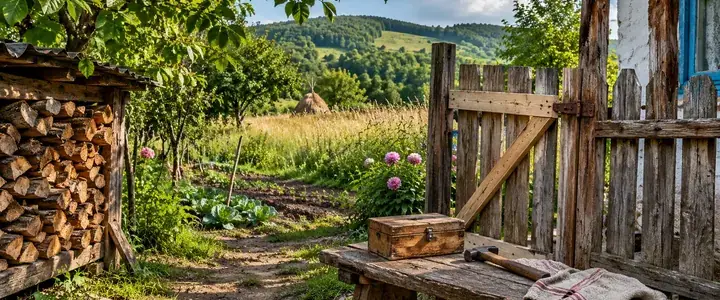
Matei has gone out to watch the sheep passing by the house. His grandfather had just shown him how to tell the sheep that leads the flock. “You can hear it even with your eyes closed,” he had said. Matei had tried, with his palms over his eyes, then run to the little gate to see if he had guessed right. When the bells sound again from behind the hill, his grandfather steps out onto the doorstep to call the boy in for dinner.
When the flock comes back, his grandfather recognises every bell, but there is no sign of Matei. The police ask for the help of a mantrailing team. The grandfather gives the handler the sweatshirt the boy wore that morning. Three people report what they hear from the forest. On one of the recordings, Matei himself can be heard calling for his grandfather.
At the edge of the forest, the leaves rustle with every step the people take. When they all stop, the grandfather hears the end of a word on the radio and asks for the recording to be played again. He recognises his grandson by the way he draws out the last syllable when he calls from far away.
You have three field sheets. Each landmark and each note appears on one sheet only. Who heard Matei's voice, and from which landmark did they report?
- Name · Lia, Petru, Sorin
- Landmark · Dry Well, Wooden Footbridge, Small Saddle
- Note · Bell, Child's voice, Barking
Search log
Field clues
I need a hint
Start with the one certain pairing, “Petru” and “Barking”.
One more hint
Once you have paired them, rule out “Barking” for the other two values in the “Name” category. Each value is used only once.
Workbook
Deduction grid
The grid is optional. You can use it to organise your notes and see which options you have ruled out. If you already have the answer, go straight to the final report.
Pick the cell where the two values you want to compare meet.
How to play: the basics and a worked example
What do I have to do in a case?
- Read the story and the question in the final report: Who heard Matei's voice, and from which landmark did they report? That tells you what you have to reconstruct.
- Take the clues one at a time. Look for the two items each sentence links and note in the grid what you have learned. Then tick the clue so you remember you have used it. You can reread it at any time.
- If two clues share an item, follow it through both pairings. When you get stuck, you can open “I need a hint”, then “One more hint”.
- When you have a theory, fill in the two fields of the final report. You can send the report even if you left the grid empty. Then press “Check the report”. If the answer doesn't match, reread the clues and try again. Once it is confirmed, read the explanation in “The log, reconstructed”, shown below the report.
How do I correct a mark?
Tap the same cell to go through the three states, in order. You start from a dot. One tap puts ×, another puts ✓, and a third brings the dot back. So from ✓, a single tap clears the mark. The other cells only change when you tap them yourself.
How do I read the big grid in a case?
Above the columns you will see categories such as “Landmark” and “Note”. The rows are on the left. Follow the name on the row across to the column you are interested in and read the pairing as a question. A dot means you haven't noted the answer yet.
The one-match rule applies within each group of columns. After a ✓ you can put × in the other cells on the row and the column of the same group. In another group, the same row can have one more ✓.
Further down, the rows compare the remaining categories with each other. The hatched areas show pairings already covered elsewhere in the table. On a phone, swipe the table sideways to see the next group.
The example below is a made-up case with two dogs, Luna and Nori, who ended up in different places. The first clue says: “Luna did not finish the trail at the jetty.” Luna gets × under Jetty, so the greenhouse is all that is left for her and she gets ✓ there. The second clue says: “The team that reached the greenhouse used the bandana.”
| Reference | Place | Article | ||
|---|---|---|---|---|
| Jetty | Greenhouse | Bandana | Scarf | |
| Luna | ruled out | confirmed | confirmed | unknown |
| Nori | unknown | unknown | unknown | unknown |
| Jetty | Unused group of cells | unknown | unknown | |
| Greenhouse | confirmed | unknown | ||
On the “Greenhouse” row, the ✓ under “Bandana” comes straight from the clue. On the “Luna” row, the ✓ under “Bandana” is your own conclusion: Luna reached the greenhouse, and the team at the greenhouse used the bandana. The two ticks on Luna's row are in different groups.
Swipe the table to the left to see all the columns.
| Sheet | Landmark | Note | ||||
|---|---|---|---|---|---|---|
Final report
Who heard Matei's voice, and from which landmark did they report?
The log, reconstructed
Mara, the mantrailing dog, leads the rescuers and the grandfather to Matei. The boy is still holding in his palm a tuft of wool caught on a branch.
| Name | Landmark | Note |
|---|---|---|
| Lia | Small Saddle | Bell |
| Petru | Wooden Footbridge | Barking |
| Sorin | Dry Well | Child's voice |
The real case
In Gorj, a dog team from Sibiu and local people found an eight-year-old child in a hard-to-reach forest, about two kilometres from home.
Solve another case
More cases of the same level from the collection.
-
 Case 045
Solved
The boot in the photograph
Ever since she started walking, Ema puts on her own boots, sometimes the wrong way round.
-
 Case 046
Solved
The mark above the clearing
Ilie was holding the box of nails for his grandmother while she mended a gate.
-
 Case 047
Solved
The mill wheel
Vlad has drawn a mill in his notebook and wants to see whether the real wheel still turns.