
Trail Journal Case 013
Five Hours on the Trail
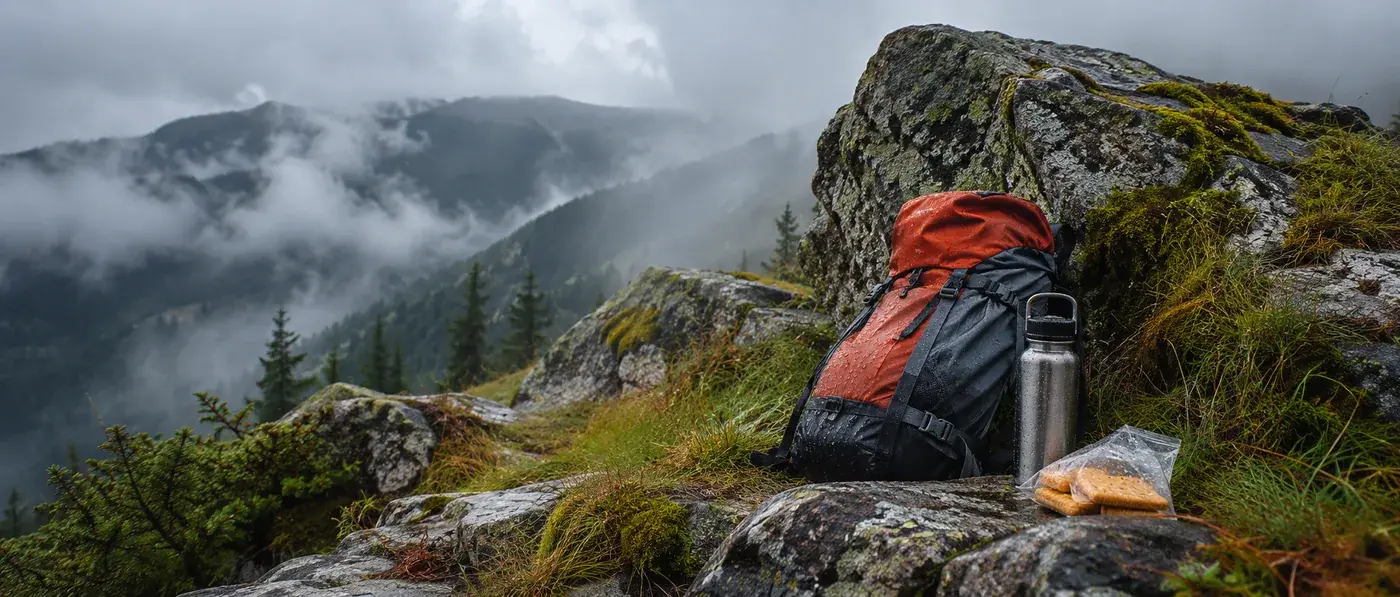
At dawn, the Salvamont rescuers reach the spot four young people rang them from. Beside a rock they find a rucksack. The group has moved on, and their phones have died.
Grey Stone Massif · Sunday morning
The Rucksack with a Stitched Strap
On Saturday, four friends set out on a trip into the mountains. They take photos from every summit and film until towards evening. When the rain and the fog come in, they realise they have left the route. They can't find the waymarks any more. They have little water and a few biscuits left. The weather keeps them stuck on the mountain overnight.
With the last phone that still has any battery, Ilie rings Salvamont (mountain rescue) and sends the group's position. The dispatcher tells them the teams are setting off towards them and asks them to stay by the rock they have described. The phone goes dead. During the night, the four decide to head for the cars all the same. The rescuers' calls go unanswered.
At dawn, at the place the call came from, the rescuers find kit left behind and ask for the support of a mantrailing team. Ilie had mentioned his rucksack, with one strap stitched in yellow thread. The handler takes from it the hat Ilie had been wearing and presents it to Arin, the team's dog. Arin picks up the trail beside the rock, and the rescuers set off with him.
The young people thought they were getting closer to the cars. In fact they had walked the opposite way and gone down into a steep gully, along the edge of a drop. When the way ahead closed, they tried to climb back up. Ilie fell and broke his leg. His friends stayed with him. Arin found all four of them after five hours on the trail.
On the map in the control room, the car park, the refuge and the gully lie in three different directions from the rock Ilie rang from. You have one message from each place, each at a different time. Which direction had the group gone in, and at what time did Arin and the rescuers reach them?
Search log
Field clues
I need a hint
Start from 06:40. What time does the clock show five full hours later?
One more hint
Put north next to the car park and east next to the refuge. Which direction is left for the gully?
Workbook
Deduction grid
The grid is optional. You can use it to organise your notes and see which options you have ruled out. If you already have the answer, go straight to the final report.
Find the North row and the Car park column. Tap their cell twice to confirm the match from your notes.
How to play: the basics and a worked example
What do I have to do in a case?
- Read the story and the question in the final report: At what time did Arin find the group, and in which direction from the place the call came from? That tells you what you have to reconstruct.
- Take the clues one at a time. Look for the two items each sentence links and note in the grid what you have learned. Then tick the clue so you remember you have used it. You can reread it at any time.
- If two clues share an item, follow it through both pairings. When you get stuck, you can open “I need a hint”, then “One more hint”.
- When you have a theory, fill in the two fields of the final report. You can send the report even if you've left the grid empty. Then press “Check the report”. If the answer doesn't match, reread the clues and try again. Once it is confirmed, read the explanation in “The log, reconstructed”, shown below the report.
How do I correct a mark?
Tap the same cell to go through the three states, in order. You start from a dot. One tap puts ×, another puts ✓, and a third brings the dot back. So from ✓, a single tap clears the mark. The other cells only change when you tap them yourself.
How do I read the big grid in a case?
Above the columns you will see categories such as “Direction” and “Point”. The rows are on the left. Follow the name on the row across to the column you are interested in and read the pairing as a question. A dot means you haven't noted the answer yet.
The one-match rule applies within each group of columns. After a ✓ you can put × in the other cells on the row and the column of the same group. In another group, the same row can have one more ✓.
Further down, the rows compare the remaining categories with each other. The hatched areas show pairings already covered elsewhere in the table. On a phone, swipe the table sideways to see the next group.
The example below is a made-up case with two dogs, Luna and Nori, who ended up in different places. The first clue says: “Luna did not finish the trail at the jetty.” Luna gets × under Jetty, so the greenhouse is all that is left for her and she gets ✓ there. The second clue says: “The team that reached the greenhouse used the bandana.”
| Reference | Place | Article | ||
|---|---|---|---|---|
| Jetty | Greenhouse | Bandana | Scarf | |
| Luna | ruled out | confirmed | confirmed | unknown |
| Nori | unknown | unknown | unknown | unknown |
| Jetty | Unused group of cells | unknown | unknown | |
| Greenhouse | confirmed | unknown | ||
On the “Greenhouse” row, the ✓ under “Bandana” comes straight from the clue. On the “Luna” row, the ✓ under “Bandana” is your own conclusion: Luna reached the greenhouse, and the team at the greenhouse used the bandana. The two ticks on Luna's row are in different groups.
Swipe the table to the left to see all the columns.
| Reference | Direction | Point | ||||
|---|---|---|---|---|---|---|
Final report
At what time did Arin find the group, and in which direction from the place the call came from?
The log, reconstructed
- The cars were to the north and the refuge to the east. The third place, the gully, was south of the place the call came from. That is where the young people had ended up.
- Starting from 06:40, the five hours are up at 11:40. This is the message from the gully, where Arin reached the group.
- That leaves 08:40 and 10:40 for the other two places. The car park transmitted first, at 08:40, and the refuge at 10:40.
| Point | Time | Direction |
|---|---|---|
| Car park | 08:40 | North |
| Refuge | 10:40 | East |
| Gully | 11:40 | South |
The rescuers call for a helicopter for Ilie. As soon as the weather allows it to fly, the helicopter picks up the young man with the broken leg. The other three walk down with the rescuers and reach the cars safely.
Solve another case
More cases of the same level from the collection.
-
 Case 044
Solved
The bell from the sheepfold
Matei has gone out to watch the sheep passing by the house.
-
 Case 045
Solved
The boot in the photograph
Ever since she started walking, Ema puts on her own boots, sometimes the wrong way round.
-
 Case 046
Solved
The mark above the clearing
Ilie was holding the box of nails for his grandmother while she mended a gate.