
Trail Journal Case 047
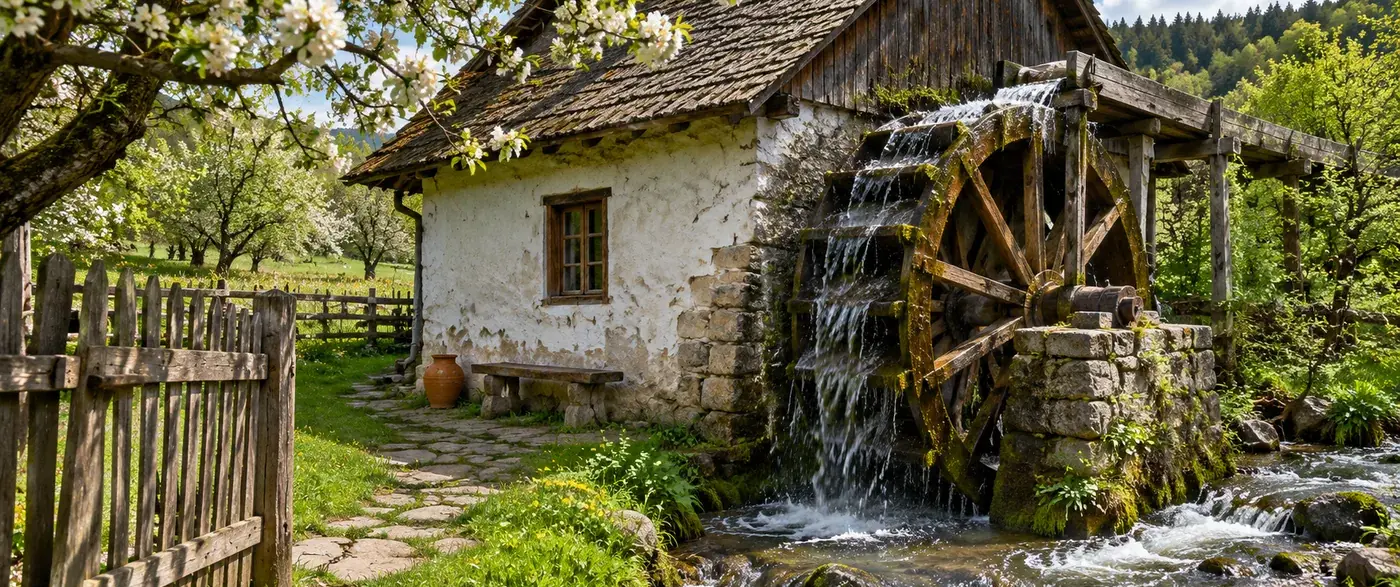
The mill wheel
At what time, and next to which landmark, was Vlad's notebook seen?
The real case · Romanian Ministry of Internal Affairs
In Constanța county, the search for a six-year-old child involved service dogs and a helicopter. A police officer on board relayed information to the teams on the ground.
How the search began
What happened?
Vlad has drawn a mill in his notebook and wants to see whether the real wheel still turns. At home the table is laid, but his chair stays empty. On the corner of the table lies a blue pencil, sharpened at both ends. The evening before, they had used it together to draw the spokes of the wheel. His father remembers that Vlad wanted to find out which way the water moves, and that he had promised him a walk after lunch. Now he opens the gate wide and tells the police about the drawing, before he forgets the detail.
The family asks for help. A mantrailing team sets off from the little gate with his T-shirt, and three descriptions come in from the helicopter. In the recording they are looking for, the boy is waving his checked notebook.
For a moment, two pale squares appear on the monitor. His father knows the gesture: when he wants to show someone a page, Vlad opens the notebook right out and holds it by the spine. The pilot describes what he sees, and the colleagues on the ground wait to learn which frame to look for on the map.
You have three field sheets. Each landmark and each note appears on one sheet only. At what time, and next to which landmark, was Vlad's notebook seen?
- Time · 13:02, 13:08, 13:14
- Landmark · Small Canal, Old Mill, Sluice Gate
- Note · Scarf on a string, Checked notebook, T-shirt on the fence
Search log
Field clues
I need a hint
Start with the one certain pairing, “13:02” and “Sluice Gate”.
One more hint
Once you have paired them, rule out “Sluice Gate” for the other two values in the “Time” category. Each value is used only once.
Workbook
Deduction grid
The grid is optional. You can use it to organise your notes and see which options you have ruled out. If you already have the answer, go straight to the final report.
Pick the cell where the two values you want to compare meet.
How to play: the basics and a worked example
What do I have to do in a case?
- Read the story and the question in the final report: At what time, and next to which landmark, was Vlad's notebook seen? That tells you what you have to reconstruct.
- Take the clues one at a time. Look for the two items each sentence links and note in the grid what you have learned. Then tick the clue so you remember you have used it. You can reread it at any time.
- If two clues share an item, follow it through both pairings. When you get stuck, you can open “I need a hint”, then “One more hint”.
- When you have a theory, fill in the two fields of the final report. You can send the report even if you left the grid empty. Then press “Check the report”. If the answer doesn't match, reread the clues and try again. Once it is confirmed, read the explanation in “The log, reconstructed”, shown below the report.
How do I correct a mark?
Tap the same cell to go through the three states, in order. You start from a dot. One tap puts ×, another puts ✓, and a third brings the dot back. So from ✓, a single tap clears the mark. The other cells only change when you tap them yourself.
How do I read the big grid in a case?
Above the columns you will see categories such as “Landmark” and “Note”. The rows are on the left. Follow the name on the row across to the column you are interested in and read the pairing as a question. A dot means you haven't noted the answer yet.
The one-match rule applies within each group of columns. After a ✓ you can put × in the other cells on the row and the column of the same group. In another group, the same row can have one more ✓.
Further down, the rows compare the remaining categories with each other. The hatched areas show pairings already covered elsewhere in the table. On a phone, swipe the table sideways to see the next group.
The example below is a made-up case with two dogs, Luna and Nori, who ended up in different places. The first clue says: “Luna did not finish the trail at the jetty.” Luna gets × under Jetty, so the greenhouse is all that is left for her and she gets ✓ there. The second clue says: “The team that reached the greenhouse used the bandana.”
| Reference | Place | Article | ||
|---|---|---|---|---|
| Jetty | Greenhouse | Bandana | Scarf | |
| Luna | ruled out | confirmed | confirmed | unknown |
| Nori | unknown | unknown | unknown | unknown |
| Jetty | Unused group of cells | unknown | unknown | |
| Greenhouse | confirmed | unknown | ||
On the “Greenhouse” row, the ✓ under “Bandana” comes straight from the clue. On the “Luna” row, the ✓ under “Bandana” is your own conclusion: Luna reached the greenhouse, and the team at the greenhouse used the bandana. The two ticks on Luna's row are in different groups.
Swipe the table to the left to see all the columns.
| Sheet | Landmark | Note | ||||
|---|---|---|---|---|---|---|
Final report
At what time, and next to which landmark, was Vlad's notebook seen?
The log, reconstructed
The police officer on the ground signals to the pilot that he has Vlad. One spoke is missing from his drawing. He adds it at home, at the table.
| Time | Landmark | Note |
|---|---|---|
| 13:02 | Sluice Gate | T-shirt on the fence |
| 13:08 | Small Canal | Scarf on a string |
| 13:14 | Old Mill | Checked notebook |
The real case
In Constanța county, the search for a six-year-old child involved service dogs and a helicopter. A police officer on board relayed information to the teams on the ground.
Solve another case
More cases of the same level from the collection.
-
 Case 048
Solved
The muddy boots
Radu wanted to show someone how deep the birds' tracks are in the mud.
-
 Case 049
Solved
Ahead of her parents
“Boo!” At every bend in the path, Ada jumps out from behind a tree.
-
 Case 050
Solved
The folded map
At the picnic, Luca had taken the map to show his sister where the old post road runs.