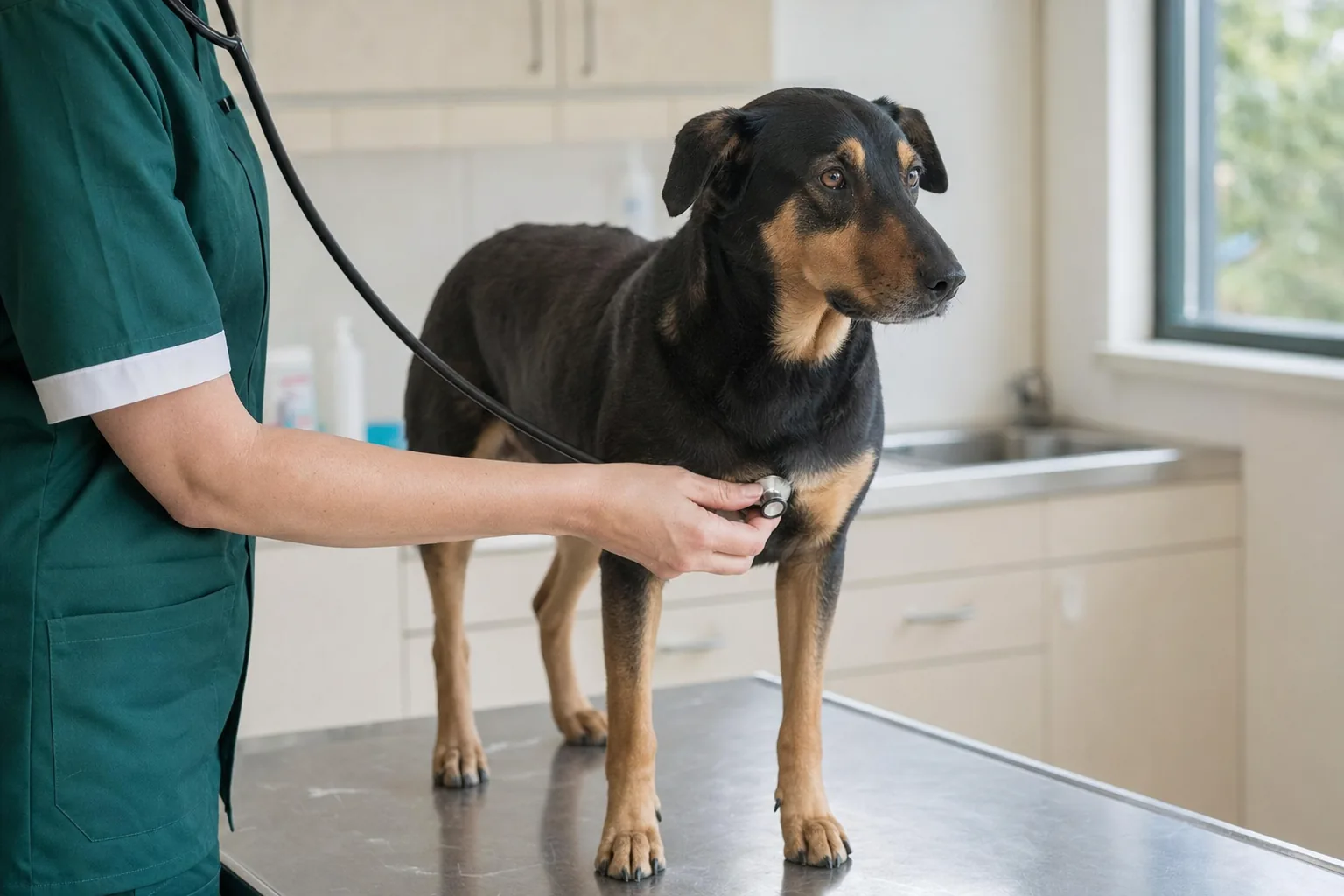
Caution. Blue or grey gums, fainting, an episode that will not stop within a few minutes, laboured breathing at rest, blood or discharge from one nostril, violent sneezing after a walk through long grass: ring your own vet today.
Noticed something different about your dog? Go straight to their vet.
Do not look for the answer in a Facebook group, on TikTok or on a forum. Look for someone trained for this: your dog's own veterinarian, the only person who can examine, investigate and treat them.
- The same sign, dozens of causes. A dog that vomits may have eaten grass or may have an object stuck in the gut. From two lines you typed, nobody can tell which. The vet feels the abdomen, takes the temperature, runs tests.
- Nobody on the internet sees your dog. They see a photo and a story. A diagnosis comes from an examination and investigations, not from a resemblance to someone else's dog.
- In groups you hear from the people whose dog "got better on its own". Those for whom it ended badly rarely post again. What you read there is a selection, not a statistic.
- Doses are calculated by weight and species. Human medicines that look harmless, paracetamol or ibuprofen, are toxic to dogs. "I gave mine half a tablet" is the most dangerous advice you can get.
- Hours matter. With a twisted stomach, a poisoning or a urinary blockage, the time spent asking online is exactly the time that decides the outcome.
- The vet is accountable for what they say. They have your dog's record, history, vaccinations, past treatments. An anonymous account has none of that and answers for nothing.
Use this page to know what to observe, what to note and what to ask at the appointment, not to treat at home. If you still have doubts after a consultation, ask another vet or a specialist (dermatologist, internist) for a second opinion, not a group. And if you do not have a regular vet yet, find one now, while your dog is healthy: how to choose a veterinary clinic.
Your dog was lying on his bed, then suddenly froze in the middle of the room. Neck stretched out, elbows wide, eyes bulging, and he is pulling air in through his nose in loud, snorting bursts, as if he were snoring wide awake. It lasts twenty seconds and your heart is in your mouth. Then he shakes himself off and wanders over to the water bowl as though nothing happened. Most of the time this is reverse sneezing: a harmless reflex, common in small dogs and flat-faced breeds. Now and then, though, it looks like something less innocent. Here is how to tell them apart, what to do while it is happening and when to see the vet.
When it is more than a reverse sneeze
A typical reverse sneeze stops by itself in under a minute and the dog is normal straight afterwards. Ring today, or go straight to the vet, if:
- the gums or tongue turn blue, grey or white, or the dog wobbles, falls or faints;
- an episode goes on for several minutes without stopping, or episodes come one after another;
- between episodes he is breathing hard at rest, mouth open, belly pumping;
- it started suddenly after a walk through long grass, with violent sneezing, pawing at his nose and discharge from one nostril only. Grass seeds travel deep into the nose;
- you see blood from the nose or thick discharge, especially from one side;
- he is a large, older dog whose breathing is getting noisier with exercise and whose bark has changed;
- a "honking goose" cough keeps coming back, especially in a small dog, or he coughs and then gags.
Book an appointment in the next few days if the episodes get more frequent from one month to the next, or if new snoring starts showing up during the day, when he is awake.
What to watch and note at home
The video
This is the most useful thing you can do. The episode never happens at the clinic, and "snorting oddly through his nose" could describe three different conditions. Film close up, from the side, with sound, from the first second until after it has stopped. Get the gums in shot if you can.
The diary
- when it happened and how long it lasted;
- what he was doing beforehand: getting excited at the door, pulling on the lead with a collar on, eating or drinking fast, sniffing through grass, sleeping;
- what was in the air: dust, pollen, a new perfume, smoke, a cleaning spray;
- how he was afterwards: normal at once, or tired and panting;
- whether he also has ordinary sneezes, a runny nose, any blood.
What it might be, going by how it looks
| What it looks like |
What it might be |
| Long, noisy in-breaths through the nose, dog standing still with neck stretched, over in under a minute |
Reverse sneezing |
| Dry, forceful "goose honk" cough, mostly in small dogs, with excitement or pulling on a collar |
A windpipe that flattens (tracheal collapse) |
| A cough ending in a retch, as if he is about to be sick |
Kennel cough or another respiratory infection |
| Snoring during the day too, noisy breathing with any effort, in a flat-faced dog |
Narrow airways, typical of brachycephalic breeds |
| Sudden violent sneezing after a walk, pawing at the nose, one nostril |
Something stuck in the nose (grass seed) |
| Noisy breathing on the in-breath and a changed voice, in a large older dog |
Laryngeal paralysis |
| Discharge from one nostril, blood, older dog |
Nasal disease, including tumours |
What sets it off, and how to avoid it
After a few weeks of keeping the diary, one or two things usually stand out because they keep coming up. The most common are excitement at the door when visitors arrive, a collar pulled tight on the lead, gulping water, dust from the hoover, spring pollen, perfumes and room fresheners. Some of these are easy to take out of his life: a harness instead of a collar, a bowl that slows his drinking, the air freshener in the bin. In dogs with seasonal allergies, episodes bunch up in spring and thin out in summer. Tell your vet, because it changes what they look for.
The dog who snores
In a dog with a normal-length muzzle, snoring in deep sleep is usually just snoring. In pugs, French and English bulldogs, Shih Tzus and Boxers, snoring and noisy breathing while awake often come from the way they are built: narrow nostrils, a soft palate that is too long, a narrow windpipe. Plenty of people think it is "normal for the breed". It is common in the breed, but the dog is working harder to breathe than he should. Note whether he tires quickly on walks, struggles in summer, sleeps with his head propped on something or wakes up suddenly. Extra weight makes all of it worse.
What to do during a reverse sneeze
Stay calm and talk to him softly. You can gently stroke his throat from top to bottom, or cover his nostrils with your fingers for a second or two so that he swallows; swallowing usually stops the reflex. If he is wearing a collar, undo it. Do not scoop him up suddenly and do not put your fingers in his mouth. Most episodes end on their own within seconds, whatever you do.
What your vet will do
- Watch the video and read the diary. Often that is enough to tell within minutes whether it is reverse sneezing or something else.
- Examine him. The nose and nostrils (how open they are), the throat, listening to the lungs and windpipe, feeling the windpipe (with tracheal collapse, light pressure sets off the cough), gums, weight.
- For flat-faced dogs, a look at the airways: how he breathes at rest and after a little exercise, the nostrils, the roof of the mouth.
- Imaging if needed. X-rays of the neck and chest for the windpipe and lungs. If a foreign body, a tumour or nasal disease is suspected, the nose is examined with a thin camera or a CT scan, under anaesthetic.
- Tests for parasites or nasal infections when the sneezing does not settle. There is a mite that lives in dogs' noses.
- What comes next. For simple reverse sneezing, usually nothing beyond avoiding what sets it off. When it is something else, treatment depends on the cause: removing the grass seed, getting his weight down, a harness instead of a collar, sometimes surgery to widen the nostrils and shorten the soft palate in brachycephalic breeds. Your vet will talk you through the options.
What not to do at home
- Do not push your fingers down his throat to pull something out. He may bite without meaning to, and you can injure his throat.
- Do not give allergy tablets, nose drops or sprays from your own cupboard. Some are toxic to dogs, and if there is a grass seed up his nose they do nothing at all.
- Do not lift him by the collar or yank the lead while he is wearing one. In dogs with reverse sneezing or a sensitive windpipe, pressure on the throat sets off more episodes than anything else. Switch to a harness.
- Do not frighten or scold him during an episode. Getting worked up makes it last longer.
- Do not dismiss daytime snoring in a flat-faced dog because "that's what pugs are like". An early check can give him years of easier breathing.
- Do not let him run in the heat if his breathing is noisy. Dogs with narrow airways get heatstroke far more easily.
Frequently asked questions
What dog owners search for most often on the internet about this problem, with the short answer. The answers are a guide only: the decision belongs to your dog's own vet, after an examination.
What is reverse sneezing in dogs?
A reflex of the nose and throat, which vets also call paroxysmal respiration. The dog pulls air in through his nose fast and noisily, in bursts, standing still with his neck stretched and elbows out. It looks as though he is choking, but air is getting in. It passes within seconds, a minute or two at most, and he is normal straight afterwards.
Is reverse sneezing dangerous?
Usually not. The trouble is that other things look like it: a flattening windpipe in small dogs, a grass seed in the nose, the narrow airways of flat-faced breeds, nasal disease in older dogs. If episodes become more frequent or longer, or come with blood, discharge or blue gums, take a video to your vet.
What do I do when my dog is reverse sneezing?
Stay calm and talk to him softly. Gently stroke his throat from top to bottom, or cover his nostrils for a second or two so he swallows; swallowing usually stops the reflex. Undo his collar. Do not put your fingers in his throat. Film it for your vet, especially if it is the first episode or looks different from usual.
Why does my dog snore?
In dogs with a normal muzzle, snoring in deep sleep is usually harmless. In pugs, bulldogs and other flat-faced breeds, snoring, especially during the day, often comes from narrow nostrils and an overlong soft palate that make breathing harder work. Extra weight makes it worse. A vet check shows how narrow the airways are.
My dog is snorting and sneezing after a walk. What could it be?
If it started suddenly after a walk through long grass, with violent sneezing, pawing at the nose or discharge from one nostril, it may be a grass seed up his nose. Grass seeds only travel forwards and do not come out on their own. See your vet the same day and do not try to get it out yourself.
The information on this page is educational and does not replace an examination. For full details and a diagnosis, consult your dog's own veterinarian.