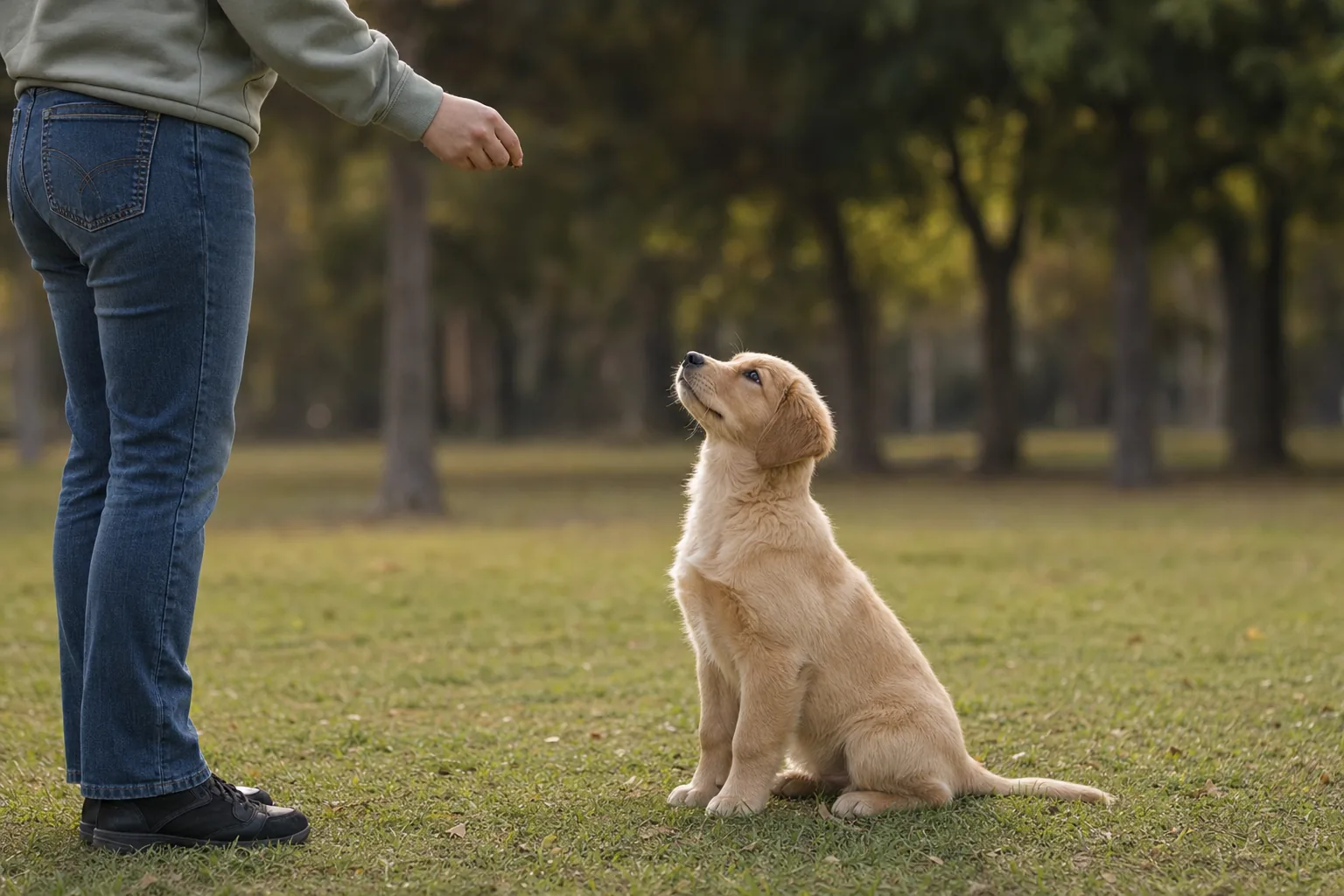
In three days an eight-week-old puppy arrives. The bowls and lead are already in your basket, and the list of questions runs to a full page: where does he sleep, what does he eat, when does he go out, what do you do if he cries at night. Or maybe he has been with you for two days already, is weeing everywhere and will only fall asleep on your foot. The first days with a new puppy wear out the whole household, and they matter more than they seem, because this is when habits get laid down. The plan below covers the first 72 hours and the first few weeks.
What to do, step by step
Before he arrives
- Puppy-proof the house as you would for a crawling baby. Tidy away or cover cables, put shoes in the cupboard, move poisonous plants up high (plenty of houseplants are), shut away medicines and cleaning products, and get a bin with a lid. Then get down on your knees at puppy height and see what you can reach from there.
- A corner that is his. A pen or an open crate with a bed, water and something to chew, in the room where the family spends its time. The hallway and the balcony will not do. He needs somewhere to retreat to where nobody bothers him.
- The same food he was eating at the breeder's or the rescue, for the first two weeks. If you want to switch, do it later and gradually, over 7 to 10 days.
- A vet appointment booked for the first few days, with his health record in hand: a general check, the vaccination and worming schedule, the microchip.
- House rules agreed in advance. Is he allowed on the sofa, where does he sleep, who takes him out in the morning. Puppies learn from what really happens, not from what you meant. If everyone in the house has a different rule, he learns there are no rules.
Day one
- Bring him home at the start of at least three days you will spend at home. Never right before a weekend full of visitors.
- From the car, carry him straight to the spot where you want him to wee outside (or to the puppy pad, if you live in a flat and he is not fully vaccinated yet). Wait. When he goes, praise him warmly and give him a treat on the spot.
- Let him explore the house at his own pace with you close by. No visitors, no neighbours popping in "just to see him", no children passing him round. Day one is a quiet day.
- Food, water, sleep. A puppy of 8 to 12 weeks sleeps 18 to 20 hours a day, and sleep is when the day's learning settles in.
The first night
Until yesterday he slept curled up with his littermates, so the first night alone is hard on him. Put his bed or crate next to yours so he can hear and smell you. If he wakes and cries, nine times out of ten he needs to go out: take him calmly, no games, and straight back to bed. A young puppy can hold on for a few hours at night but not the whole night, so one trip out in the small hours is normal for the first weeks. Once he has settled in, move his bed a little at a time to wherever you want him to sleep for good.
The first weeks
Toilet training. Take him out every time he wakes, after every meal, after play, after any excitement and, the rest of the time, every 1 to 2 hours. Always the same spot. When he goes there, make a fuss of him right away, with praise and a treat. Clean up indoor accidents with an enzyme cleaner (one that breaks the smell down rather than masking it), and never tell him off. We have a separate page on toilet training.
Biting. Every puppy bites. Give him something to chew instead of your hand, stop the game for a few seconds when the teeth press too hard, and make sure he gets enough sleep, because a tired puppy bites twice as much. There is a separate page on that too.
Home alone, a little at a time. From the first week, leave the room for a few seconds, then a few minutes, while he is busy with a food toy. A puppy who is never left alone in his first months is more likely to panic badly on the day you go back to work.
The world, carefully. Until about 12 to 14 weeks a puppy has a window in which he gets used to people, sounds, surfaces, cars and other animals with ease. After it closes, new things are harder. Even before his vaccinations are complete you can carry him down the street, take him in the car, sit on a park bench with him or visit a friend with a healthy, vaccinated adult dog. Until then, steer clear only of places where lots of unknown dogs pass through. Agree with your vet exactly where the line is for your puppy.
Handling. A few times a day, for a few seconds: touch his paws and ears, lift his lip, stroke his tail, and follow each touch with a treat. A puppy who gets used to being handled now copes far better with the vet, the groomer and nail trims.
His name. Say his name in a cheerful voice and, when he looks at you, give him a treat. Ten times a day. His name comes to mean that good things come from this person.
The first 72 hours, day by day
| When |
What you do |
| Day 1 |
Quiet arrival, first wee outside, exploring, lots of sleep. His bed next to yours at night. |
| Day 2 |
Fixed times for meals and trips out. Name practice. A few seconds alone in the room. |
| Day 3 |
Vet visit. New sounds and people, one at a time, from a distance. Paws and ears handled, with treats. |
By age: puppy, adolescent, adopted adult
The puppy of 7 to 9 weeks. The most common case. Where you can, do not take him before 8 weeks: time with his mother and littermates teaches him to control his bite and read other dogs. He sleeps a lot, needs to go out very often and learns anything in a few repetitions.
The puppy of 3 to 5 months. The window for easy socialisation is closing or already shut. If he saw very little at the breeder's, getting him used to the world becomes the top priority, patiently and from a distance. Teething starts now too, and he wants to chew everything.
The adolescent of 6 to 12 months. He arrives with habits of his own and lots of energy. The first days look the same (quiet, routine, his own corner), but expect him to test your rules. He needs more exercise and nose games from the first week. We have a separate page on adolescent dogs.
The adopted adult or senior. Rescues often quote a rule of thumb: three days to decompress, three weeks to learn the routine, three months to feel at home. It is not a law, but it is a useful guide. Ask nothing of him in the first days: short walks, the same times, food from your hand, lots of sleep. Plenty of rescue dogs seem "perfect" in the first week and only show their real personality after a month.
Common mistakes
Too much, too soon. The whole family, all your friends, a trip to the grandparents, the park, the shops, all in the first weekend. He comes out of that weekend overwhelmed, and next time he frightens more easily.
Telling him off for accidents. A puppy scolded for weeing indoors learns to hide when he needs to go, and that makes everything else harder.
The run of the house. A puppy roaming the whole house on his own wees in rooms where you cannot see him and chews whatever he finds. Freedom comes gradually, room by room.
"Let him cry, he will get used to it." An eight-week-old left to cry alone for hours in another room learns that being alone is terrifying. To begin with, he sleeps next to you.
Not enough sleep. A tired puppy behaves like a tired toddler: bites, races about, hears nothing. When he "goes mad" in the evening, he often just needs to sleep.
Putting the world on hold until after the jabs. By the last vaccination the window for easy socialisation has closed. A puppy kept indoors until four months often grows into a fearful dog. In your arms, in the car, in safe places, you can do a great deal.
Long adult walks. A three-month-old puppy does not need an hour of walking on tarmac. Short, frequent outings with lots of smells.
How long it takes and how to tell it is working
The first three days are for settling in. After about two weeks, a puppy usually has a routine, sleeps better at night and wees outside more often than indoors. For most puppies, toilet training is sorted by around 4 to 6 months, with the odd accident before then, which is normal. Mouthing eases off as the adult teeth come through, at around 6 to 7 months.
Good signs: he sleeps calmly in his corner, comes to you when you call his name around the house, approaches new things with curiosity and without fear, eats well and plays. If you have got there in the first three or four weeks, you are on the right track.
When to call a trainer
- you want to get off to a good start: a puppy class with other healthy, vaccinated puppies from around 9 or 10 weeks is one of the best things you can do for him;
- he seems frightened of a lot of things, hides, trembles, does not explore;
- he bites very hard, growls when you pick him up or guards his food;
- after a month, the accidents indoors are not going down at all;
- he cries or howls a lot when left alone, even for a few minutes.
A good trainer helps you turn the first months into the foundation for the rest of his life. They will also save you a few sleepless nights.