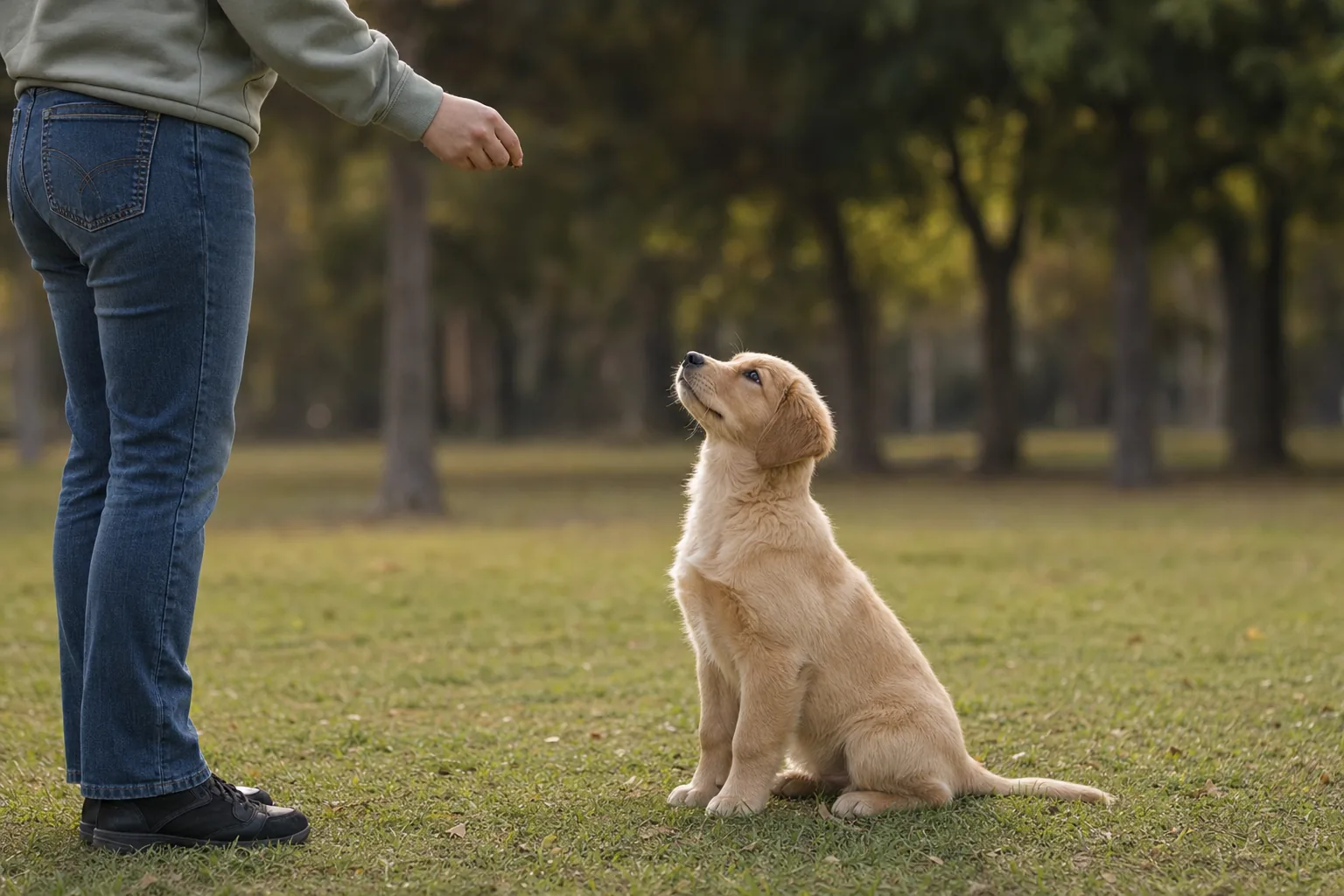
You lift the harness off the hook and the dog has already vanished under the table. Another dog stays put, but the moment the harness goes over his head he drops onto his belly and freezes, then walks like a robot for the first ten minutes outside. And then there is the three-month-old puppy who, as soon as the lead touches him, grabs it and hauls on it like a rope, growling with delight. Those are three different situations: fear of the harness, fear of the lead (or of what comes after it) and play. You fix all three the same way, by helping him link the kit with good things, one small step at a time and at his pace.
Getting him used to it, step by step
First, work out what is bothering him
Watch him closely for a week. Does he leave as soon as he sees the harness, or only when you touch him with it? When something goes over his head? At the click of the buckle? At the sound of the lead clip by his ear? Or does he run because the harness usually means you going out, the car, the vet? Each answer gives you a different place to start.
Then check the harness itself. One that rubs under the armpits, presses on the neck or shoulder, or tightens when he sits is simply uncomfortable. Plenty of dogs who "hate the harness" really hate that particular harness. A good one leaves the shoulders free, keeps the straps at least two fingers' width from the armpits and goes on without anything tight passing over his head. For dogs who dislike things going over their heads, the easiest are harnesses that open right up, with buckles on both sides.
The harness, in small steps
Repeat each step for a few days in two- or three-minute sessions, until he looks relaxed or even pleased. If he moves away, lies down, licks his lips or looks off to the side at any step, go back to the one before.
- Harness on the floor. Put it down, let him come over to sniff it, and give him a tasty treat. Drop a few treats on the harness itself and let him pick them off.
- Harness in your hand. You hold it, he comes closer, treat. You move it a few centimetres towards him, another treat.
- Touches. Touch his shoulder with the harness for one second, then treat. Then his back, then his chest.
- Head through, his choice. Hold the neck opening like a hoop with a treat on the far side, and let him push his own nose through to reach it. You never push the harness at him; he comes to it. Over time hold the treat further back so his ears go through too.
- The click. In a separate session, click the buckle well away from him and give a treat. Then a bit closer. Then on the harness while he is wearing it, without tightening anything.
- A few seconds wearing it. Put the harness on, give him something to eat (a lick mat with soft cheese works well) and take it off again. Build up gradually: ten seconds, a minute, five minutes around the house with a game.
- The harness brings good things. From now on it comes out for sniffy walks, games in the garden and treat searches as well. The trip to the vet is just one outing among many.
The lead, for a dog who runs from it
Many dogs are not frightened of the lead at all. What worries them is what follows, because they have learnt that the lead means the end of play in the park or getting into the car.
- Clip the lead on and off several times on every walk, with a treat each time, then say "off you go" and let him loose or on a long line. Clipping on stops being the signal that the fun is over.
- At home, clip the lead on, give him his dinner, unclip. Another time, clip on, go to the kitchen, play, unclip.
- If the sound of the clip near his head worries him, attach the lead to the ring on the back of the harness, well away from the collar.
- Never grab him unexpectedly with a hand shooting towards his neck. Call him, stroke his chest and clip on calmly.
The lead, for a puppy who bites it
A puppy chewing the lead is not scared of anything. He is playing: the lead moves, it hangs right at nose height, and you react every time he pulls. From where he stands, it is a brilliant game.
- Carry a long, soft tug toy on every walk. When you see him eyeing the lead, offer the toy before he grabs.
- If he has got hold of the lead anyway, stop, let it go slack and do not pull. A tug game with no one on the other end fizzles out quickly. When he lets go, praise him and walk on, or hand him the toy.
- A longer lead that hangs lower tempts him less than a short one swinging in front of his face.
- Tired puppies bite a lot more. Keep outings shorter, with plenty of sniffing breaks.
By age
The puppy. The best time of all. Put the harness on for a few seconds from the first days, indoors and with food, long before you need it outside. Clip the lead to the harness and let it trail around the house for a few minutes while you play and keep an eye on him. Lead-biting is normal at this age, and the tug toy gets you out of trouble.
The adolescent (6 to 18 months). The puppy who accepted anything starts to object. He turns away, runs off with the harness in his mouth, stops coming over when he sees the lead. Make the steps smaller, go back to where it was easy and do not let putting the harness on turn into a chase round the house. At this age, running from the lead usually means the lead has come to mark the end of the fun.
The adopted adult. Plenty of rescue dogs have never worn a harness, and some have bad memories of being grabbed by the neck. Start at step 1 even if it feels over the top. In the first weeks, a harness put on once and left on all day (if it is comfortable, safe and you are around) can be less stressful for him than a twice-daily routine of on and off.
The senior. An old dog who starts refusing the harness sometimes has sore shoulders or a stiff neck, or finds it hard to lift a leg to step in. Get one that closes at the side with no paw-lifting, and if the refusal is new, ask your vet.
Common mistakes
- Forcing it on. You corner him, hold him between your knees and get the harness on. It works today. Tomorrow he bolts at the first jingle of a buckle.
- The harness only comes out for bad things. If he only sees it before the vet or when you leave the house, he has every reason to hide.
- A harness that does not fit. Too tight, too loose, straps in the armpits or across the shoulder. Check it: two fingers under every strap, shoulders moving freely when he walks.
- Pulling back on the lead when the puppy bites it. As far as he is concerned, you have just joined the game.
- Telling him off or hitting him with the lead. Both the fear and the urge to play get stronger.
- Rushing. Going straight from "sniffs the harness" to "wears it outside for an hour". He gets through the steps that matter at his speed.
- Bitter sprays on the lead. They may stop the chewing for a moment, but the puppy is left with nothing else to do. A tug toy gives him exactly that.
- The collar as the only attachment point on a dog who pulls or struggles. The neck copes badly with pressure, and he links the discomfort with the lead.
How long it takes and how to tell it is working
For a puppy, a few days to two weeks. For an adult dog who is afraid of the harness, usually two to six weeks of short sessions every day. A puppy who bites the lead settles as he grows and gets alternatives; most lose interest by about five or six months.
The good signs tend to show up in this order. He no longer leaves the room when he sees the harness. He walks up to it. The head goes through the harness without any help from you. His tail goes at the click of the buckle. One day he is waiting by the door as soon as you take the harness off the hook. Outside, his body is loose and his nose is down, with no robot walk. If he shakes himself all over right after you put the harness on, the way he does after a bath, that was too much, and next time you drop back a step.
When to call a trainer
- he growls, snaps or panics when you try to put on the harness or lead;
- after four weeks of small steps you still have not got past step 3 or 4;
- the fear of the harness is part of a wider fear: of hands, of being touched, of leaving the house;
- the refusal started suddenly in a dog who used to wear the harness happily (see your vet first, then a trainer);
- the puppy who bites the lead starts biting hands too, and the play gets too rough.
A trainer who works only with rewards can show you how much your dog can cope with and how to stretch that bit by bit. They will also see what your hands are doing without you noticing, which is often where the problem starts. In our puppy class, the harness and lead are among the first things we practise.