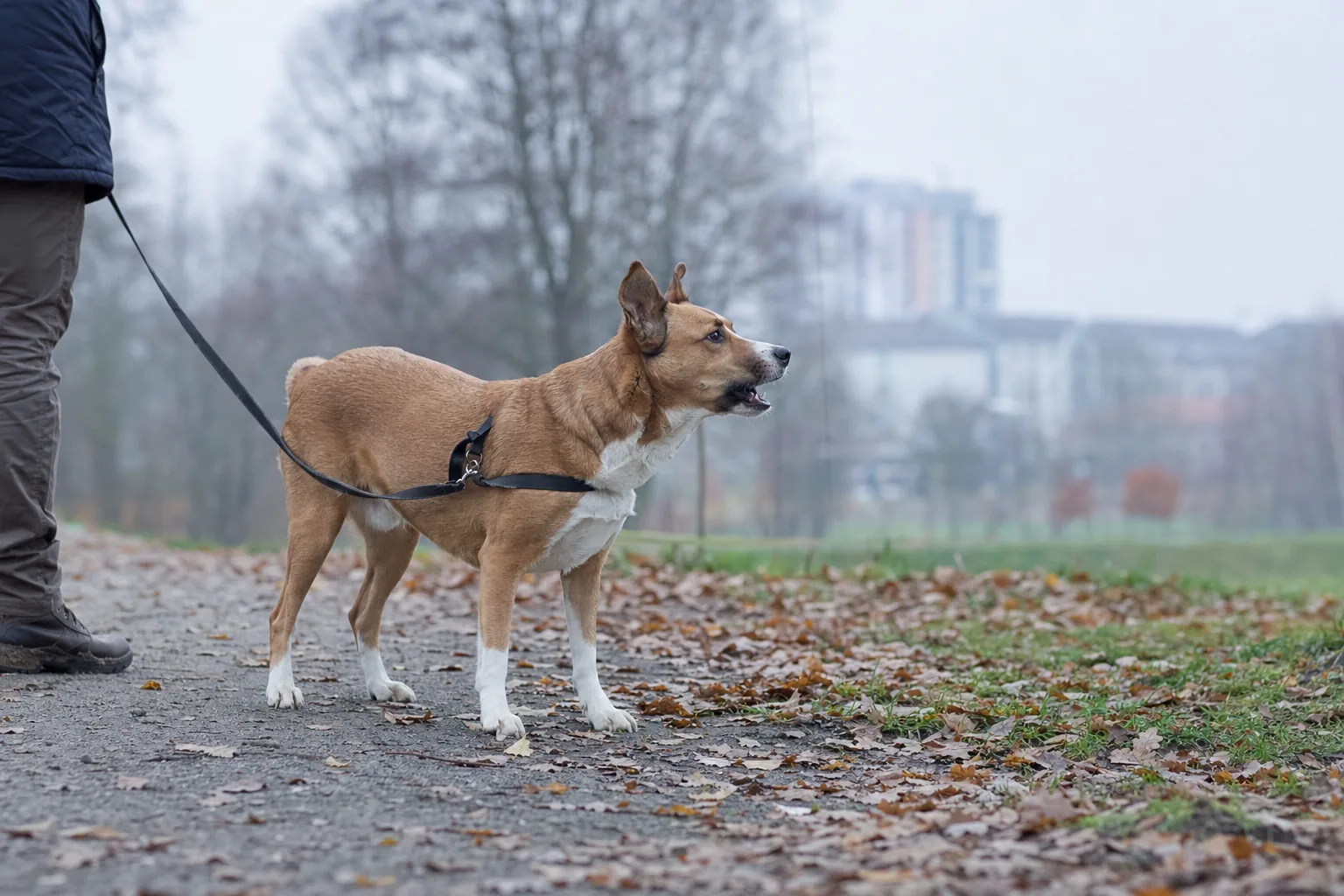
You step out of the front door, take ten steps and the dog stops. He plants his feet, leans back, sometimes flops onto the pavement belly-up and looks at you as if you had asked the impossible. Or he sets off happily, gets to the corner and digs in like a mule. Or the other way round: he goes beautifully all the way out, and when you turn for home he will not budge.
A dog who does not want to walk nearly always has a reason, even if you cannot see it. What you do next depends on that reason, so the first job is to find it.
Why does my dog stop on the lead or flop down on the pavement?
For one week, write down where he stops, at what time, what was around and what happened next. Draw a rough map of your neighbourhood and mark an X at every stop. That map will tell you more than any guide, and the pattern usually fits one of the situations below.
Fear is the most common cause in puppies and rescue dogs. He stops in the same spot every time, near a noise: the bus stop, the building site, the main road. He looks around, tail low, ears back, sometimes trembling or panting when it is not warm. If he got a fright somewhere once (a banger, a bike that came too close, a dog that hurled itself at a fence), he may avoid that place for weeks.
Pain looks different. He used to walk well and suddenly will not. He is slow to get going after lying down, stops after a few hundred metres, no longer takes the stairs. Behind it there might be overlong nails, an injured paw, sore joints, a harness rubbing under his armpit, his back. Sometimes refusing to walk is the only sign that something hurts.
Weather matters more than people think. In summer, hot tarmac burns pads: put the back of your hand on it for seven seconds, and if you cannot keep your hand there, he cannot keep his paw there either. Flat-faced breeds overheat faster. Short-coated dogs shiver in winter. And lots of dogs simply hate rain.
A ten-week-old puppy on a busy high street sees, hears and smells a hundred times more than he can cope with. He stops to take it in, and he is right to.
Some dogs do not want the walk to end. They go well on the way out and dig in on the way back or at the front door, because heading home means the best part of the day is over. Without meaning to, you taught him that, if every walk finishes the same predictable way.
Others want to go somewhere else. He stops at the junction and pulls left towards the park when you want to go right to the shop. Dogs have favourite routes with favourite smells.
Sometimes he has just found something to read. To a dog, a lamp post is the morning paper, and that is what he came out for. Let him read it.
Then there is the dog who has learned that stopping pays off. Every time he flopped down, you picked him up, gave him a treat to get him moving or turned for home. A dog repeats whatever brought him something good.
And age. An old dog tires more quickly, sees and hears less well, and some routes have simply become too long. Stubbornness has nothing to do with it.
What does not work when your dog refuses to walk
Dragging him. You pull on the lead and in the end he comes. It worked this time, but you have just confirmed that the spot is unpleasant, because that is where the collar tightened round his throat. In a frightened dog, fear grows. And necks are not built for it: in small breeds, pressure on the windpipe can do damage.
Holding a treat in front of his nose to tow him along. He takes a few steps, but quickly learns that stopping makes food appear. A week later he stops more often.
Telling him off. A dog who stopped out of fear and gets a telling-off now has two problems: the place, and the person on the other end of the lead.
Picking him up every time. With a scared puppy, sometimes that is exactly right, to get him out of something that is too much for him. As a habit, though, a dog who gets carried whenever he stops learns to stop.
Walking him past the building site he is afraid of every day "so he gets used to it". He does not get used to it; he gets more sensitive. Every pass adds another bad memory.
Turning the walk into a route march: fixed route, fixed time, "come on, come on" at every lamp post. A dog who is not allowed to sniff anything has very few reasons to leave the house.
How to get him enjoying walks again, step by step
1. Rule out pain
If the refusal came on suddenly in a dog who used to walk well, if it is worse after rest, or if he is over seven or eight, start with your own vet. Meanwhile, check what you can: his nails (do they touch the floor when he stands?), his pads, between his toes, his harness (any red marks under the armpits or on the chest?).
2. Change what you can change today
- The time. In summer go out early in the morning and late in the evening; in winter, around midday. It is quieter and the temperature is kinder.
- The kit. A well-fitted harness that does not press on the throat or rub, with a 2 to 3 metre lead instead of a short one that is always tight.
- The route. Steer round the spot where he freezes for a while. That is not giving in; it is what you do until you have worked on that spot.
- The start. If he stops right at your front door, for a few days drive or carry him to somewhere quiet and walk him there.
3. Let him sniff
The first ten minutes of every walk belong to him. Long lead, his pace, stopping where he likes, nose in the grass. For many dogs that alone changes the whole walk: it becomes the place where good things happen.
4. Work on the place that scares him
Find the distance at which he can see or hear what frightens him but can still eat and look at you. Stand there for a minute, feed him good treats one at a time, and leave before he gets wound up. Next day, the same. Only when he looks calmly towards that spot and then back at you do you move a few steps closer.
Behaviourists call this desensitisation and counter-conditioning: you get him used to it gradually, from a distance, and link the place with something he likes. It takes weeks.
5. What to do when he stops
Do not pull and do not lure. Stop too, relaxed, lead slack, and let him look. If it is fear, calmly turn back a few steps the way you came and praise him when he walks with you. When he is sniffing, wait until he has finished. If he wants to go another way, let him choose now and then. When he sets off on his own, sound pleased and give him a good treat after a few steps, not before.
6. If he digs in on the way home
Stop putting the trip home right at the end of the best bit. Walk a loop rather than out and back. Every now and then, halfway round, head for home and then set off again. At the door, have something good waiting: a food toy, his dinner, treats to hunt for in the hall.
The first week
| Day |
What you do |
| 1 |
The map with an X at every stop. Check nails, paws and harness. If the refusal came on suddenly, book the vet. |
| 2 to 3 |
Short walks at the quiet time, with the first ten minutes just for sniffing. |
| 3 |
No dragging, no treat dangled in front of his nose: you stop and wait. |
| 4 to 7 |
The distance exercise, two minutes a day, near the place that scares him. |
| 7 |
Look at the map: have the Xs moved or thinned out? That tells you what to work on next. |
When refusing to walk is a medical problem
A dog who does not want to walk may be in pain he shows no other way. See the vet if:
- the refusal came on suddenly, with no change of route or routine;
- he is limping, even slightly, or slow to get going after sleep;
- he no longer takes the stairs or jumps into the car, though he used to;
- he pants, coughs or tires very quickly, especially if he is flat-faced or overweight;
- he licks his paws a lot or his pads are red and cracked;
- he is old and seems confused outdoors, or stops and stares into space.
Show the vet what you noted on your map: where, after how many metres, at what time. "He won't walk" is hard to diagnose. "He stops after 300 metres, worse in the mornings" is much easier.
Why nose work helps a dog who will not walk
A dog walking with his nose down stops looking at all the things that frighten him. At training we often see nervous dogs who, once they have something to search for, set off along pavements they would never otherwise have set foot on.
You do not have to take up mantrailing to use this. Throw a handful of treats into the grass and say "find it". He sets off nose down, and you have gained a few metres with no pressure at all. For lots of dogs, sniffing walks on a long line in quiet places are the quickest route to a walk they look forward to.
When to call in a professional
- After four weeks of working from a distance, the fear of walks has not eased.
- Outside he panics: fights to get out of the harness, tries to bolt back home, trembles the whole time.
- He refuses to go out at all, not even into the garden.
- He growls or bites when you try to get him moving, put his harness on or lift him.
- He is a puppy who still cannot settle outside after days of short, calm outings.
An assessment with a behaviour professional tells you why your dog freezes and which steps make sense for him. It might be fear, it might be pain, it might be a learned habit, and each one is solved differently.
A behaviour that appears suddenly or changes for no apparent reason can have a medical cause. For full details, consult your dog's own veterinarian.