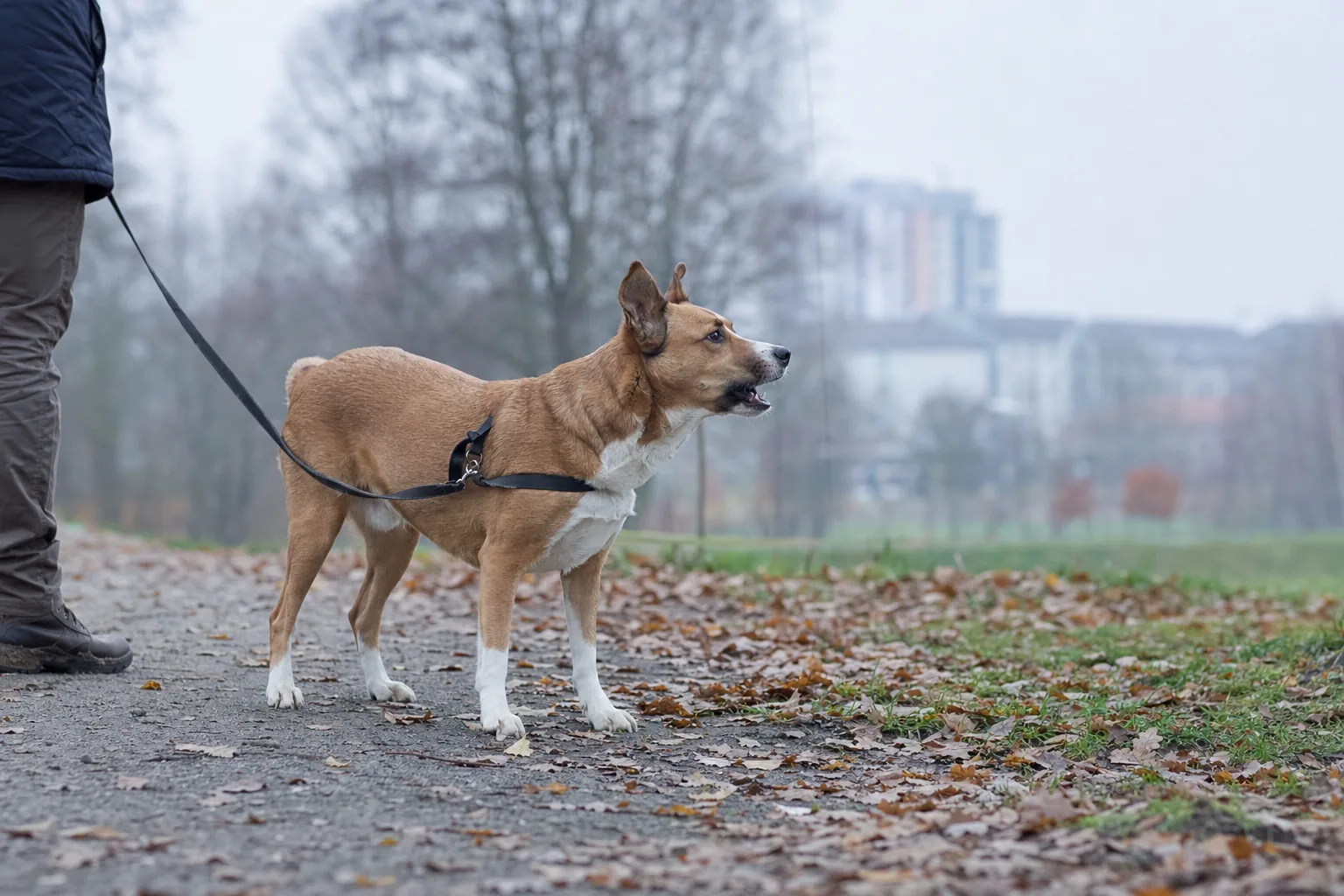
A bus goes past and your dog flattens himself against the wall, tail tucked. Maybe you adopted him from the countryside, where he grew up in a yard, and town is a whole new world to him. Maybe he used to trot along the pavement happily until the day a motorbike revved right beside him, and now he turns for home after two steps. Or you have a puppy who simply sits down in the middle of the pavement and will not move. You walk him two or three times a day, so this kind of fear wears you down quickly too. It does improve with work, on one condition: you go at his pace, not yours.
Why is my dog scared of cars and traffic?
There is rarely just one reason. Working out how the fear started also tells you where to begin.
He never met the town in time
Puppies have a window, roughly up to 12 to 14 weeks, when they get used to sights and sounds easily. A dog who spent that window in a rural yard, a rescue kennel or a breeder's place with no town noise can find traffic strange and threatening even at three years old.
A fright
A car that passed too close, a horn right by his ear, a bike that clipped him, a motorbike with a blown exhaust. For some dogs once is enough, and the fear then spreads to all traffic.
Noise in general
Dogs who are scared of fireworks, thunder or the hoover are often scared of lorries, buses and squealing brakes as well. Same sensitivity, different sound.
Temperament and breed
Some dogs are simply more cautious by nature. Livestock guardian breeds and their crosses were bred for the quiet of open country and sometimes struggle in town.
Age, sight and hearing
An older dog who sees or hears less well no longer spots the car coming. He finds it when it is already next to him, and the surprise frightens him.
The second fear period
Plenty of adolescent dogs, between 6 and 14 months, go through a phase of being spooked by things they used to ignore. If the fear started then, it often passes, as long as he is not frightened over and over during those months.
How to spot it
Tail low or tucked, ears pinned back, body lowered, hugging the buildings, stopping dead, pulling back towards home, scanning everywhere, panting, trembling. And one sign people miss: he will not take food. A dog who refuses even his favourite treat is too scared to learn anything at that moment. Some try to bolt and back out of their collar. That is the dangerous part, because a frightened dog often runs straight into the road.
What does not work, even when it looks like it does
Sitting by the main road "so he gets used to it"
This is called flooding: the dog is overwhelmed and has no way out. Sometimes he freezes and you think he has calmed down. He has shut down. Next time the fear is bigger.
Dragging him forward on the lead
A dog who wants to go home and gets hauled towards the road learns that walks are where he has no escape. On top of that, the collar tightens on his neck exactly when he is most frightened.
Stopping walks altogether
A dog kept indoors loses the little confidence he had. He also loses the exercise and the sniffing he needs every day.
Telling him off
Fear is not stubbornness. A telling-off just gives him one more reason to dread the walk.
Picking him up at every car
With a small puppy in the first few days this is sometimes the only option, and it does not make the fear worse. But a dog whose feet never touch the ground near a noise learns nothing about it. Give him distance instead.
The plan, step by step
1. Safety first
- A well-fitted harness he cannot back out of, plus a collar. Clip the lead to the harness. For very frightened dogs, add a second short lead on the collar as a back-up.
- An ID tag with your phone number and a microchip registered to you.
- A lead of 2 to 3 metres. Not an extending one.
A traffic-shy dog who slips his lead is the biggest risk in this whole story. Everything else comes after.
2. Take him out of the noise for now
For a few weeks, do the long walks where he is relaxed: quiet parks, fields, the edge of town, back streets. If you have to cross a busy area to get there, go through quickly at the quietest time of day, or drive him. These places are where he lets off steam, sniffs, plays and gets his appetite for walks back.
3. Find the distance at which he stays calm
Sit on a bench or on the grass well back from a road with moderate traffic. He can see and hear the cars, but he still eats and can look at you. That might be 30 metres from a quiet street. It might be 200 metres from a main road. That is your working distance. If he refuses food, pants or wants to leave, you are too close.
4. Every car brings something good
From the working distance, every time a car goes past (especially a big or noisy one), your dog gets a really good treat: boiled chicken, cheese, whatever makes him light up. Car passes, treats arrive. Quiet returns, treats stop. Keep sessions to 5 to 10 minutes, then head back to his quiet spot and let him sniff as much as he likes.
Behaviourists call this desensitisation and counter-conditioning. In plain terms, you get him used to it gradually, from a distance, and pair the noise with something he loves. After a few weeks he hears the lorry and turns to you expecting a treat. Only then do you move a few metres closer, and never further than he can cope with.
5. Sounds at home
If it is mainly the noise that scares him, you can also work at home with recordings of traffic, lorries, horns and buses. Start at a very low volume, barely audible, while he eats or plays. Turn it up very slowly, from one day to the next. If he lifts his head looking worried, you have gone too far. Recordings will not replace work on the street, but they make it easier.
6. Short town walks, last of all
Once he is relaxed at a distance, start short walks along quiet streets, with an easy way out towards the park. Five good minutes do more than half an hour of pulling. Always finish before he reaches his limit.
The first week
| Day |
What you do |
| 1 |
Harness, ID tag, double lead. Note the routes and the moments he gets scared. |
| 1 to 7 |
Long walks in quiet places only. Through busy areas as rarely and as quickly as possible. |
| 2 |
First bench session, well away from the road, to find the working distance. |
| 3 to 7 |
One 5 to 10 minute session a day: car passes, treat arrives. At home, recordings at minimum volume during meals. |
| 7 |
Does he eat more easily at the working distance? Does he turn to you at a noise? If not, or if the fear has grown, call a professional. |
Could it be a medical problem?
If the fear appeared suddenly in an adult dog who used to walk through town calmly, or in a dog over 8 or 9, see your own vet first. When hearing or sight fades, cars seem to come out of nowhere. Pain in the joints, back or ears lowers a dog's tolerance for everything. In older dogs, an ageing brain can bring new fears. And for dogs with a severe fear of noise, the vet may suggest treatment that takes the edge off enough for the dog to learn. That is decided at the consultation and nowhere else.
How nose work helps
A dog who is sniffing is a dog who is settling. Long sniffy walks on a long line, somewhere with no traffic, take the edge off for the rest of the day, and a calmer dog at home sets off on the town walk carrying less tension. In our trailing sessions we often see shy dogs who, nose down on a trail, walk past noises that would have stopped them dead on an ordinary walk. The job absorbs them.
A simple game helps too: scatter a few treats in the grass at the working distance. He stops scanning the road and starts searching with his nose.
When should you call a professional?
- he panics: thrashes about, tries to back out of the harness, stops responding to anything;
- he has got loose, or nearly got loose, out of fear;
- he cannot leave the house or the garden without shaking;
- the fear has spread: now he is also scared of people, of other noises, of going out of the front door;
- after four weeks of steady work you see no change at all.
A trainer will teach you to read the fear before it boils over and will build the steps at your dog's pace. In severe cases they work alongside your vet.
A behaviour that appears suddenly or changes for no apparent reason can have a medical cause. For full details, consult your dog's own veterinarian.