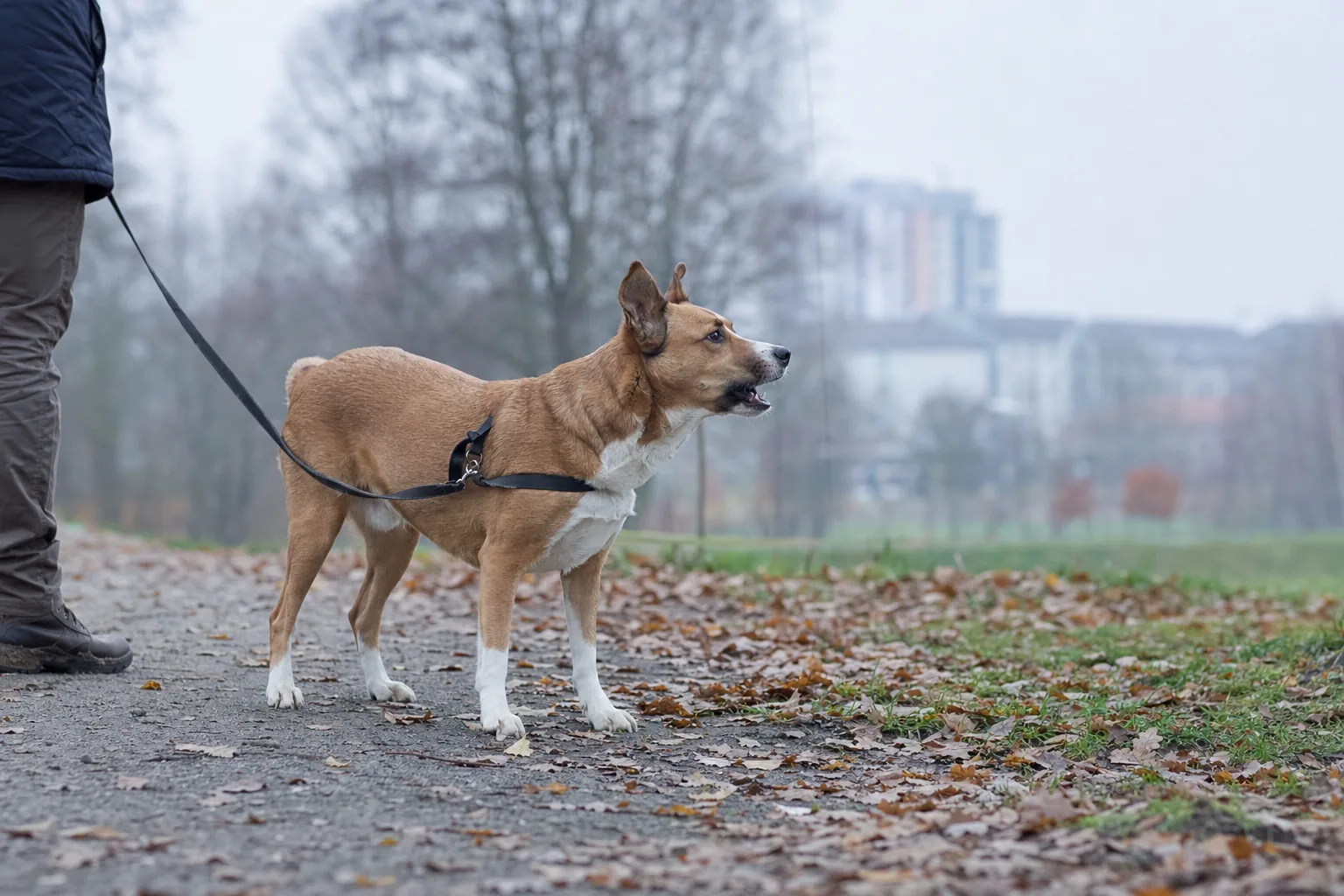
Your two-year-old male has been clean in the house since he was a pup, and this week he started cocking his leg on the corner of the sofa. Or a friend popped round, left her handbag in the hall, and ten minutes later the bag smelt of dog. Or you moved house and he has "signed" every door in the new place. A puppy who has not worked out where to go leaves puddles. This is different: a few drops, placed high, on chosen things, with a purpose. That is marking, and you work on it differently from ordinary house soiling.
Why does my dog mark in the house?
To a dog, urine is a note left for others: who came by, male or female, in what state, how recently. Marking outside is completely normal. Sniffing walks, where he reads everyone else's notes and leaves his own, are a big part of his life and you should not take them away. The trouble starts when the notes end up on your furniture.
You can usually spot marking. The amount is small and it goes on something upright, such as the corner of a cupboard, a door, a curtain or a table leg, at roughly the height of a raised leg. The target is often new or smells unfamiliar: a bag, a visitor's shoes, a pushchair, a sofa that has just been delivered, the shopping. And it happens right after a walk, when his bladder is nearly empty. When he properly wees, he empties his bladder, and usually on the floor.
These are the situations where it shows up, starting with the one we see most often:
- An entire male. Hormones push him to mark, and a bitch in season somewhere nearby can wind him up from a long way off, because he can smell her.
- Something new or strange in the house. A visitor who stayed overnight, a dog who came to stay, new furniture, a house move. He marks whatever does not smell of home.
- Another animal inside or at the window. A second dog, a cat, or the dogs and cats who walk past the gate every day while he watches from the window.
- Tension and uncertainty. A new baby, rows, a changed routine, someone moving out. Some dogs mark more when they feel unsettled.
- Spots already marked. A corner that smells of urine, even faintly, tells his nose that this is where you mark. If you do not clean it properly, the loop keeps itself going.
Bitches mark as well, and so do neutered males. Less often, but it happens.
What do people get wrong about marking?
The first mistake is telling him off afterwards. You find the stain an hour later and scold him. He has no way of linking your raised voice to something he did an hour ago; he links it to you standing next to the stain. What he learns is to mark when you are out of the room.
Rubbing his nose in it is worse. It teaches him nothing about where he is allowed to go and plenty about keeping away from you. A dog who marks because he feels unsure will mark more once you have frightened him as well.
Then there is the cleaner. A lot of household products contain ammonia, and to a dog ammonia smells a lot like urine. The patch you scrubbed so carefully turns into an invitation.
Plenty of owners put all their hope in neutering and change nothing else. In many males it does cut marking down, but not in all of them and not overnight, especially when the habit is well established. Without a thorough clean and changes at home, many carry on.
The last one is relying on a belly band. A fabric wrap for males stops urine reaching the furniture and is fine for a short while, say when you have guests. He learns nothing from it, though. If he wears it all the time, the problem is still there; you just cannot see it.
How to stop a dog marking indoors, step by step
1. Start with the vet
Urinary infections, bladder stones, prostate trouble, diabetes and kidney disease can all look exactly like marking: small, frequent wees in odd places. So the first trip is to your vet. The signs that should get you there quickly are in the medical section further down.
2. Clean it properly
Find every spot, not just the ones you know about. A UV torch in a dark room shows up old stains that dried long ago. Use an enzyme cleaner made for pet urine on each one: the enzymes break down what is left of the urine and get rid of the smell rather than covering it with perfume. Leave it on for as long as the label says, and on carpets and sofas do it again, because you usually need to. Ammonia and bleach stay in the cupboard.
3. Give the marked spots a new meaning
Dogs do not mark where they eat, sleep or play. Once you have cleaned, move his bowl or his bed next to the problem corner for a few days. Hide treats there and let him find them. If that is not practical, block it off with a closed door, moved furniture or an upturned chair for at least a few weeks.
4. Eyes on him, and a lead indoors
For the first few weeks he is either where you can see him or somewhere he has never marked, such as a particular room or his crate if he is used to one. Around the house you can keep him on a light lead clipped to you or to a piece of furniture beside you. When you see him sniffing hard at a corner and the leg starting to come up, interrupt him gently (say his name, clap softly, a cheerful "outside!") and take him out. On the first tree or post he marks outside, make a fuss of him and give him something tasty. Outside is where his notes belong.
5. Keep the triggers out of reach
- Windows. If he guards the window and sees dogs and cats every day, put frosted film on the lower part of the glass or move the furniture he watches from.
- Visitors' things. Bags, shoes and coats go in a cupboard or a closed room.
- New things. For a few days they stay shut away or under your eye, until they start to smell of home.
- A visiting dog. Walk them together outside first, then go in, and supervise both of them for the first few hours.
6. Deal with whatever is unsettling him
If the marking started with a change (a baby, a second dog, the move), the change is the cause and the marking is how he is coping with it. A predictable day helps, as does a quiet quarter of an hour with you alone, long sniffy walks and a resting spot where nobody bothers him. If there is friction between two dogs or between the dog and the cat, we have separate guides for each.
7. Neutering, with your vet
In an entire male who marks a lot, neutering helps in many cases, and the sooner after the marking started, the better. There is no guarantee. The operation has other effects as well, which differ by breed, size and age, so make the decision with your own vet once you have gone through all of it.
The first week
| Day |
What you do |
| 1 |
Book the vet. Find every stain with the UV torch and clean each one with enzyme cleaner. |
| 1–2 |
Block off the marked spots or move his bowl and bed there. Cover the windows he guards. |
| 2–7 |
Supervise him all the time or keep him on a lead indoors; interrupt gently and go out; celebrate with him when he marks outside. |
| 3–7 |
One long walk a day where he chooses where to sniff and where to mark. |
| 7 |
Look at your diary: how many incidents, where, what happened just before. Whatever is left tells you the next step. |
When is marking a medical problem?
These dogs go to the vet before any training plan:
- dogs weeing little and often, outside as well, with straining or pain;
- dogs with blood in their urine or urine that smells very strong;
- dogs drinking much more than they used to;
- older entire males who strain to wee or to pass a stool (the vet will check the prostate);
- dogs who started suddenly, at an age when they had never marked before;
- dogs leaking urine in their sleep or on their bed, which is incontinence and works differently from marking.
Take your diary to the appointment, plus a sample of first-morning urine caught in a clean container.
How scent work helps
Dogs who mark indoors often need more "correspondence" with the world of smells. A walk on a long line, where he picks the route, stops at every bush and leaves messages where he likes, meets that need outside, where it belongs. Treat-searching games played right beside the old marking spots also change what those corners mean to him: they become places where good things turn up rather than places to leave a note. Scent work will not stop hormone-driven marking on its own, but it makes it a lot easier to work on.
When should you call in a professional?
- you have cleaned, supervised and changed what needed changing at home, and a month later he is still marking;
- the marking comes with tension between two dogs or between the dog and the cat;
- he growls or stiffens when you come near him while he is marking or straight after;
- it started after a big change and he seems unsettled in other ways too;
- you have a young entire male and want to talk through every option with someone before neutering.
In an assessment we look at the house, the daily routine and how the animals get on. Marking nearly always has something to do with the dog's surroundings, and surroundings can be changed.
A behaviour that appears suddenly or changes for no apparent reason can have a medical cause. For full details, consult your dog's own veterinarian.