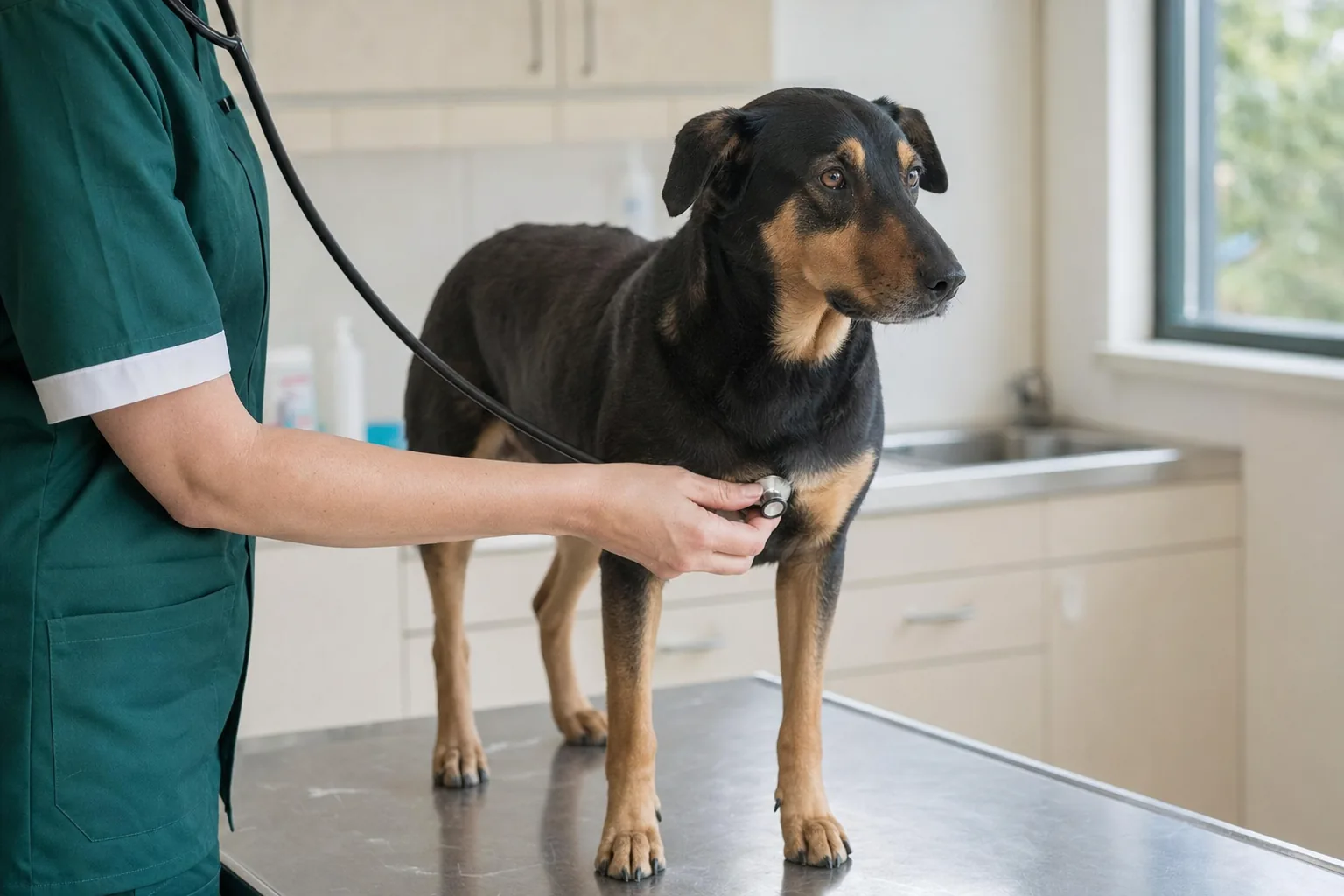
Caution. Hiccups lasting hours or returning daily in an adult dog, laboured breathing, blue gums, vomiting, coughing or lethargy: ring your own vet the same day. Retching with nothing coming up and a swollen belly is an emergency: go straight away.
Noticed something different about your dog? Go straight to their vet.
Do not look for the answer in a Facebook group, on TikTok or on a forum. Look for someone trained for this: your dog's own veterinarian, the only person who can examine, investigate and treat them.
- The same sign, dozens of causes. A dog that vomits may have eaten grass or may have an object stuck in the gut. From two lines you typed, nobody can tell which. The vet feels the abdomen, takes the temperature, runs tests.
- Nobody on the internet sees your dog. They see a photo and a story. A diagnosis comes from an examination and investigations, not from a resemblance to someone else's dog.
- In groups you hear from the people whose dog "got better on its own". Those for whom it ended badly rarely post again. What you read there is a selection, not a statistic.
- Doses are calculated by weight and species. Human medicines that look harmless, paracetamol or ibuprofen, are toxic to dogs. "I gave mine half a tablet" is the most dangerous advice you can get.
- Hours matter. With a twisted stomach, a poisoning or a urinary blockage, the time spent asking online is exactly the time that decides the outcome.
- The vet is accountable for what they say. They have your dog's record, history, vaccinations, past treatments. An anonymous account has none of that and answers for nothing.
Use this page to know what to observe, what to note and what to ask at the appointment, not to treat at home. If you still have doubts after a consultation, ask another vet or a specialist (dermatologist, internist) for a second opinion, not a group. And if you do not have a regular vet yet, find one now, while your dog is healthy: how to choose a veterinary clinic.
Your ten-week-old puppy has emptied his bowl in three seconds flat, chased you round the whole house, and is now lying on the rug jerking every few seconds with a tiny "hic", looking slightly surprised at himself. Or your adult dog has hiccups after a play session, you check the clock and a quarter of an hour has gone by.
In puppies, hiccups are practically part of growing up and pass on their own. In an adult dog they deserve attention when they go on for a long time or come with other signs. Below: what real hiccups look like, what else looks like them, and when to ring your own vet.
When are hiccups in a dog serious?
Ordinary hiccups pass in a few minutes, an hour at most, and otherwise the dog is completely normal. Ring the same day if:
- in an adult dog, the hiccups go on for hours or come back day after day, several days running;
- he is breathing hard, mouth open at rest, or his gums turn blue or grey;
- there is vomiting, regurgitation (food comes back up undigested, without effort), coughing or a lot of drool;
- he is trying to be sick with nothing coming up, his belly is swollen and he is restless (this can be a twisted stomach, which is an emergency: go now);
- he is flat, off his food or feverish;
- the hiccups started after he swallowed something, a bone or a toy, or after a knock, a fall or an accident;
- the "hiccups" come with a fixed stare, trembling or movements he cannot stop. It may be a seizure, and the vet needs to see it.
What to watch for and write down at home
What real hiccups look like
A hiccup is a sudden contraction of the diaphragm, the muscle that separates the chest from the belly. With each contraction a short breath rushes in and the vocal cords snap shut, which is where the little sound comes from. In a dog you see a rhythmic jerk of the chest and belly every few seconds. You hear a short sound, a "hic" or a click, sometimes barely audible. The dog stays awake and aware of what is going on, perhaps a bit puzzled, but not frightened or distressed. Between hiccups he can eat, drink and play.
In puppies they are very common, because puppies eat fast, gulp air and get wound up, and their diaphragm is still young. Plenty of puppies get hiccups after nearly every meal for the first few months, and that is normal. The older they get, the less often it happens.
Things that look like hiccups but are something else
| What you see |
What it might be |
How serious |
| Rhythmic jerks, small sound, relaxed dog |
Hiccups |
Usually nothing |
| Noisy snorting in through the nose in bursts, neck stretched, looks like choking for a few seconds, then over |
Reverse sneezing |
Usually harmless, but show the vet if it happens a lot |
| Dry, honking cough, or a cough followed by swallowing |
Coughing (airways, heart) |
Vet visit |
| Retching with the neck stretched out, nothing comes up, swollen belly |
Twisted stomach |
Emergency |
| Throat heaves, then froth or food comes up |
Vomiting or regurgitation |
Vet visit if it repeats |
| Rhythmic movements, blank stare, no response to his name |
Partial seizure |
Vet the same day |
The easiest thing is to film it. A 20 to 30 second clip shows the vet far better than any description whether it is hiccups, reverse sneezing or something else.
What to write down
Note when it happens: after meals, after play, in his sleep, when he is excited. How long it usually lasts, timed on a clock, and how often it comes, anywhere from once a week to several times a day. What he ate beforehand and how fast. And anything else you notice: vomiting, coughing, loose stools, a gurgling tummy, a smaller appetite.
What to do when he has hiccups
For ordinary hiccups, nothing much. A few things help them pass sooner and come less often:
- let him calm down, with a short walk at a slow pace or a gentle hand stroking his chest;
- put water within reach, without making him drink;
- at the next meals use a slow-feeder bowl (with bumps or a maze) or scatter his food on a snuffle mat, because a dog who eats slowly swallows less air;
- for puppies, smaller and more frequent meals;
- right after a meal is not the time for wild games.
What the vet checks when hiccups will not stop
An occasional bout in a healthy puppy does not need a vet. The vet comes in when the hiccups go on for a long time, keep coming back in an adult or arrive with other signs.
- Asks how old he is, when it started, how often and how long, what and how he eats, and what other signs you have seen. Your videos help most of all.
- Examines him: listens to the heart and lungs, feels the belly, looks in the mouth and throat, checks his temperature and gum colour.
- If something is not right, runs blood tests (inflammation, kidneys, liver, blood salts), X-rays of the chest and belly, sometimes an ultrasound scan. The vet is looking for anything irritating the diaphragm or the nerves that control it: stomach and gullet trouble (reflux, gastritis), respiratory disease, more rarely chest or neurological problems.
- If it turns out to be reverse sneezing or something else, explains what it is and what to watch for. Reverse sneezing, for instance, usually comes from irritation at the back of the nose and has different causes from hiccups.
- Treats the cause if there is one. Most of the time, though, the advice comes down to how he eats: small portions, slow pace, no exertion straight after a meal.
What not to do at home when your dog has hiccups
- Do not try to make him jump "like with people". A dog frightened on purpose does not lose his hiccups; he just learns you are unpredictable.
- Do not pull his tongue, press on his chest or hold his muzzle shut so he "holds his breath". It does not help and can be dangerous, especially in flat-faced breeds.
- Do not give him sugar, honey, vinegar or any other old wives' remedies meant for people. Some do nothing, some upset his stomach, and the sweetener in "sugar-free" products is toxic to dogs.
- Do not give him human stomach or reflux medicines without talking to the vet first.
- Do not force him to drink by pouring water into his mouth. It can go down the wrong way.
- Do not mistake retching with nothing coming up, in a big dog with a swollen belly, for hiccups. There is no waiting with that; you go to the clinic.
- Do not ignore new hiccups in an old dog who has never had them. A new habit at that age is worth a question to the vet.
In a puppy, after-dinner hiccups are one of those things you film because they are sweet and forget about within a few months. In an adult dog, time them and look at everything else. If everything else is normal, you wait. If not, you ring.
Frequently asked questions
What dog owners search for most often on the internet about this problem, with the short answer. The answers are a guide only: the decision belongs to your dog's own vet, after an examination.
Why does my dog get hiccups?
Because the diaphragm, the muscle between chest and belly, contracts suddenly and repeatedly. It happens most after eating or drinking fast and gulping air, after hard play or when he is excited. Puppies get hiccups far more often than adults. In an adult dog, frequent hiccups can be linked to the stomach or the airways and are worth mentioning to the vet.
Is it normal for a puppy to get hiccups a lot?
Yes. Lots of puppies get hiccups after almost every meal for the first few months, because they eat fast, gulp air and get excited. They pass on their own within minutes and become rarer as the puppy grows. Smaller, more frequent meals, a slow-feeder bowl and some quiet time after eating all help.
How long do hiccups last in dogs?
Usually a few minutes, occasionally up to an hour. If they go on for hours, come back every day in an adult dog, or come with vomiting, coughing, heavy drooling, laboured breathing or lethargy, ring your own vet the same day and bring a video of an episode.
How do I tell hiccups from reverse sneezing?
With hiccups you see small rhythmic jerks of the chest, hear a short sound, and the dog is relaxed. With reverse sneezing he snorts air in noisily through his nose in bursts, neck stretched, as if choking, for a few seconds, then stops. Film it: the vet will tell them apart at once.
How do I stop my dog's hiccups?
Usually you do not need to do anything; they stop on their own. Let him settle, leave water within reach without forcing it, take him for a short, slow walk. Do not startle him, pull his tongue or give him sugar or human remedies. In the longer run, smaller meals, slower eating and no play straight after food all help.
The information on this page is educational and does not replace an examination. For full details and a diagnosis, consult your dog's own veterinarian.