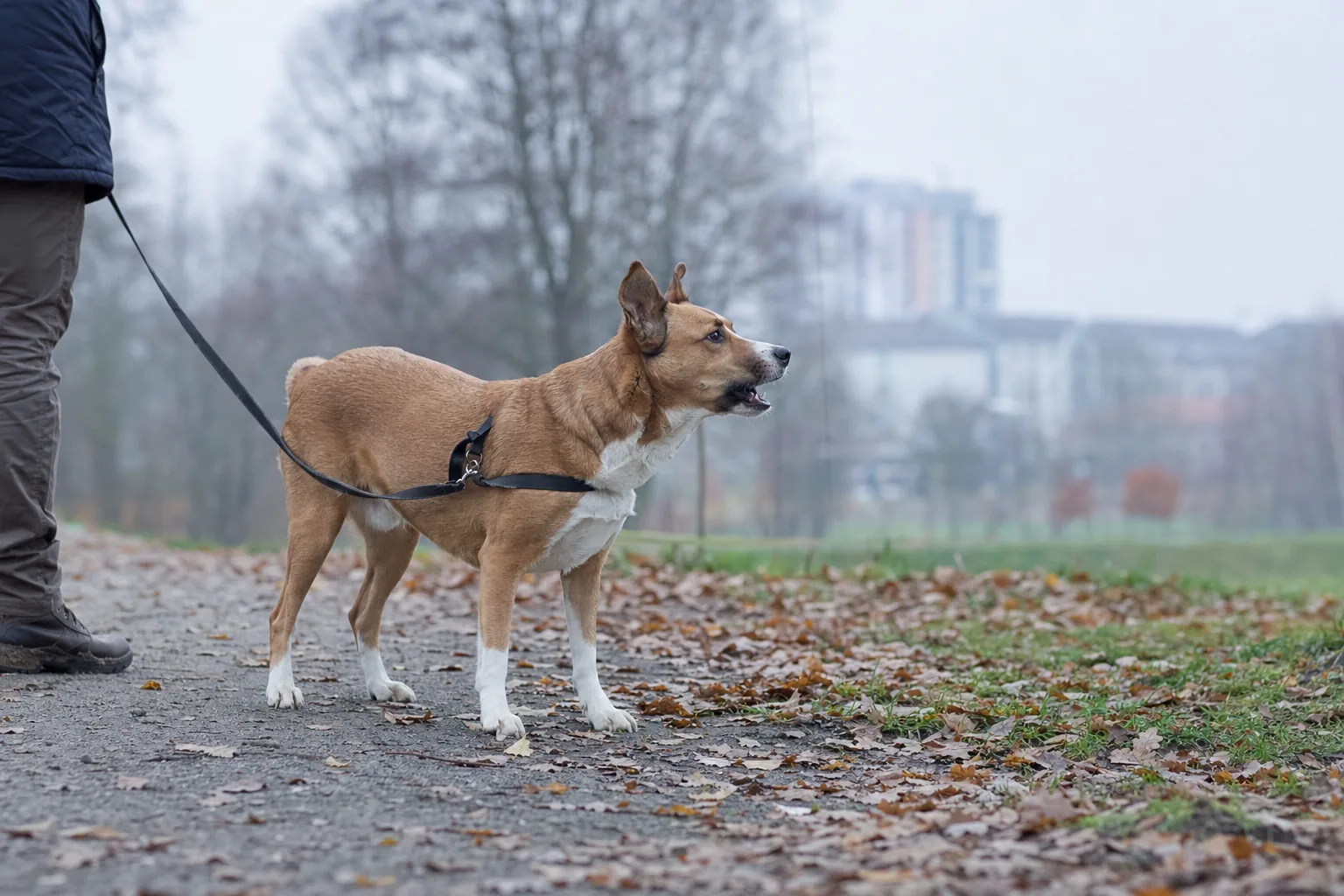
An evening on the sofa. Your dog comes over and leans against you, you stroke his head, and a few seconds later he stiffens and nips your hand. Another version: the rescue dog you adopted a month ago loves a chest scratch but growls when you try to pick him up. Or your child bent down to kiss him on the head while he was asleep, and he bit. Each of these seems to come "out of nowhere". It almost never does. Below you will find why dogs bite when they are stroked, what not to do, and how to rebuild being touched, step by step, into something you both enjoy again.
Why he bites when you stroke him
Pain. This is the first thing to think of, especially if the biting is new. A dog with arthritis, an ear infection, back trouble, a skin problem or bad teeth has no way of telling you where it hurts. He tells you with his teeth when your hand lands on the sore spot. A dog who has enjoyed being stroked all his life and starts biting at 8 is in pain until shown otherwise.
He does not like the way he is touched. People stroke dogs the way people like: on top of the head, with pats on the back, with hugs, leaning over the dog. Many dogs merely put up with all that. Most prefer a scratch on the chest, the side of the neck, the base of the ears or the back just above the tail, with your hand coming in from the side. To a dog, a hug usually means being held still.
It went on too long. He came over for ten seconds of fuss and you carried on for two minutes. He told you a few times that he had had enough, you missed it, and he moved on to the last signal he had left.
Fear of hands. A dog who has been hit, yanked by the collar or held down for nail trims or ear drops learns that a hand coming towards him can mean something unpleasant. Rescue dogs often bring that fear with them.
Startled awake. Touched while asleep, especially if he is old, deaf or sleeping deeply, a dog can wake in a fright and bite before he knows where he is. It is a reflex, the same one that makes you jump when someone touches you from behind.
Guarding a spot or a person. He only bites on the sofa, on the bed, in his crate, or only near one particular person. Here the touch matters less than the place or the person he is guarding.
The puppy who chews hands. A three-month-old who bites the hand stroking him is playing and trying out his teeth. That is a different story with a different plan, and it has its own page.
The signals before the bite
Dogs almost always warn, but the signals are small and quick. Behaviourists line them up like a ladder, from subtle to obvious: yawning, lip licking, turning the head away, "whale eye" (the white of the eye showing as a crescent), freezing, ears pinned back, a low, stiff tail, growling, a lifted lip, a snap that does not close, the bite. A dog who has been punished for the lower rungs learns to jump straight to the top ones.
What does not work (and why it seems to)
Punishing the growl. While he is growling, he is still talking to you before he bites. Tell him off for it and he stops growling, but he still does not like being touched. Next time he bites without warning.
"He has to get used to it, I'll hold him until he calms down." A dog held down until he stops struggling has not relaxed; he has given up. Next time the fear is just as big, and his trust in your hands has dropped.
Showing him "who is boss". Rolling him on his back, scruffing him, staring him down all come from old ideas about wolves that the research dropped long ago. With a dog who bites out of fear or pain, they are a provocation.
Stroking him "to make up" straight after a bite. He bit to make the touching stop; another touch right then does not settle him.
Pulling away completely. Some owners, hurt in both senses, stop touching him and stop giving him attention altogether. He still needs contact, just a different kind.
The plan, step by step
1. Body first
Book an appointment with your own vet and tell them exactly where you touched him when he bit. Show them the places he will not tolerate as well (ears, paws, back, tail). Very often, once the pain goes, so does the biting.
2. Take the bite situations out of daily life
- Stop touching him while he sleeps. Call his name from a distance and wait for him to come, or leave him be.
- No more hugs, no kisses on the head, no leaning over him. Children above all.
- If he guards the sofa or the bed, he loses access for a while and gets a good bed on the floor next to you.
- Children only stroke him with you right beside them, and only by the rule in step 3. If he has bitten a child, he and the children are never left unsupervised.
3. The three-second test
This is the simplest exercise on the page, and afterwards you will stroke every dog differently. Let him come to you. Stroke his chest or the side of his neck for three seconds, then stop and take your hand away. Watch what he does:
- he leans in, nudges your hand with his nose, turns the side he wants scratched towards you: he wants more, so give him another three seconds;
- he shakes off, moves away, looks elsewhere, licks his lips: he has had enough, so praise him with your voice and leave him.
He learns that he gets a say, and a dog who knows he can stop the touching at any moment will put up with much more of it. Most people are surprised how often their dog only "wants more" for two or three rounds.
4. Hands bring good things
For dogs who are afraid of hands, work on this separately in two- or three-minute sessions. One hand moves a little closer and stops well short of his body, while the other hand gives him a tasty treat. The hand leaves, the treats stop. Once he looks at your hand with happy anticipation, it touches his shoulder for one second, and the treat follows. Build up very slowly: closer, longer, other places. If you see any signal from the warning ladder, you have gone too fast, so go back a step.
5. Grooming with his consent
Nail trims, ear drops, brushing: break them into small pieces, one paw a day, one nail at a time, with breaks. Some trainers teach dogs a "ready" signal (chin resting on a towel or in your palm). While the chin stays down, you carry on; when he lifts it, you stop. Vet practices use the approach more and more, under the name cooperative care.
The first week
| Day |
What you do |
| 1 |
Vet appointment booked. A list of the places and situations where he has bitten or growled. |
| 1 to 7 |
No touching while he sleeps, no hugs, no leaning over him. The rule applies to the whole family. |
| 2 to 7 |
The three-second test every time you stroke him. |
| 3 to 7 |
Two short "hands bring treats" sessions a day, if he is afraid of hands. |
| 7 |
Count the growls and bites you noted. If nothing has changed or there have been bites, call a specialist. |
When it is a medical problem
With biting on being touched, pain is involved so often that the vet check comes first. Your vet will look at his ears (an ear infection makes any touch to the head hurt), back and hips (he bites when stroked over the rump), skin (allergies, inflamed patches), teeth and mouth (he bites if you touch his muzzle). In older dogs, failing hearing and sight make a touch more startling, and an ageing brain can shorten their patience. The thyroid is on the vet's list too. In an adult dog, any sudden change in behaviour means a vet check first.
When to call a specialist
- he has bitten and held on, left marks or caused an injury;
- he has bitten a child, however lightly;
- the bites are becoming more frequent or harder, or come with no warning at all;
- you cannot do basic care (nails, ears, brushing) without risk;
- your vet has ruled out pain, and after three or four weeks on the plan nothing has changed.
A trainer or a veterinary behaviourist sees your dog in your own home, reads the signals you miss and builds a plan with you that fits him. The earlier you start, the fewer bites he gets to practise.
A behaviour that appears suddenly or changes for no apparent reason can have a medical cause. For full details, consult your dog's own veterinarian.